

88
M. Scarsini et al.
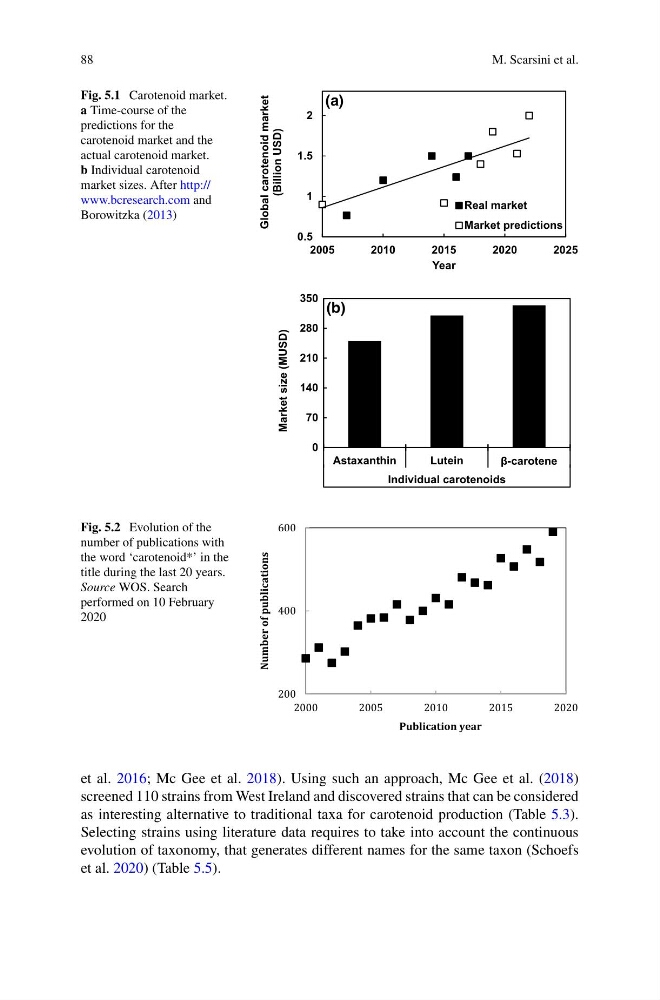
Fig. 5.1 Carotenoid market.
a Time-course of the
predictions for the
carotenoid market and the
actual carotenoid market.
b Individual carotenoid
market sizes. After http://
www.bcresearch.com and
Borowitzka (2013)
0
70
140
210
280
350
Astaxanthin
Lutein
β-carotene
Individual carotenoids
Market size (MUSD)
0.5
1
1.5
2
2005
2010
2015
2020
2025
Global carotenoid market
(Billion USD)
Year
Real market
Market predictions
(a)
(b)
Fig. 5.2 Evolution of the
number of publications with
the word ‘carotenoid*’ in the
title during the last 20 years.
Source WOS. Search
performed on 10 February
2020
200
400
600
2000
2005
2010
2015
2020
Number of publications
Publication year
et al. 2016; Mc Gee et al. 2018). Using such an approach, Mc Gee et al. (2018)
screened 110 strains from West Ireland and discovered strains that can be considered
as interesting alternative to traditional taxa for carotenoid production (Table 5.3).
Selecting strains using literature data requires to take into account the continuous
evolution of taxonomy, that generates different names for the same taxon (Schoefs
et al. 2020) (Table 5.5).
M. Scarsini et al.
Fig. 5.1 Carotenoid market.
a Time-course of the
predictions for the
carotenoid market and the
actual carotenoid market.
b Individual carotenoid
market sizes. After http://
www.bcresearch.com and
Borowitzka (2013)
0
70
140
210
280
350
Astaxanthin
Lutein
β-carotene
Individual carotenoids
Market size (MUSD)
0.5
1
1.5
2
2005
2010
2015
2020
2025
Global carotenoid market
(Billion USD)
Year
Real market
Market predictions
(a)
(b)
Fig. 5.2 Evolution of the
number of publications with
the word ‘carotenoid*’ in the
title during the last 20 years.
Source WOS. Search
performed on 10 February
2020
200
400
600
2000
2005
2010
2015
2020
Number of publications
Publication year
et al. 2016; Mc Gee et al. 2018). Using such an approach, Mc Gee et al. (2018)
screened 110 strains from West Ireland and discovered strains that can be considered
as interesting alternative to traditional taxa for carotenoid production (Table 5.3).
Selecting strains using literature data requires to take into account the continuous
evolution of taxonomy, that generates different names for the same taxon (Schoefs
et al. 2020) (Table 5.5).