

82
M. Scarsini et al.
may happen when cells experience a stress (e.g. Tan and Norhaizan 2019; Liu et al.
2017). Because carotenoids conserve their properties in vitro, the interest for these
natural molecules has progressively shifted from the curiosity of some to the general
interest at the end of World War II when it became clear that lifestyle will be directed
toward the consumption of more proceeded food. Food processing is usually destructive for natural molecules that, therefore, need to be replaced by food supplements.
Carotenoids enter in this category and, since, has also attracted the attention for their
antioxidant and colouring properties (Ambati et al. 2014; Solymosi et al. 2015). With
the exceptions of aphids (Moran and Jarvik 2010) and spotted spider mites (Altincicek
et al. 2011), carotenoids cannot be synthesized by animal cells and therefore must be
acquired through the alimentation, before being eventually modified after ingestion
(Solymosi et al. 2015). Today, carotenoids are of considerable interest for numerous
applications including food and feed, cosmetics and medicine (Garg et al. 2019; Le
Goff et al. 2019, 2020; Gateau et al. 2017; Tan and Norhaizan 2019; Mimouni et al.
2012). For instance, carotenoids can help in fighting age-related macular degeneration, a disease leading causes of vision loss (Edelshtain et al. 2019). These being
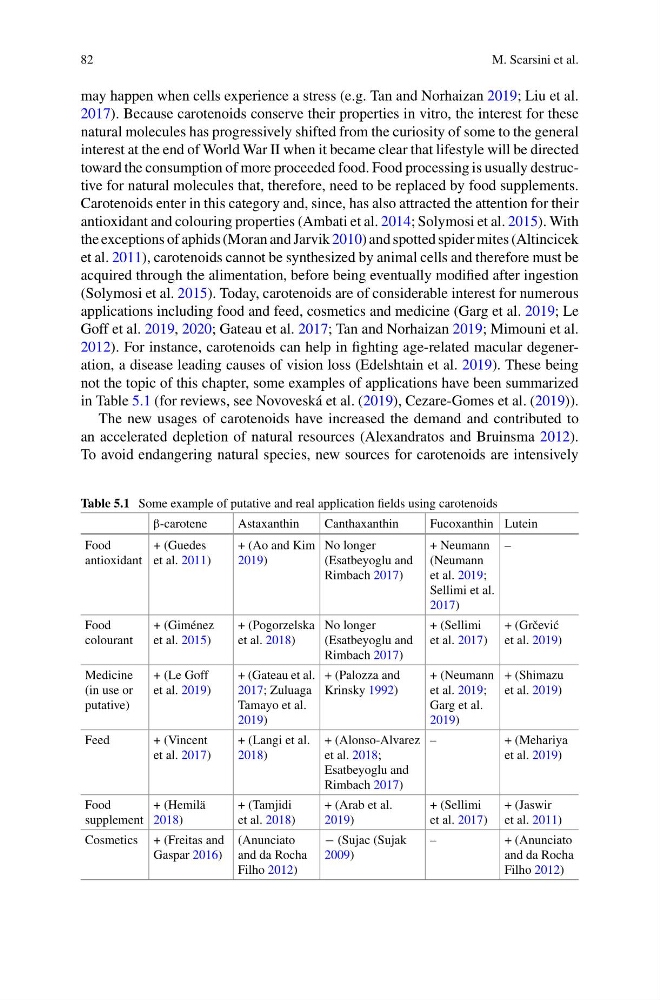
not the topic of this chapter, some examples of applications have been summarized
in Table 5.1 (for reviews, see Novoveská et al. (2019), Cezare-Gomes et al. (2019)).
The new usages of carotenoids have increased the demand and contributed to
an accelerated depletion of natural resources (Alexandratos and Bruinsma 2012).
To avoid endangering natural species, new sources for carotenoids are intensively
Table 5.1 Some example of putative and real application fields using carotenoids
β-carotene
Astaxanthin
Canthaxanthin
Fucoxanthin Lutein
Food
antioxidant
+ (Guedes
et al. 2011)
+ (Ao and Kim
2019)
No longer
(Esatbeyoglu and
Rimbach 2017)
+ Neumann
(Neumann
et al. 2019;
Sellimi et al.
2017)
–
Food
colourant
+ (Giménez
et al. 2015)
+ (Pogorzelska
et al. 2018)
No longer
(Esatbeyoglu and
Rimbach 2017)
+ (Sellimi
et al. 2017)
+ (Grˇ cevi´ c
et al. 2019)
Medicine
(in use or
putative)
+ (Le Goff
et al. 2019)
+ (Gateau et al.
2017; Zuluaga
Tamayo et al.
2019)
+ (Palozza and
Krinsky 1992)
+ (Neumann
et al. 2019;
Garg et al.
2019)
+ (Shimazu
et al. 2019)
Feed
+ (Vincent
et al. 2017)
+ (Langi et al.
2018)
+ (Alonso-Alvarez
et al. 2018;
Esatbeyoglu and
Rimbach 2017)
–
+ (Mehariya
et al. 2019)
Food
supplement
+ (Hemilä
2018)
+ (Tamjidi
et al. 2018)
+ (Arab et al.
2019)
+ (Sellimi
et al. 2017)
+ (Jaswir
et al. 2011)
Cosmetics + (Freitas and
Gaspar 2016)
(Anunciato
and da Rocha
Filho 2012)
− (Sujac (Sujak
2009)
–
+ (Anunciato
and da Rocha
Filho 2012)
M. Scarsini et al.
may happen when cells experience a stress (e.g. Tan and Norhaizan 2019; Liu et al.
2017). Because carotenoids conserve their properties in vitro, the interest for these
natural molecules has progressively shifted from the curiosity of some to the general
interest at the end of World War II when it became clear that lifestyle will be directed
toward the consumption of more proceeded food. Food processing is usually destructive for natural molecules that, therefore, need to be replaced by food supplements.
Carotenoids enter in this category and, since, has also attracted the attention for their
antioxidant and colouring properties (Ambati et al. 2014; Solymosi et al. 2015). With
the exceptions of aphids (Moran and Jarvik 2010) and spotted spider mites (Altincicek
et al. 2011), carotenoids cannot be synthesized by animal cells and therefore must be
acquired through the alimentation, before being eventually modified after ingestion
(Solymosi et al. 2015). Today, carotenoids are of considerable interest for numerous
applications including food and feed, cosmetics and medicine (Garg et al. 2019; Le
Goff et al. 2019, 2020; Gateau et al. 2017; Tan and Norhaizan 2019; Mimouni et al.
2012). For instance, carotenoids can help in fighting age-related macular degeneration, a disease leading causes of vision loss (Edelshtain et al. 2019). These being
not the topic of this chapter, some examples of applications have been summarized
in Table 5.1 (for reviews, see Novoveská et al. (2019), Cezare-Gomes et al. (2019)).
The new usages of carotenoids have increased the demand and contributed to
an accelerated depletion of natural resources (Alexandratos and Bruinsma 2012).
To avoid endangering natural species, new sources for carotenoids are intensively
Table 5.1 Some example of putative and real application fields using carotenoids
β-carotene
Astaxanthin
Canthaxanthin
Fucoxanthin Lutein
Food
antioxidant
+ (Guedes
et al. 2011)
+ (Ao and Kim
2019)
No longer
(Esatbeyoglu and
Rimbach 2017)
+ Neumann
(Neumann
et al. 2019;
Sellimi et al.
2017)
–
Food
colourant
+ (Giménez
et al. 2015)
+ (Pogorzelska
et al. 2018)
No longer
(Esatbeyoglu and
Rimbach 2017)
+ (Sellimi
et al. 2017)
+ (Grˇ cevi´ c
et al. 2019)
Medicine
(in use or
putative)
+ (Le Goff
et al. 2019)
+ (Gateau et al.
2017; Zuluaga
Tamayo et al.
2019)
+ (Palozza and
Krinsky 1992)
+ (Neumann
et al. 2019;
Garg et al.
2019)
+ (Shimazu
et al. 2019)
Feed
+ (Vincent
et al. 2017)
+ (Langi et al.
2018)
+ (Alonso-Alvarez
et al. 2018;
Esatbeyoglu and
Rimbach 2017)
–
+ (Mehariya
et al. 2019)
Food
supplement
+ (Hemilä
2018)
+ (Tamjidi
et al. 2018)
+ (Arab et al.
2019)
+ (Sellimi
et al. 2017)
+ (Jaswir
et al. 2011)
Cosmetics + (Freitas and
Gaspar 2016)
(Anunciato
and da Rocha
Filho 2012)
− (Sujac (Sujak
2009)
–
+ (Anunciato
and da Rocha
Filho 2012)