

4 Carotenoid Synthesis and Accumulation in Microalgae …
73
higher astaxanthin accumulation in the vegetative cells of this microalga, although the
total content of chlorophyll and carotenoids (except for astaxanthin) was the highest
in the cells grown under illumination at 10 μmol photon m
−2 s
−1 (Steinbrenner and
Linden 2003). Wang et al. (2003) suggested that those carotenoid-accumulated red
cells were more tolerant to high-intensity irradiation (3000 μmol photon m
−2 s
−1 )
than green cells, comparing the turnover of D1 protein and O 2 evolution rate between
the green and red cell cultures.
We previously reported high-intensity light-induced accumulation of carotenoids
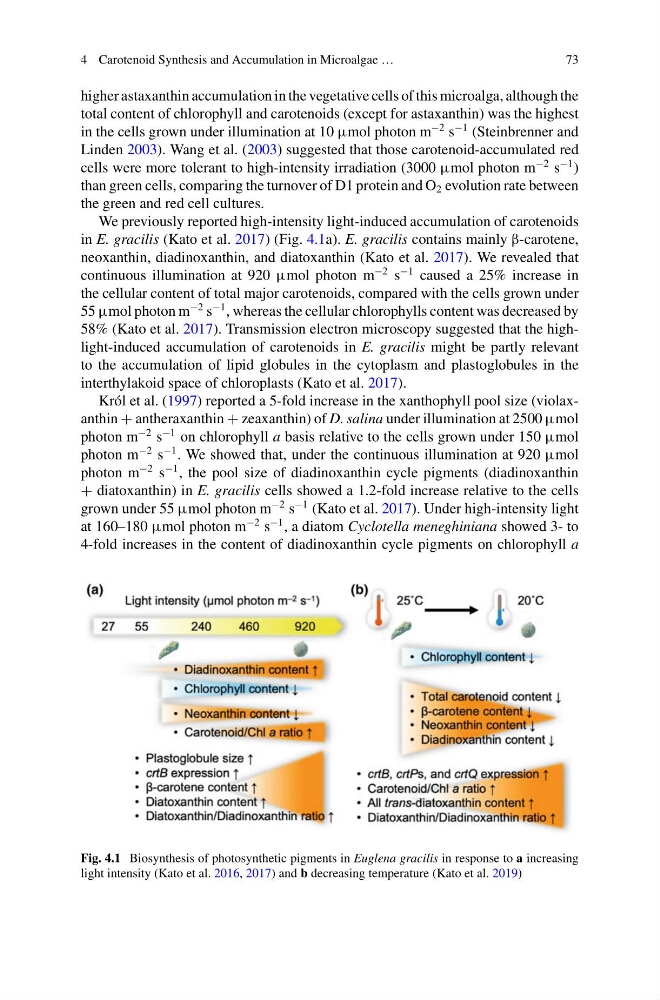
in E. gracilis (Kato et al. 2017) (Fig. 4.1a). E. gracilis contains mainly β-carotene,
neoxanthin, diadinoxanthin, and diatoxanthin (Kato et al. 2017). We revealed that
continuous illumination at 920 μmol photon m
−2 s
−1 caused a 25% increase in
the cellular content of total major carotenoids, compared with the cells grown under
55 μmol photon m
−2 s
−1 , whereas the cellular chlorophylls content was decreased by
58% (Kato et al. 2017). Transmission electron microscopy suggested that the highlight-induced accumulation of carotenoids in E. gracilis might be partly relevant
to the accumulation of lipid globules in the cytoplasm and plastoglobules in the
interthylakoid space of chloroplasts (Kato et al. 2017).
Król et al. (1997) reported a 5-fold increase in the xanthophyll pool size (violaxanthin + antheraxanthin + zeaxanthin) of D. salina under illumination at 2500 μmol
photon m
−2 s
−1 on chlorophyll a basis relative to the cells grown under 150 μmol
photon m
−2 s
−1 . We showed that, under the continuous illumination at 920 μmol
photon m
−2 s
−1 , the pool size of diadinoxanthin cycle pigments (diadinoxanthin
+ diatoxanthin) in E. gracilis cells showed a 1.2-fold increase relative to the cells
grown under 55 μmol photon m
−2 s
−1 (Kato et al. 2017). Under high-intensity light
at 160–180 μmol photon m
−2 s
−1 , a diatom Cyclotella meneghiniana showed 3- to
4-fold increases in the content of diadinoxanthin cycle pigments on chlorophyll a
Fig. 4.1 Biosynthesis of photosynthetic pigments in Euglena gracilis in response to a increasing
light intensity (Kato et al. 2016, 2017) and b decreasing temperature (Kato et al. 2019)
73
higher astaxanthin accumulation in the vegetative cells of this microalga, although the
total content of chlorophyll and carotenoids (except for astaxanthin) was the highest
in the cells grown under illumination at 10 μmol photon m
−2 s
−1 (Steinbrenner and
Linden 2003). Wang et al. (2003) suggested that those carotenoid-accumulated red
cells were more tolerant to high-intensity irradiation (3000 μmol photon m
−2 s
−1 )
than green cells, comparing the turnover of D1 protein and O 2 evolution rate between
the green and red cell cultures.
We previously reported high-intensity light-induced accumulation of carotenoids
in E. gracilis (Kato et al. 2017) (Fig. 4.1a). E. gracilis contains mainly β-carotene,
neoxanthin, diadinoxanthin, and diatoxanthin (Kato et al. 2017). We revealed that
continuous illumination at 920 μmol photon m
−2 s
−1 caused a 25% increase in
the cellular content of total major carotenoids, compared with the cells grown under
55 μmol photon m
−2 s
−1 , whereas the cellular chlorophylls content was decreased by
58% (Kato et al. 2017). Transmission electron microscopy suggested that the highlight-induced accumulation of carotenoids in E. gracilis might be partly relevant
to the accumulation of lipid globules in the cytoplasm and plastoglobules in the
interthylakoid space of chloroplasts (Kato et al. 2017).
Król et al. (1997) reported a 5-fold increase in the xanthophyll pool size (violaxanthin + antheraxanthin + zeaxanthin) of D. salina under illumination at 2500 μmol
photon m
−2 s
−1 on chlorophyll a basis relative to the cells grown under 150 μmol
photon m
−2 s
−1 . We showed that, under the continuous illumination at 920 μmol
photon m
−2 s
−1 , the pool size of diadinoxanthin cycle pigments (diadinoxanthin
+ diatoxanthin) in E. gracilis cells showed a 1.2-fold increase relative to the cells
grown under 55 μmol photon m
−2 s
−1 (Kato et al. 2017). Under high-intensity light
at 160–180 μmol photon m
−2 s
−1 , a diatom Cyclotella meneghiniana showed 3- to
4-fold increases in the content of diadinoxanthin cycle pigments on chlorophyll a
Fig. 4.1 Biosynthesis of photosynthetic pigments in Euglena gracilis in response to a increasing
light intensity (Kato et al. 2016, 2017) and b decreasing temperature (Kato et al. 2019)