

26 Encapsulation of Microalgal Pigments
649
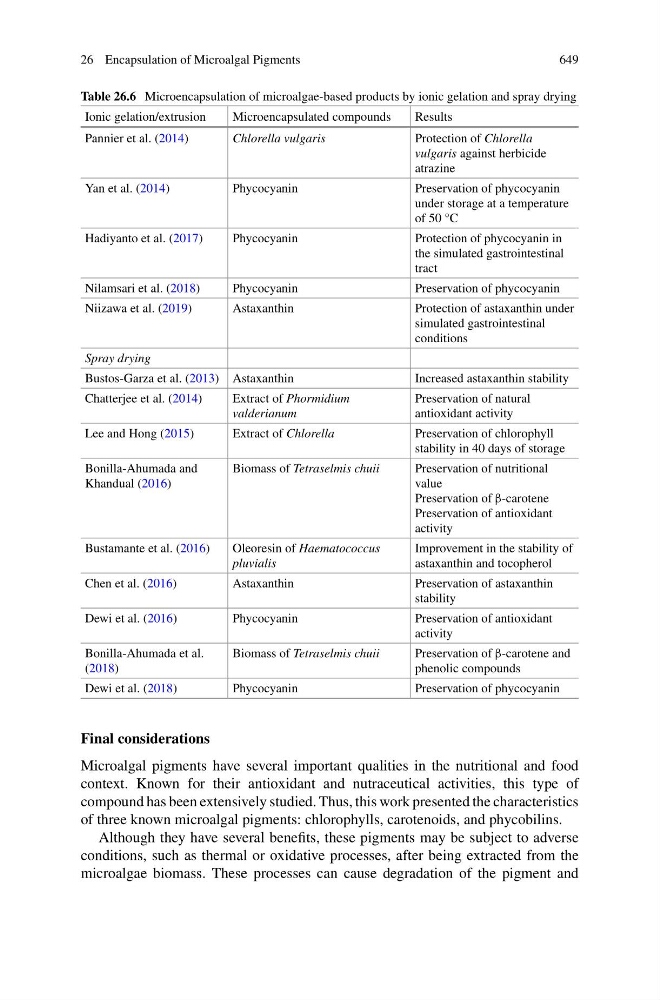
Table 26.6 Microencapsulation of microalgae-based products by ionic gelation and spray drying
Ionic gelation/extrusion
Microencapsulated compounds
Results
Pannier et al. (2014)
Chlorella vulgaris
Protection of Chlorella
vulgaris against herbicide
atrazine
Yan et al. (2014)
Phycocyanin
Preservation of phycocyanin
under storage at a temperature
of 50 °C
Hadiyanto et al. (2017)
Phycocyanin
Protection of phycocyanin in
the simulated gastrointestinal
tract
Nilamsari et al. (2018)
Phycocyanin
Preservation of phycocyanin
Niizawa et al. (2019)
Astaxanthin
Protection of astaxanthin under
simulated gastrointestinal
conditions
Spray drying
Bustos-Garza et al. (2013) Astaxanthin
Increased astaxanthin stability
Chatterjee et al. (2014)
Extract of Phormidium
valderianum
Preservation of natural
antioxidant activity
Lee and Hong (2015)
Extract of Chlorella
Preservation of chlorophyll
stability in 40 days of storage
Bonilla-Ahumada and
Khandual (2016)
Biomass of Tetraselmis chuii
Preservation of nutritional
value
Preservation of β-carotene
Preservation of antioxidant
activity
Bustamante et al. (2016)
Oleoresin of Haematococcus
pluvialis
Improvement in the stability of
astaxanthin and tocopherol
Chen et al. (2016)
Astaxanthin
Preservation of astaxanthin
stability
Dewi et al. (2016)
Phycocyanin
Preservation of antioxidant
activity
Bonilla-Ahumada et al.
(2018)
Biomass of Tetraselmis chuii
Preservation of β-carotene and
phenolic compounds
Dewi et al. (2018)
Phycocyanin
Preservation of phycocyanin
Final considerations
Microalgal pigments have several important qualities in the nutritional and food
context. Known for their antioxidant and nutraceutical activities, this type of
compound has been extensively studied. Thus, this work presented the characteristics
of three known microalgal pigments: chlorophylls, carotenoids, and phycobilins.
Although they have several benefits, these pigments may be subject to adverse
conditions, such as thermal or oxidative processes, after being extracted from the
microalgae biomass. These processes can cause degradation of the pigment and