

26 Encapsulation of Microalgal Pigments
637
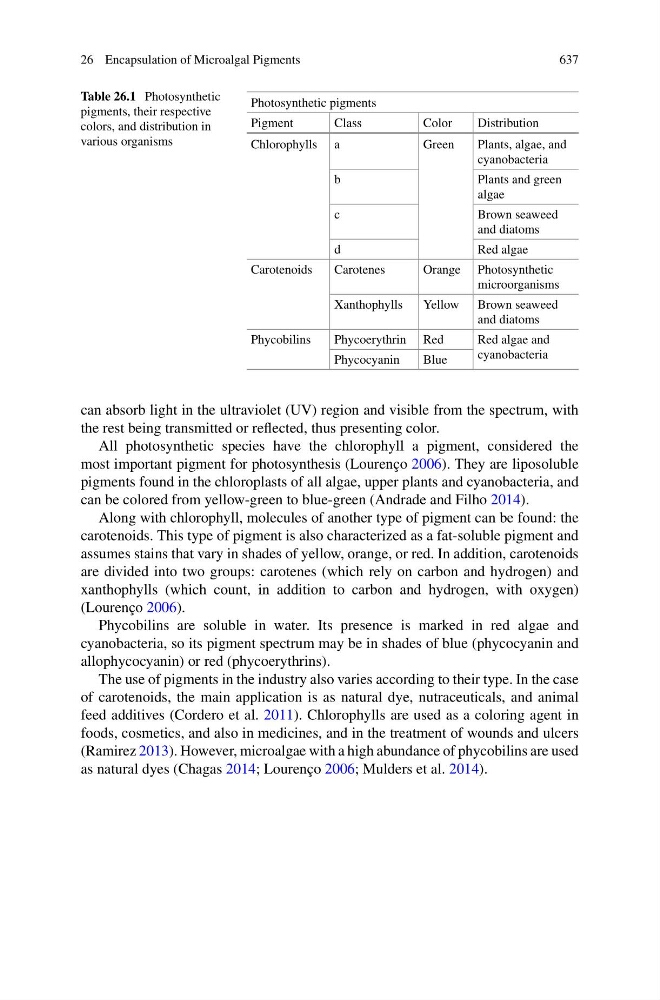
Table 26.1 Photosynthetic
pigments, their respective
colors, and distribution in
various organisms
Photosynthetic pigments
Pigment
Class
Color
Distribution
Chlorophylls a
Green
Plants, algae, and
cyanobacteria
b
Plants and green
algae
c
Brown seaweed
and diatoms
d
Red algae
Carotenoids
Carotenes
Orange Photosynthetic
microorganisms
Xanthophylls
Yellow Brown seaweed
and diatoms
Phycobilins
Phycoerythrin Red
Red algae and
cyanobacteria
Phycocyanin
Blue
can absorb light in the ultraviolet (UV) region and visible from the spectrum, with
the rest being transmitted or reflected, thus presenting color.
All photosynthetic species have the chlorophyll a pigment, considered the
most important pigment for photosynthesis (Lourenço 2006). They are liposoluble
pigments found in the chloroplasts of all algae, upper plants and cyanobacteria, and
can be colored from yellow-green to blue-green (Andrade and Filho 2014).
Along with chlorophyll, molecules of another type of pigment can be found: the
carotenoids. This type of pigment is also characterized as a fat-soluble pigment and
assumes stains that vary in shades of yellow, orange, or red. In addition, carotenoids
are divided into two groups: carotenes (which rely on carbon and hydrogen) and
xanthophylls (which count, in addition to carbon and hydrogen, with oxygen)
(Lourenço 2006).
Phycobilins are soluble in water. Its presence is marked in red algae and
cyanobacteria, so its pigment spectrum may be in shades of blue (phycocyanin and
allophycocyanin) or red (phycoerythrins).
The use of pigments in the industry also varies according to their type. In the case
of carotenoids, the main application is as natural dye, nutraceuticals, and animal
feed additives (Cordero et al. 2011). Chlorophylls are used as a coloring agent in
foods, cosmetics, and also in medicines, and in the treatment of wounds and ulcers
(Ramirez 2013). However, microalgae with a high abundance of phycobilins are used
as natural dyes (Chagas 2014; Lourenço 2006; Mulders et al. 2014).