

25 Cosmetics and Cosmeceutical Applications of Microalgae Pigments
619
cells located in the center of the flask, and no hot spots exist as in UAE. In addition, no
degradation of carotenoids was observed during microwave irradiation since degradation of carotenoids during microwave heating usually starts at temperatures above
60 zC for the most thermosensitive carotenoids; while provitamin A carotenoids and
lutein are more stable to heat (Pasquet et al. 2011).
Recently, SC-CO 2 has been widely employed as an alternative to organic solvent
extractions including natural pigments. The SC-CO 2 allows extracting natural
pigments from microalgae in an oxygen free situation with moderated temperatures and short extraction times, which reduces oxidation. Carbon dioxide (CO 2 ) is
the most widely used supercritical fluid because of an inert gas, which is nontoxic,
nonflammable, and available at low cost. The SC-CO 2 process can selectively extract
low polar lipid compounds, avoiding the co-extraction of polar impurities such as
some inorganic derivatives with heavy metals. In addition, after SC-CO 2 extraction
of pigments from microalgae, the de-oiled portion of the microalgae could be used as
a raw material for the extraction of bioactive materials, which may facilitate another
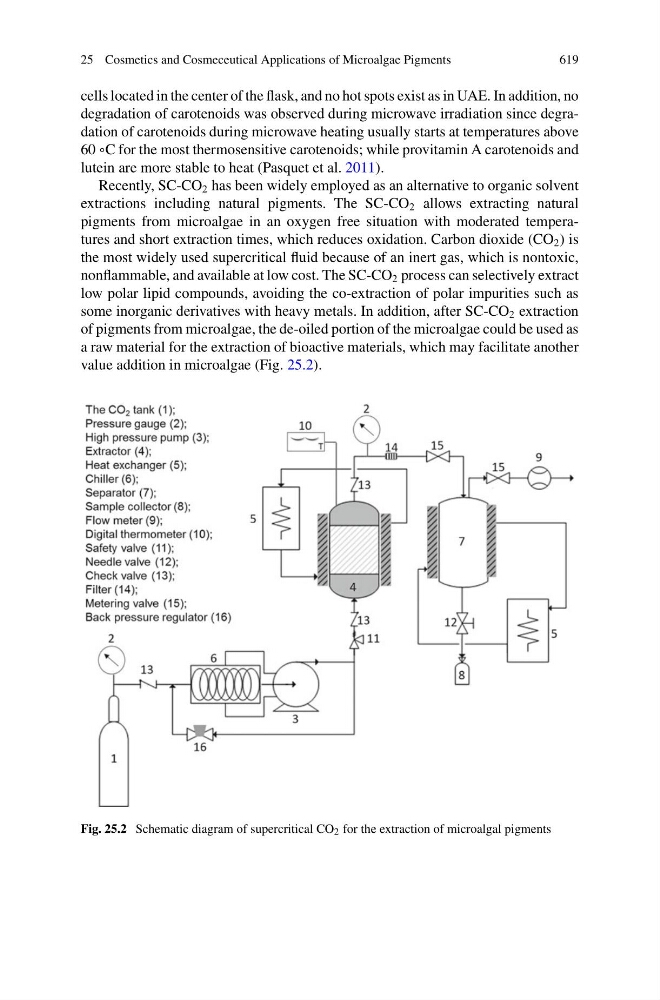
value addition in microalgae (Fig. 25.2).
Fig. 25.2 Schematic diagram of supercritical CO 2 for the extraction of microalgal pigments