

580
E. Manirafasha et al.
23.3 A Glance at Phycobiliproteins (PBPs)
Microalgae resources are regarded as sustainable sources of bioactive compounds
with various industrial applications. Phycobiliproteins are one of those compounds
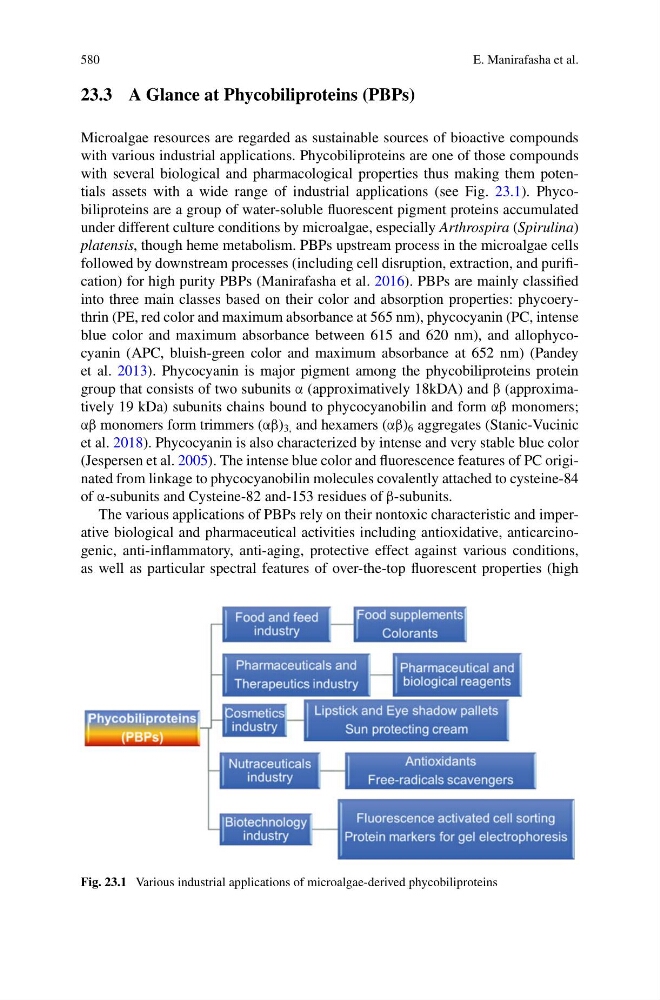
with several biological and pharmacological properties thus making them potentials assets with a wide range of industrial applications (see Fig. 23.1). Phycobiliproteins are a group of water-soluble fluorescent pigment proteins accumulated
under different culture conditions by microalgae, especially Arthrospira (Spirulina)
platensis, though heme metabolism. PBPs upstream process in the microalgae cells
followed by downstream processes (including cell disruption, extraction, and purification) for high purity PBPs (Manirafasha et al. 2016). PBPs are mainly classified
into three main classes based on their color and absorption properties: phycoerythrin (PE, red color and maximum absorbance at 565 nm), phycocyanin (PC, intense
blue color and maximum absorbance between 615 and 620 nm), and allophycocyanin (APC, bluish-green color and maximum absorbance at 652 nm) (Pandey
et al. 2013). Phycocyanin is major pigment among the phycobiliproteins protein
group that consists of two subunits α (approximatively 18kDA) and β (approximatively 19 kDa) subunits chains bound to phycocyanobilin and form αβ monomers;
αβ monomers form trimmers (αβ) 3, and hexamers (αβ) 6 aggregates (Stanic-Vucinic
et al. 2018). Phycocyanin is also characterized by intense and very stable blue color
(Jespersen et al. 2005). The intense blue color and fluorescence features of PC originated from linkage to phycocyanobilin molecules covalently attached to cysteine-84
of α-subunits and Cysteine-82 and-153 residues of β-subunits.
The various applications of PBPs rely on their nontoxic characteristic and imperative biological and pharmaceutical activities including antioxidative, anticarcinogenic, anti-inflammatory, anti-aging, protective effect against various conditions,
as well as particular spectral features of over-the-top fluorescent properties (high
Fig. 23.1 Various industrial applications of microalgae-derived phycobiliproteins