

520
P. F. Surai and I. I. Kochish
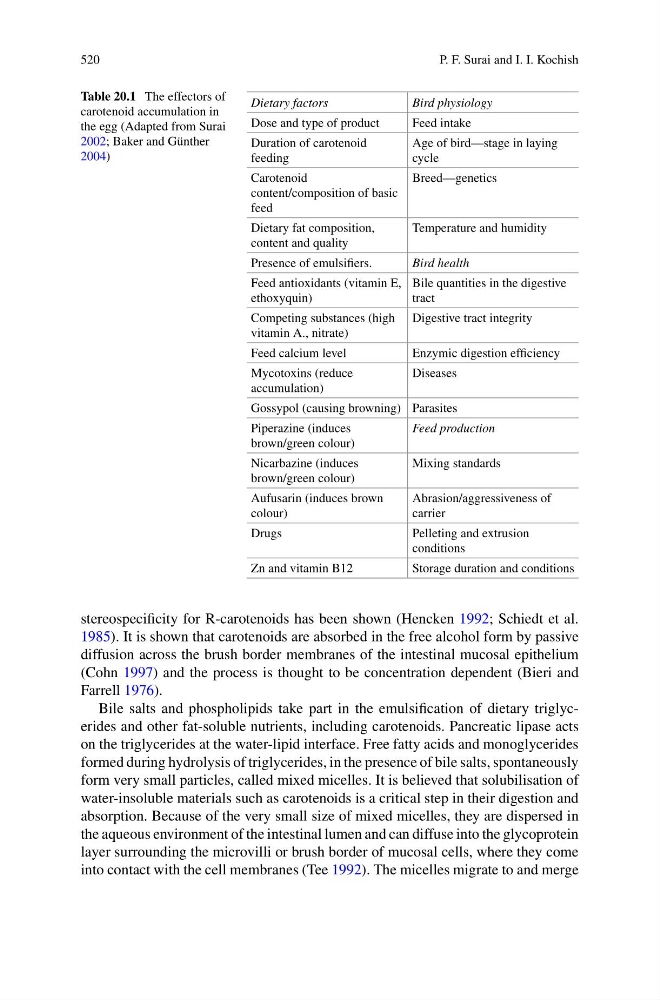
Table 20.1 The effectors of
carotenoid accumulation in
the egg (Adapted from Surai
2002; Baker and Günther
2004)
Dietary factors
Bird physiology
Dose and type of product
Feed intake
Duration of carotenoid
feeding
Age of bird—stage in laying
cycle
Carotenoid
content/composition of basic
feed
Breed—genetics
Dietary fat composition,
content and quality
Temperature and humidity
Presence of emulsifiers.
Bird health
Feed antioxidants (vitamin E,
ethoxyquin)
Bile quantities in the digestive
tract
Competing substances (high
vitamin A., nitrate)
Digestive tract integrity
Feed calcium level
Enzymic digestion efficiency
Mycotoxins (reduce
accumulation)
Diseases
Gossypol (causing browning) Parasites
Piperazine (induces
brown/green colour)
Feed production
Nicarbazine (induces
brown/green colour)
Mixing standards
Aufusarin (induces brown
colour)
Abrasion/aggressiveness of
carrier
Drugs
Pelleting and extrusion
conditions
Zn and vitamin B12
Storage duration and conditions
stereospecificity for R-carotenoids has been shown (Hencken 1992; Schiedt et al.
1985). It is shown that carotenoids are absorbed in the free alcohol form by passive
diffusion across the brush border membranes of the intestinal mucosal epithelium
(Cohn 1997) and the process is thought to be concentration dependent (Bieri and
Farrell 1976).
Bile salts and phospholipids take part in the emulsification of dietary triglycerides and other fat-soluble nutrients, including carotenoids. Pancreatic lipase acts
on the triglycerides at the water-lipid interface. Free fatty acids and monoglycerides
formed during hydrolysis of triglycerides, in the presence of bile salts, spontaneously
form very small particles, called mixed micelles. It is believed that solubilisation of
water-insoluble materials such as carotenoids is a critical step in their digestion and
absorption. Because of the very small size of mixed micelles, they are dispersed in
the aqueous environment of the intestinal lumen and can diffuse into the glycoprotein
layer surrounding the microvilli or brush border of mucosal cells, where they come
into contact with the cell membranes (Tee 1992). The micelles migrate to and merge
P. F. Surai and I. I. Kochish
Table 20.1 The effectors of
carotenoid accumulation in
the egg (Adapted from Surai
2002; Baker and Günther
2004)
Dietary factors
Bird physiology
Dose and type of product
Feed intake
Duration of carotenoid
feeding
Age of bird—stage in laying
cycle
Carotenoid
content/composition of basic
feed
Breed—genetics
Dietary fat composition,
content and quality
Temperature and humidity
Presence of emulsifiers.
Bird health
Feed antioxidants (vitamin E,
ethoxyquin)
Bile quantities in the digestive
tract
Competing substances (high
vitamin A., nitrate)
Digestive tract integrity
Feed calcium level
Enzymic digestion efficiency
Mycotoxins (reduce
accumulation)
Diseases
Gossypol (causing browning) Parasites
Piperazine (induces
brown/green colour)
Feed production
Nicarbazine (induces
brown/green colour)
Mixing standards
Aufusarin (induces brown
colour)
Abrasion/aggressiveness of
carrier
Drugs
Pelleting and extrusion
conditions
Zn and vitamin B12
Storage duration and conditions
stereospecificity for R-carotenoids has been shown (Hencken 1992; Schiedt et al.
1985). It is shown that carotenoids are absorbed in the free alcohol form by passive
diffusion across the brush border membranes of the intestinal mucosal epithelium
(Cohn 1997) and the process is thought to be concentration dependent (Bieri and
Farrell 1976).
Bile salts and phospholipids take part in the emulsification of dietary triglycerides and other fat-soluble nutrients, including carotenoids. Pancreatic lipase acts
on the triglycerides at the water-lipid interface. Free fatty acids and monoglycerides
formed during hydrolysis of triglycerides, in the presence of bile salts, spontaneously
form very small particles, called mixed micelles. It is believed that solubilisation of
water-insoluble materials such as carotenoids is a critical step in their digestion and
absorption. Because of the very small size of mixed micelles, they are dispersed in
the aqueous environment of the intestinal lumen and can diffuse into the glycoprotein
layer surrounding the microvilli or brush border of mucosal cells, where they come
into contact with the cell membranes (Tee 1992). The micelles migrate to and merge