

424
Á. Farkas et al.
improved carotenoid formulation processes, e.g. insertion in emulsions or nanoparticles, carotenoid colourings show high stability with regard to light, acids and heat.
Due to the antioxidant properties of carotenoids, the product gets an additional health
benefit for the consumer. Carotenoids are also used as animal food additives and as
supplements (Westphal and Böhm 2015).
As food additives, carotenoids play an important role in the global food
industry. In Europe, carotenoids are the most preferred food-colouring agents. The
global market for carotenoids reached $1.5 billion in 2017 and should reach $2.0
billion by 2022, at a compound annual growth rate (CAGR) of 5.7% for the period
of 2017–2022 (www.bccresearch.com).
The carotenoid market is segmented by type, source and application. By type,
carotenoids are further sub-segmented into β-carotene, astaxanthin, lutein, annatto,
canthaxanthin, lycopene, zeaxanthin and others. Among these, β-carotene is estimated to have the fastest growth rate during the forecast period. It is widely used for
food colouring and as a natural supplement.
17.2 The Most Important Carotenoids Used in Food, Feed
and Cosmetics Industries
17.2.1 Astaxanthin
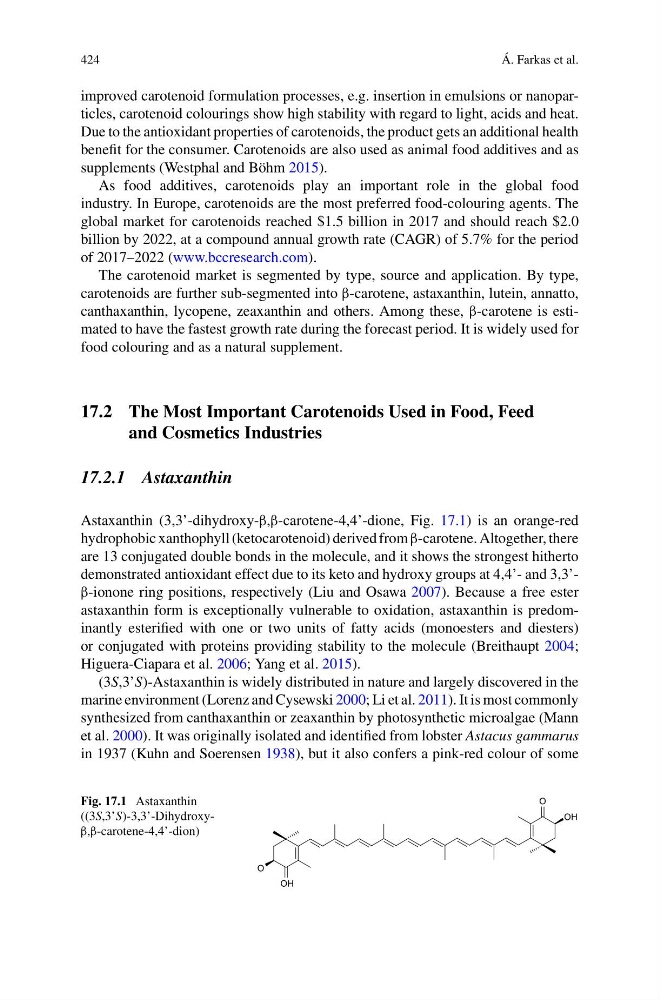
Astaxanthin (3,3’-dihydroxy-β,β-carotene-4,4’-dione, Fig. 17.1) is an orange-red
hydrophobic xanthophyll (ketocarotenoid) derived from β-carotene. Altogether, there
are 13 conjugated double bonds in the molecule, and it shows the strongest hitherto
demonstrated antioxidant effect due to its keto and hydroxy groups at 4,4’- and 3,3’β-ionone ring positions, respectively (Liu and Osawa 2007). Because a free ester
astaxanthin form is exceptionally vulnerable to oxidation, astaxanthin is predominantly esterified with one or two units of fatty acids (monoesters and diesters)
or conjugated with proteins providing stability to the molecule (Breithaupt 2004;
Higuera-Ciapara et al. 2006; Yang et al. 2015).
(3S,3’S)-Astaxanthin is widely distributed in nature and largely discovered in the
marine environment (Lorenz and Cysewski 2000; Li et al. 2011). It is most commonly
synthesized from canthaxanthin or zeaxanthin by photosynthetic microalgae (Mann
et al. 2000). It was originally isolated and identified from lobster Astacus gammarus
in 1937 (Kuhn and Soerensen 1938), but it also confers a pink-red colour of some
Fig. 17.1 Astaxanthin
((3S,3’S)-3,3’-Dihydroxyβ,β-carotene-4,4’-dion)
O
OH
OH
O
Á. Farkas et al.
improved carotenoid formulation processes, e.g. insertion in emulsions or nanoparticles, carotenoid colourings show high stability with regard to light, acids and heat.
Due to the antioxidant properties of carotenoids, the product gets an additional health
benefit for the consumer. Carotenoids are also used as animal food additives and as
supplements (Westphal and Böhm 2015).
As food additives, carotenoids play an important role in the global food
industry. In Europe, carotenoids are the most preferred food-colouring agents. The
global market for carotenoids reached $1.5 billion in 2017 and should reach $2.0
billion by 2022, at a compound annual growth rate (CAGR) of 5.7% for the period
of 2017–2022 (www.bccresearch.com).
The carotenoid market is segmented by type, source and application. By type,
carotenoids are further sub-segmented into β-carotene, astaxanthin, lutein, annatto,
canthaxanthin, lycopene, zeaxanthin and others. Among these, β-carotene is estimated to have the fastest growth rate during the forecast period. It is widely used for
food colouring and as a natural supplement.
17.2 The Most Important Carotenoids Used in Food, Feed
and Cosmetics Industries
17.2.1 Astaxanthin
Astaxanthin (3,3’-dihydroxy-β,β-carotene-4,4’-dione, Fig. 17.1) is an orange-red
hydrophobic xanthophyll (ketocarotenoid) derived from β-carotene. Altogether, there
are 13 conjugated double bonds in the molecule, and it shows the strongest hitherto
demonstrated antioxidant effect due to its keto and hydroxy groups at 4,4’- and 3,3’β-ionone ring positions, respectively (Liu and Osawa 2007). Because a free ester
astaxanthin form is exceptionally vulnerable to oxidation, astaxanthin is predominantly esterified with one or two units of fatty acids (monoesters and diesters)
or conjugated with proteins providing stability to the molecule (Breithaupt 2004;
Higuera-Ciapara et al. 2006; Yang et al. 2015).
(3S,3’S)-Astaxanthin is widely distributed in nature and largely discovered in the
marine environment (Lorenz and Cysewski 2000; Li et al. 2011). It is most commonly
synthesized from canthaxanthin or zeaxanthin by photosynthetic microalgae (Mann
et al. 2000). It was originally isolated and identified from lobster Astacus gammarus
in 1937 (Kuhn and Soerensen 1938), but it also confers a pink-red colour of some
Fig. 17.1 Astaxanthin
((3S,3’S)-3,3’-Dihydroxyβ,β-carotene-4,4’-dion)
O
OH
OH
O