

396
A. S. Fernandes et al.
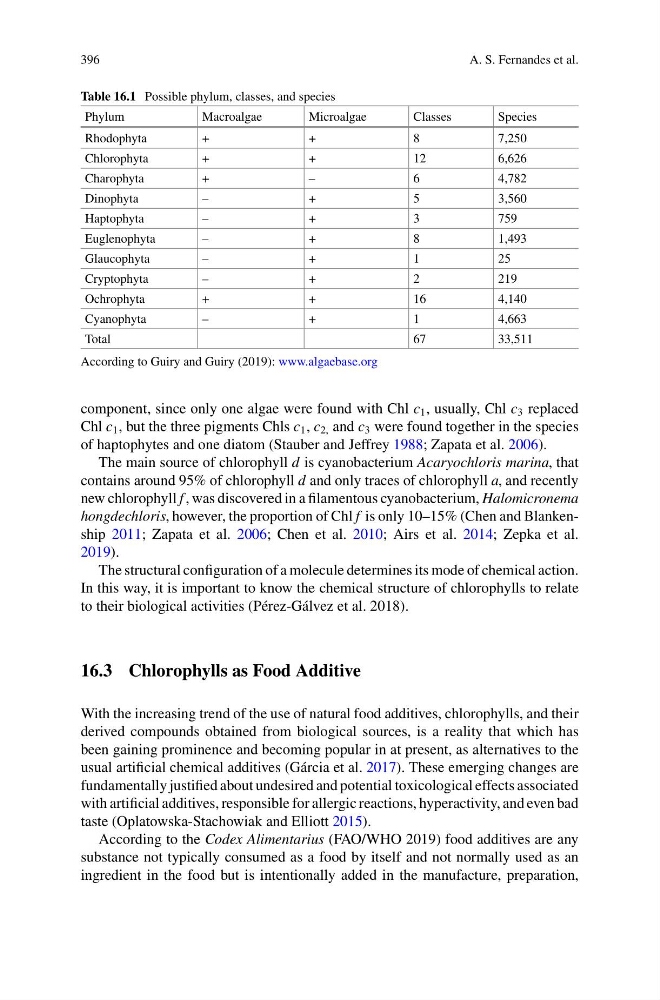
Table 16.1 Possible phylum, classes, and species
Phylum
Macroalgae
Microalgae
Classes
Species
Rhodophyta
+
+
8
7,250
Chlorophyta
+
+
12
6,626
Charophyta
+
–
6
4,782
Dinophyta
–
+
5
3,560
Haptophyta
–
+
3
759
Euglenophyta
–
+
8
1,493
Glaucophyta
–
+
1
25
Cryptophyta
–
+
2
219
Ochrophyta
+
+
16
4,140
Cyanophyta
–
+
1
4,663
Total
67
33,511
According to Guiry and Guiry (2019): www.algaebase.org
component, since only one algae were found with Chl c 1 , usually, Chl c 3 replaced
Chl c 1 , but the three pigments Chls c 1 , c 2, and c 3 were found together in the species
of haptophytes and one diatom (Stauber and Jeffrey 1988; Zapata et al. 2006).
The main source of chlorophyll d is cyanobacterium Acaryochloris marina, that
contains around 95% of chlorophyll d and only traces of chlorophyll a, and recently
new chlorophyll f , was discovered in a filamentous cyanobacterium, Halomicronema
hongdechloris, however, the proportion of Chl f is only 10–15% (Chen and Blankenship 2011; Zapata et al. 2006; Chen et al. 2010; Airs et al. 2014; Zepka et al.
2019).
The structural configuration of a molecule determines its mode of chemical action.
In this way, it is important to know the chemical structure of chlorophylls to relate
to their biological activities (Pérez-Gálvez et al. 2018).
16.3 Chlorophylls as Food Additive
With the increasing trend of the use of natural food additives, chlorophylls, and their
derived compounds obtained from biological sources, is a reality that which has
been gaining prominence and becoming popular in at present, as alternatives to the
usual artificial chemical additives (Gárcia et al. 2017). These emerging changes are
fundamentally justified about undesired and potential toxicological effects associated
with artificial additives, responsible for allergic reactions, hyperactivity, and even bad
taste (Oplatowska-Stachowiak and Elliott 2015).
According to the Codex Alimentarius (FAO/WHO 2019) food additives are any
substance not typically consumed as a food by itself and not normally used as an
ingredient in the food but is intentionally added in the manufacture, preparation,
A. S. Fernandes et al.
Table 16.1 Possible phylum, classes, and species
Phylum
Macroalgae
Microalgae
Classes
Species
Rhodophyta
+
+
8
7,250
Chlorophyta
+
+
12
6,626
Charophyta
+
–
6
4,782
Dinophyta
–
+
5
3,560
Haptophyta
–
+
3
759
Euglenophyta
–
+
8
1,493
Glaucophyta
–
+
1
25
Cryptophyta
–
+
2
219
Ochrophyta
+
+
16
4,140
Cyanophyta
–
+
1
4,663
Total
67
33,511
According to Guiry and Guiry (2019): www.algaebase.org
component, since only one algae were found with Chl c 1 , usually, Chl c 3 replaced
Chl c 1 , but the three pigments Chls c 1 , c 2, and c 3 were found together in the species
of haptophytes and one diatom (Stauber and Jeffrey 1988; Zapata et al. 2006).
The main source of chlorophyll d is cyanobacterium Acaryochloris marina, that
contains around 95% of chlorophyll d and only traces of chlorophyll a, and recently
new chlorophyll f , was discovered in a filamentous cyanobacterium, Halomicronema
hongdechloris, however, the proportion of Chl f is only 10–15% (Chen and Blankenship 2011; Zapata et al. 2006; Chen et al. 2010; Airs et al. 2014; Zepka et al.
2019).
The structural configuration of a molecule determines its mode of chemical action.
In this way, it is important to know the chemical structure of chlorophylls to relate
to their biological activities (Pérez-Gálvez et al. 2018).
16.3 Chlorophylls as Food Additive
With the increasing trend of the use of natural food additives, chlorophylls, and their
derived compounds obtained from biological sources, is a reality that which has
been gaining prominence and becoming popular in at present, as alternatives to the
usual artificial chemical additives (Gárcia et al. 2017). These emerging changes are
fundamentally justified about undesired and potential toxicological effects associated
with artificial additives, responsible for allergic reactions, hyperactivity, and even bad
taste (Oplatowska-Stachowiak and Elliott 2015).
According to the Codex Alimentarius (FAO/WHO 2019) food additives are any
substance not typically consumed as a food by itself and not normally used as an
ingredient in the food but is intentionally added in the manufacture, preparation,