

368
M. C. Deprá et al.
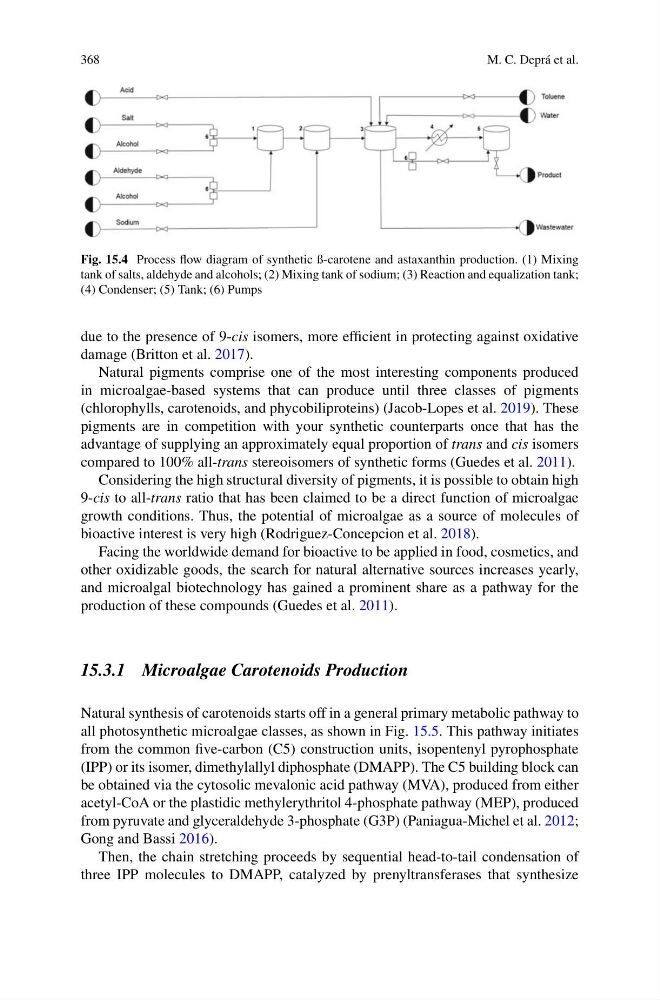
Fig. 15.4 Process flow diagram of synthetic ß-carotene and astaxanthin production. (1) Mixing
tank of salts, aldehyde and alcohols; (2) Mixing tank of sodium; (3) Reaction and equalization tank;
(4) Condenser; (5) Tank; (6) Pumps
due to the presence of 9-cis isomers, more efficient in protecting against oxidative
damage (Britton et al. 2017).
Natural pigments comprise one of the most interesting components produced
in microalgae-based systems that can produce until three classes of pigments
(chlorophylls, carotenoids, and phycobiliproteins) (Jacob-Lopes et al. 2019). These
pigments are in competition with your synthetic counterparts once that has the
advantage of supplying an approximately equal proportion of trans and cis isomers
compared to 100% all-trans stereoisomers of synthetic forms (Guedes et al. 2011).
Considering the high structural diversity of pigments, it is possible to obtain high
9-cis to all-trans ratio that has been claimed to be a direct function of microalgae
growth conditions. Thus, the potential of microalgae as a source of molecules of
bioactive interest is very high (Rodriguez-Concepcion et al. 2018).
Facing the worldwide demand for bioactive to be applied in food, cosmetics, and
other oxidizable goods, the search for natural alternative sources increases yearly,
and microalgal biotechnology has gained a prominent share as a pathway for the
production of these compounds (Guedes et al. 2011).
15.3.1 Microalgae Carotenoids Production
Natural synthesis of carotenoids starts off in a general primary metabolic pathway to
all photosynthetic microalgae classes, as shown in Fig. 15.5. This pathway initiates
from the common five-carbon (C5) construction units, isopentenyl pyrophosphate
(IPP) or its isomer, dimethylallyl diphosphate (DMAPP). The C5 building block can
be obtained via the cytosolic mevalonic acid pathway (MVA), produced from either
acetyl-CoA or the plastidic methylerythritol 4-phosphate pathway (MEP), produced
from pyruvate and glyceraldehyde 3-phosphate (G3P) (Paniagua-Michel et al. 2012;
Gong and Bassi 2016).
Then, the chain stretching proceeds by sequential head-to-tail condensation of
three IPP molecules to DMAPP, catalyzed by prenyltransferases that synthesize
M. C. Deprá et al.
Fig. 15.4 Process flow diagram of synthetic ß-carotene and astaxanthin production. (1) Mixing
tank of salts, aldehyde and alcohols; (2) Mixing tank of sodium; (3) Reaction and equalization tank;
(4) Condenser; (5) Tank; (6) Pumps
due to the presence of 9-cis isomers, more efficient in protecting against oxidative
damage (Britton et al. 2017).
Natural pigments comprise one of the most interesting components produced
in microalgae-based systems that can produce until three classes of pigments
(chlorophylls, carotenoids, and phycobiliproteins) (Jacob-Lopes et al. 2019). These
pigments are in competition with your synthetic counterparts once that has the
advantage of supplying an approximately equal proportion of trans and cis isomers
compared to 100% all-trans stereoisomers of synthetic forms (Guedes et al. 2011).
Considering the high structural diversity of pigments, it is possible to obtain high
9-cis to all-trans ratio that has been claimed to be a direct function of microalgae
growth conditions. Thus, the potential of microalgae as a source of molecules of
bioactive interest is very high (Rodriguez-Concepcion et al. 2018).
Facing the worldwide demand for bioactive to be applied in food, cosmetics, and
other oxidizable goods, the search for natural alternative sources increases yearly,
and microalgal biotechnology has gained a prominent share as a pathway for the
production of these compounds (Guedes et al. 2011).
15.3.1 Microalgae Carotenoids Production
Natural synthesis of carotenoids starts off in a general primary metabolic pathway to
all photosynthetic microalgae classes, as shown in Fig. 15.5. This pathway initiates
from the common five-carbon (C5) construction units, isopentenyl pyrophosphate
(IPP) or its isomer, dimethylallyl diphosphate (DMAPP). The C5 building block can
be obtained via the cytosolic mevalonic acid pathway (MVA), produced from either
acetyl-CoA or the plastidic methylerythritol 4-phosphate pathway (MEP), produced
from pyruvate and glyceraldehyde 3-phosphate (G3P) (Paniagua-Michel et al. 2012;
Gong and Bassi 2016).
Then, the chain stretching proceeds by sequential head-to-tail condensation of
three IPP molecules to DMAPP, catalyzed by prenyltransferases that synthesize