

286
R. Halim
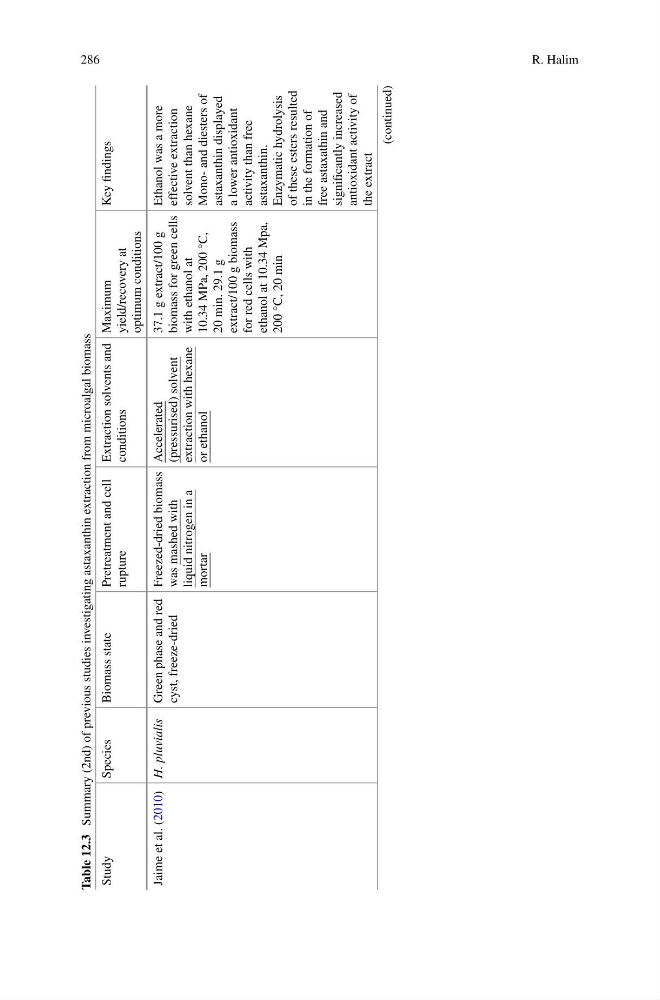
Table 12.3
Summary (2nd) of previous studies investigating astaxanthin extraction from microalgal biomass
Study
Species
Biomass state
Pretreatment and cell
rupture
Extraction solvents and
conditions
Maximum
yield/recovery at
optimum conditions
Key findings
Jaime et al. (2010) H. pluvialis
Green phase and red
cyst, freeze-dried
Freezed-dried biomass
was
mashed with
liquid nitrogen in a
mortar
Accelerated
(pressurised) solvent
extraction with hexane
or ethanol
37.1 g extract/100 g
biomass for green cells
with ethanol at
10.34 MPa, 200 °C,
20 min. 29.1 g
extract/100 g biomass
for red cells with
ethanol at 10.34 Mpa,
200 °C, 20 min
Ethanol was a more
effective extraction
solvent than hexane
Mono- and diesters of
astaxanthin displayed
a lower antioxidant
activity than free
astaxanthin.
Enzymatic hydrolysis
of these esters resulted
in the formation of
free astaxathin and
significantly increased
antioxidant activity of
the extract
(continued)
R. Halim
Table 12.3
Summary (2nd) of previous studies investigating astaxanthin extraction from microalgal biomass
Study
Species
Biomass state
Pretreatment and cell
rupture
Extraction solvents and
conditions
Maximum
yield/recovery at
optimum conditions
Key findings
Jaime et al. (2010) H. pluvialis
Green phase and red
cyst, freeze-dried
Freezed-dried biomass
was
mashed with
liquid nitrogen in a
mortar
Accelerated
(pressurised) solvent
extraction with hexane
or ethanol
37.1 g extract/100 g
biomass for green cells
with ethanol at
10.34 MPa, 200 °C,
20 min. 29.1 g
extract/100 g biomass
for red cells with
ethanol at 10.34 Mpa,
200 °C, 20 min
Ethanol was a more
effective extraction
solvent than hexane
Mono- and diesters of
astaxanthin displayed
a lower antioxidant
activity than free
astaxanthin.
Enzymatic hydrolysis
of these esters resulted
in the formation of
free astaxathin and
significantly increased
antioxidant activity of
the extract
(continued)