

11 Microalgae-Based Processes for Pigments Production
247
11.5 Microalgae-Based Pigments Processes
and Particularities
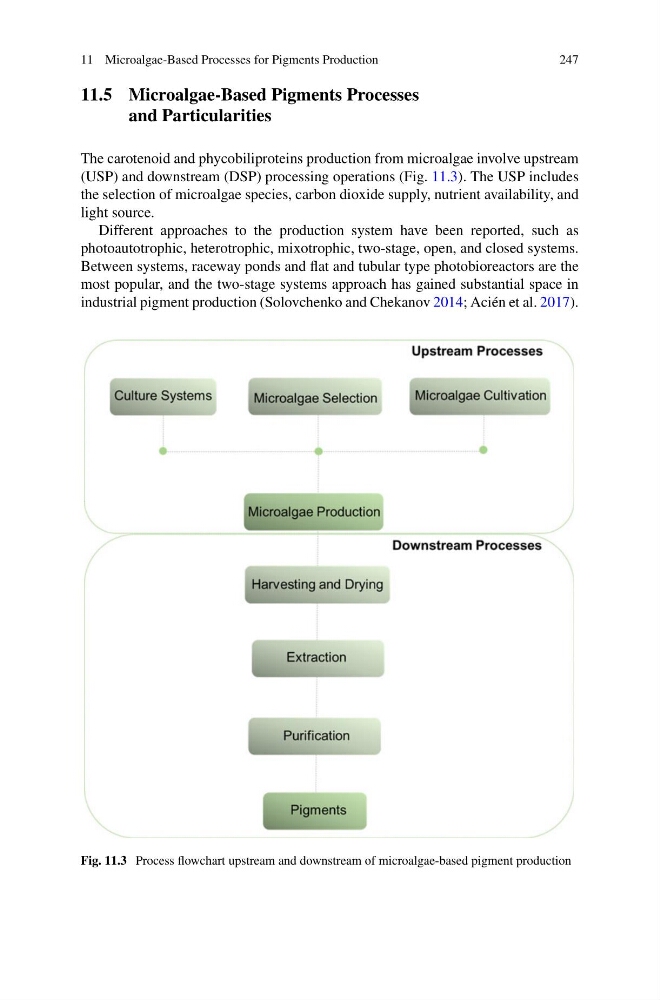
The carotenoid and phycobiliproteins production from microalgae involve upstream
(USP) and downstream (DSP) processing operations (Fig. 11.3). The USP includes
the selection of microalgae species, carbon dioxide supply, nutrient availability, and
light source.
Different approaches to the production system have been reported, such as
photoautotrophic, heterotrophic, mixotrophic, two-stage, open, and closed systems.
Between systems, raceway ponds and flat and tubular type photobioreactors are the
most popular, and the two-stage systems approach has gained substantial space in
industrial pigment production (Solovchenko and Chekanov 2014; Acién et al. 2017).
Fig. 11.3 Process flowchart upstream and downstream of microalgae-based pigment production
247
11.5 Microalgae-Based Pigments Processes
and Particularities
The carotenoid and phycobiliproteins production from microalgae involve upstream
(USP) and downstream (DSP) processing operations (Fig. 11.3). The USP includes
the selection of microalgae species, carbon dioxide supply, nutrient availability, and
light source.
Different approaches to the production system have been reported, such as
photoautotrophic, heterotrophic, mixotrophic, two-stage, open, and closed systems.
Between systems, raceway ponds and flat and tubular type photobioreactors are the
most popular, and the two-stage systems approach has gained substantial space in
industrial pigment production (Solovchenko and Chekanov 2014; Acién et al. 2017).
Fig. 11.3 Process flowchart upstream and downstream of microalgae-based pigment production