

12
J. C. da Silva and A. T. Lombardi
before Chl b when chlorophyll synthesis begins after irradiation of angiosperm plants
(Bogorad 1976). In green algae and plants, the assembly of stable light-harvesting
complexes (LHC) requires the presence of Chl b. Eggink et al. (2004) showed that
the transformation of the 7-methyl in Chl a group to the 7-formyl group in Chl b is a
reaction that uses molecular oxygen and is catalyzed by the enzyme chlorophyllide
a oxygenase (CAO). Based on the location of the CAO the authors suggest that the
envelope membranes of chloroplast are the initial site of Chl b synthesis. Some years
later, Nakagawara et al. (2007) showed that a chloroplast protease (Clp) is involved
in regulating chlorophyll b biosynthesis through the destabilization of CAO protein
in response to the accumulation of chlorophyll b.
1.3.2 Chlorophylls c, d, and f
Chlorophyll c is present in three forms, Chl c1 (no phytol tail), Chl c2, and Chl c3
(no phytol tail) (Cahoon and Timko 2003). They are found in chromophyte algae,
which belong to the Chromista kingdom that includes the alveolates, and that have
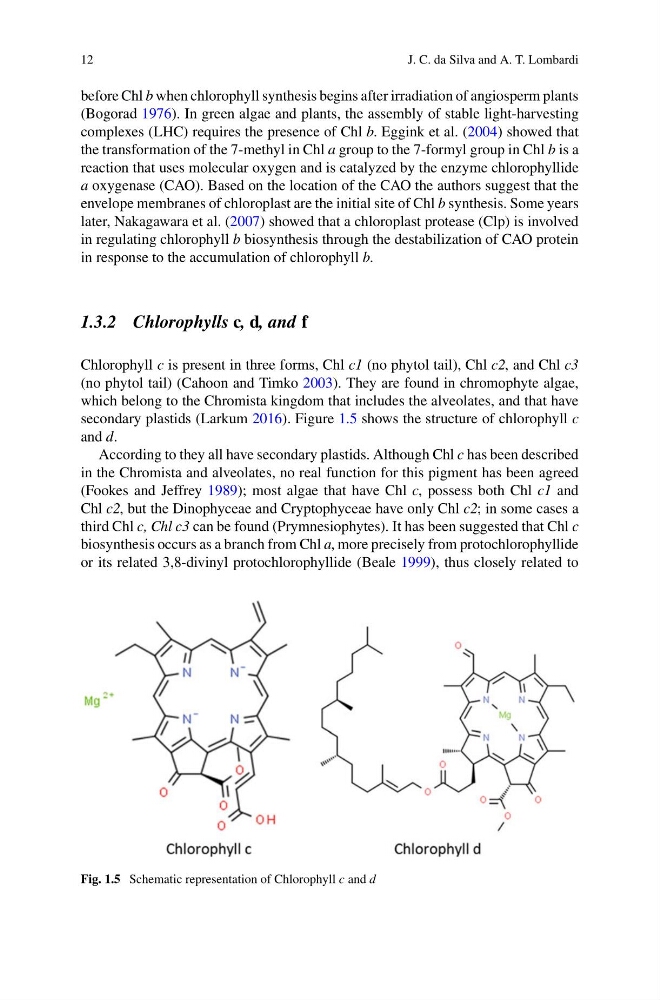
secondary plastids (Larkum 2016). Figure 1.5 shows the structure of chlorophyll c
and d.
According to they all have secondary plastids. Although Chl c has been described
in the Chromista and alveolates, no real function for this pigment has been agreed
(Fookes and Jeffrey 1989); most algae that have Chl c, possess both Chl c1 and
Chl c2, but the Dinophyceae and Cryptophyceae have only Chl c2; in some cases a
third Chl c, Chl c3 can be found (Prymnesiophytes). It has been suggested that Chl c
biosynthesis occurs as a branch from Chl a, more precisely from protochlorophyllide
or its related 3,8-divinyl protochlorophyllide (Beale 1999), thus closely related to
Fig. 1.5 Schematic representation of Chlorophyll c and d
J. C. da Silva and A. T. Lombardi
before Chl b when chlorophyll synthesis begins after irradiation of angiosperm plants
(Bogorad 1976). In green algae and plants, the assembly of stable light-harvesting
complexes (LHC) requires the presence of Chl b. Eggink et al. (2004) showed that
the transformation of the 7-methyl in Chl a group to the 7-formyl group in Chl b is a
reaction that uses molecular oxygen and is catalyzed by the enzyme chlorophyllide
a oxygenase (CAO). Based on the location of the CAO the authors suggest that the
envelope membranes of chloroplast are the initial site of Chl b synthesis. Some years
later, Nakagawara et al. (2007) showed that a chloroplast protease (Clp) is involved
in regulating chlorophyll b biosynthesis through the destabilization of CAO protein
in response to the accumulation of chlorophyll b.
1.3.2 Chlorophylls c, d, and f
Chlorophyll c is present in three forms, Chl c1 (no phytol tail), Chl c2, and Chl c3
(no phytol tail) (Cahoon and Timko 2003). They are found in chromophyte algae,
which belong to the Chromista kingdom that includes the alveolates, and that have
secondary plastids (Larkum 2016). Figure 1.5 shows the structure of chlorophyll c
and d.
According to they all have secondary plastids. Although Chl c has been described
in the Chromista and alveolates, no real function for this pigment has been agreed
(Fookes and Jeffrey 1989); most algae that have Chl c, possess both Chl c1 and
Chl c2, but the Dinophyceae and Cryptophyceae have only Chl c2; in some cases a
third Chl c, Chl c3 can be found (Prymnesiophytes). It has been suggested that Chl c
biosynthesis occurs as a branch from Chl a, more precisely from protochlorophyllide
or its related 3,8-divinyl protochlorophyllide (Beale 1999), thus closely related to
Fig. 1.5 Schematic representation of Chlorophyll c and d