

206
T. Casagrande do Nascimento et al.
Lutein
Zeaxanthin
Astaxanthin
Cantaxanthin
Fucoxanthin
Echinenone
Myxoxanthophyll
Violaxanthin
α-carotene
β-carotene
Crocoxanthin
Neoxanthin
O
MAIN ANTIOXIDANT MECHANISM
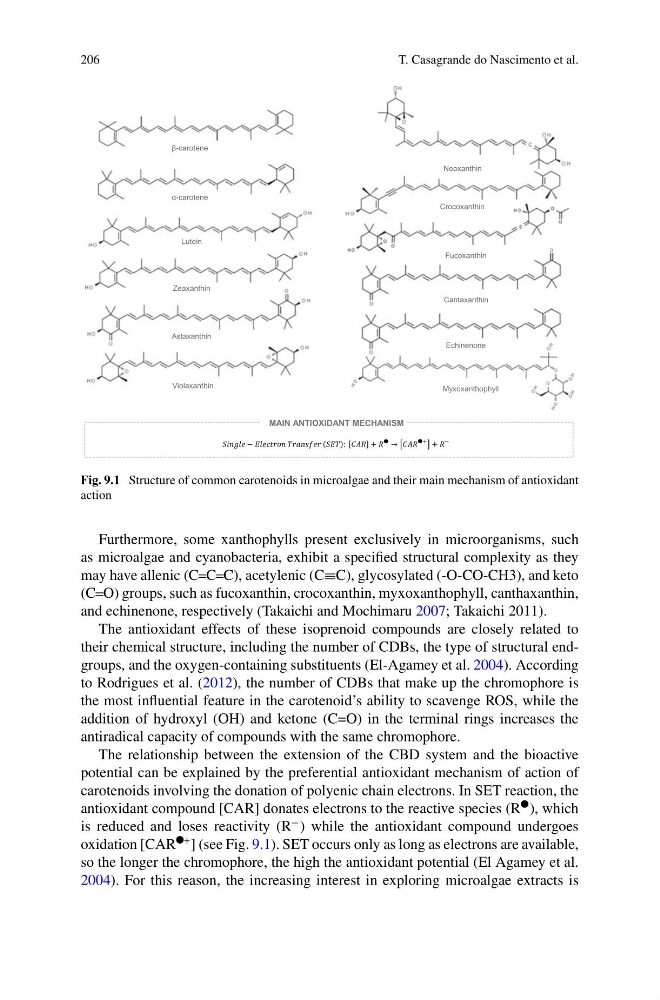
Fig. 9.1 Structure of common carotenoids in microalgae and their main mechanism of antioxidant
action
Furthermore, some xanthophylls present exclusively in microorganisms, such
as microalgae and cyanobacteria, exhibit a specified structural complexity as they
may have allenic (C C C), acetylenic (C≡C), glycosylated (-O-CO-CH3), and keto
(C O) groups, such as fucoxanthin, crocoxanthin, myxoxanthophyll, canthaxanthin,
and echinenone, respectively (Takaichi and Mochimaru 2007; Takaichi 2011).
The antioxidant effects of these isoprenoid compounds are closely related to
their chemical structure, including the number of CDBs, the type of structural endgroups, and the oxygen-containing substituents (El-Agamey et al. 2004). According
to Rodrigues et al. (2012), the number of CDBs that make up the chromophore is
the most influential feature in the carotenoid’s ability to scavenge ROS, while the
addition of hydroxyl (OH) and ketone (C=O) in the terminal rings increases the
antiradical capacity of compounds with the same chromophore.
The relationship between the extension of the CBD system and the bioactive
potential can be explained by the preferential antioxidant mechanism of action of
carotenoids involving the donation of polyenic chain electrons. In SET reaction, the
antioxidant compound [CAR] donates electrons to the reactive species (R
● ), which
is reduced and loses reactivity (R
− ) while the antioxidant compound undergoes
oxidation [CAR
●+ ] (see Fig. 9.1). SET occurs only as long as electrons are available,
so the longer the chromophore, the high the antioxidant potential (El Agamey et al.
2004). For this reason, the increasing interest in exploring microalgae extracts is
T. Casagrande do Nascimento et al.
Lutein
Zeaxanthin
Astaxanthin
Cantaxanthin
Fucoxanthin
Echinenone
Myxoxanthophyll
Violaxanthin
α-carotene
β-carotene
Crocoxanthin
Neoxanthin
O
MAIN ANTIOXIDANT MECHANISM
Fig. 9.1 Structure of common carotenoids in microalgae and their main mechanism of antioxidant
action
Furthermore, some xanthophylls present exclusively in microorganisms, such
as microalgae and cyanobacteria, exhibit a specified structural complexity as they
may have allenic (C C C), acetylenic (C≡C), glycosylated (-O-CO-CH3), and keto
(C O) groups, such as fucoxanthin, crocoxanthin, myxoxanthophyll, canthaxanthin,
and echinenone, respectively (Takaichi and Mochimaru 2007; Takaichi 2011).
The antioxidant effects of these isoprenoid compounds are closely related to
their chemical structure, including the number of CDBs, the type of structural endgroups, and the oxygen-containing substituents (El-Agamey et al. 2004). According
to Rodrigues et al. (2012), the number of CDBs that make up the chromophore is
the most influential feature in the carotenoid’s ability to scavenge ROS, while the
addition of hydroxyl (OH) and ketone (C=O) in the terminal rings increases the
antiradical capacity of compounds with the same chromophore.
The relationship between the extension of the CBD system and the bioactive
potential can be explained by the preferential antioxidant mechanism of action of
carotenoids involving the donation of polyenic chain electrons. In SET reaction, the
antioxidant compound [CAR] donates electrons to the reactive species (R
● ), which
is reduced and loses reactivity (R
− ) while the antioxidant compound undergoes
oxidation [CAR
●+ ] (see Fig. 9.1). SET occurs only as long as electrons are available,
so the longer the chromophore, the high the antioxidant potential (El Agamey et al.
2004). For this reason, the increasing interest in exploring microalgae extracts is