

128
I. Viera and M. Roca
6.1 Introduction
Following the definition of Scheer (2006), chlorophyll can be defined as cyclic
tetrapyrroles with a characteristic isocyclic five-membered ring and having an active
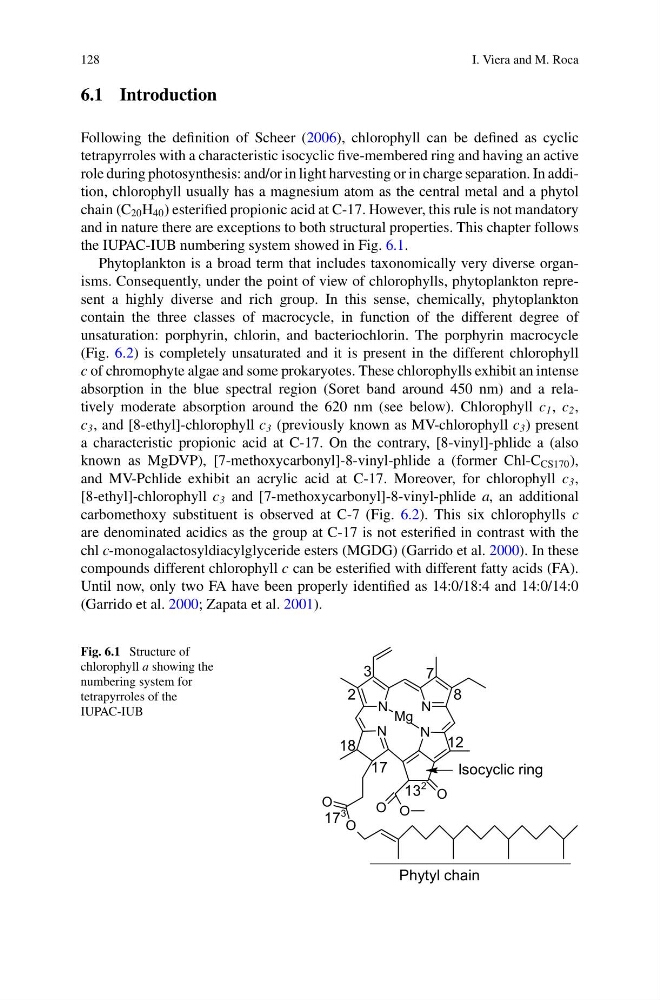
role during photosynthesis: and/or in light harvesting or in charge separation. In addition, chlorophyll usually has a magnesium atom as the central metal and a phytol
chain (C 20 H 40 ) esterified propionic acid at C-17. However, this rule is not mandatory
and in nature there are exceptions to both structural properties. This chapter follows
the IUPAC-IUB numbering system showed in Fig. 6.1.
Phytoplankton is a broad term that includes taxonomically very diverse organisms. Consequently, under the point of view of chlorophylls, phytoplankton represent a highly diverse and rich group. In this sense, chemically, phytoplankton
contain the three classes of macrocycle, in function of the different degree of
unsaturation: porphyrin, chlorin, and bacteriochlorin. The porphyrin macrocycle
(Fig. 6.2) is completely unsaturated and it is present in the different chlorophyll
c of chromophyte algae and some prokaryotes. These chlorophylls exhibit an intense
absorption in the blue spectral region (Soret band around 450 nm) and a relatively moderate absorption around the 620 nm (see below). Chlorophyll c 1 , c 2 ,
c 3 , and [8-ethyl]-chlorophyll c 3 (previously known as MV-chlorophyll c 3 ) present
a characteristic propionic acid at C-17. On the contrary, [8-vinyl]-phlide a (also
known as MgDVP), [7-methoxycarbonyl]-8-vinyl-phlide a (former Chl-C CS170 ),
and MV-Pchlide exhibit an acrylic acid at C-17. Moreover, for chlorophyll c 3 ,
[8-ethyl]-chlorophyll c 3 and [7-methoxycarbonyl]-8-vinyl-phlide a, an additional
carbomethoxy substituent is observed at C-7 (Fig. 6.2). This six chlorophylls c
are denominated acidics as the group at C-17 is not esterified in contrast with the
chl c-monogalactosyldiacylglyceride esters (MGDG) (Garrido et al. 2000). In these
compounds different chlorophyll c can be esterified with different fatty acids (FA).
Until now, only two FA have been properly identified as 14:0/18:4 and 14:0/14:0
(Garrido et al. 2000; Zapata et al. 2001).
Fig. 6.1 Structure of
chlorophyll a showing the
numbering system for
tetrapyrroles of the
IUPAC-IUB
N
N
N
N
O
O
O
O
O
Mg
3
7
2
17
18
8
13
2
12
17
3
Phytyl chain
Isocyclic ring
I. Viera and M. Roca
6.1 Introduction
Following the definition of Scheer (2006), chlorophyll can be defined as cyclic
tetrapyrroles with a characteristic isocyclic five-membered ring and having an active
role during photosynthesis: and/or in light harvesting or in charge separation. In addition, chlorophyll usually has a magnesium atom as the central metal and a phytol
chain (C 20 H 40 ) esterified propionic acid at C-17. However, this rule is not mandatory
and in nature there are exceptions to both structural properties. This chapter follows
the IUPAC-IUB numbering system showed in Fig. 6.1.
Phytoplankton is a broad term that includes taxonomically very diverse organisms. Consequently, under the point of view of chlorophylls, phytoplankton represent a highly diverse and rich group. In this sense, chemically, phytoplankton
contain the three classes of macrocycle, in function of the different degree of
unsaturation: porphyrin, chlorin, and bacteriochlorin. The porphyrin macrocycle
(Fig. 6.2) is completely unsaturated and it is present in the different chlorophyll
c of chromophyte algae and some prokaryotes. These chlorophylls exhibit an intense
absorption in the blue spectral region (Soret band around 450 nm) and a relatively moderate absorption around the 620 nm (see below). Chlorophyll c 1 , c 2 ,
c 3 , and [8-ethyl]-chlorophyll c 3 (previously known as MV-chlorophyll c 3 ) present
a characteristic propionic acid at C-17. On the contrary, [8-vinyl]-phlide a (also
known as MgDVP), [7-methoxycarbonyl]-8-vinyl-phlide a (former Chl-C CS170 ),
and MV-Pchlide exhibit an acrylic acid at C-17. Moreover, for chlorophyll c 3 ,
[8-ethyl]-chlorophyll c 3 and [7-methoxycarbonyl]-8-vinyl-phlide a, an additional
carbomethoxy substituent is observed at C-7 (Fig. 6.2). This six chlorophylls c
are denominated acidics as the group at C-17 is not esterified in contrast with the
chl c-monogalactosyldiacylglyceride esters (MGDG) (Garrido et al. 2000). In these
compounds different chlorophyll c can be esterified with different fatty acids (FA).
Until now, only two FA have been properly identified as 14:0/18:4 and 14:0/14:0
(Garrido et al. 2000; Zapata et al. 2001).
Fig. 6.1 Structure of
chlorophyll a showing the
numbering system for
tetrapyrroles of the
IUPAC-IUB
N
N
N
N
O
O
O
O
O
Mg
3
7
2
17
18
8
13
2
12
17
3
Phytyl chain
Isocyclic ring