

5 Carotenoid Overproduction in Microalgae: Biochemical …
95
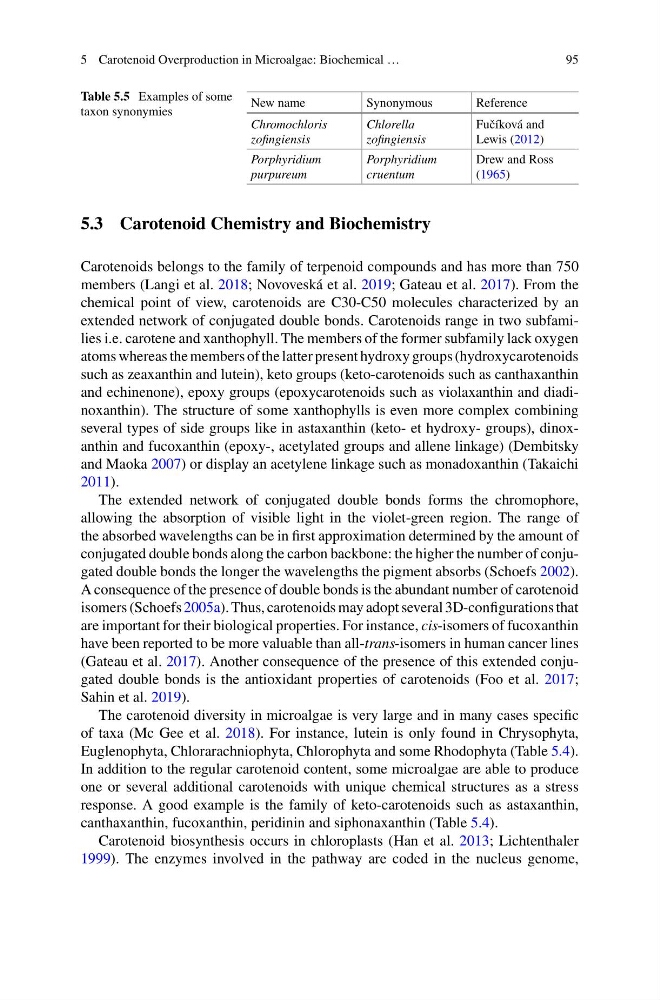
Table 5.5 Examples of some
taxon synonymies
New name
Synonymous
Reference
Chromochloris
zofingiensis
Chlorella
zofingiensis
Fuˇ cíková and
Lewis (2012)
Porphyridium
purpureum
Porphyridium
cruentum
Drew and Ross
(1965)
5.3 Carotenoid Chemistry and Biochemistry
Carotenoids belongs to the family of terpenoid compounds and has more than 750
members (Langi et al. 2018; Novoveská et al. 2019; Gateau et al. 2017). From the
chemical point of view, carotenoids are C30-C50 molecules characterized by an
extended network of conjugated double bonds. Carotenoids range in two subfamilies i.e. carotene and xanthophyll. The members of the former subfamily lack oxygen
atoms whereas the members of the latter present hydroxy groups (hydroxycarotenoids
such as zeaxanthin and lutein), keto groups (keto-carotenoids such as canthaxanthin
and echinenone), epoxy groups (epoxycarotenoids such as violaxanthin and diadinoxanthin). The structure of some xanthophylls is even more complex combining
several types of side groups like in astaxanthin (keto- et hydroxy- groups), dinoxanthin and fucoxanthin (epoxy-, acetylated groups and allene linkage) (Dembitsky
and Maoka 2007) or display an acetylene linkage such as monadoxanthin (Takaichi
2011).
The extended network of conjugated double bonds forms the chromophore,
allowing the absorption of visible light in the violet-green region. The range of
the absorbed wavelengths can be in first approximation determined by the amount of
conjugated double bonds along the carbon backbone: the higher the number of conjugated double bonds the longer the wavelengths the pigment absorbs (Schoefs 2002).
A consequence of the presence of double bonds is the abundant number of carotenoid
isomers (Schoefs 2005a). Thus, carotenoids may adopt several 3D-configurations that
are important for their biological properties. For instance, cis-isomers of fucoxanthin
have been reported to be more valuable than all-trans-isomers in human cancer lines
(Gateau et al. 2017). Another consequence of the presence of this extended conjugated double bonds is the antioxidant properties of carotenoids (Foo et al. 2017;
Sahin et al. 2019).
The carotenoid diversity in microalgae is very large and in many cases specific
of taxa (Mc Gee et al. 2018). For instance, lutein is only found in Chrysophyta,
Euglenophyta, Chlorarachniophyta, Chlorophyta and some Rhodophyta (Table 5.4).
In addition to the regular carotenoid content, some microalgae are able to produce
one or several additional carotenoids with unique chemical structures as a stress
response. A good example is the family of keto-carotenoids such as astaxanthin,
canthaxanthin, fucoxanthin, peridinin and siphonaxanthin (Table 5.4).
Carotenoid biosynthesis occurs in chloroplasts (Han et al. 2013; Lichtenthaler
1999). The enzymes involved in the pathway are coded in the nucleus genome,
95
Table 5.5 Examples of some
taxon synonymies
New name
Synonymous
Reference
Chromochloris
zofingiensis
Chlorella
zofingiensis
Fuˇ cíková and
Lewis (2012)
Porphyridium
purpureum
Porphyridium
cruentum
Drew and Ross
(1965)
5.3 Carotenoid Chemistry and Biochemistry
Carotenoids belongs to the family of terpenoid compounds and has more than 750
members (Langi et al. 2018; Novoveská et al. 2019; Gateau et al. 2017). From the
chemical point of view, carotenoids are C30-C50 molecules characterized by an
extended network of conjugated double bonds. Carotenoids range in two subfamilies i.e. carotene and xanthophyll. The members of the former subfamily lack oxygen
atoms whereas the members of the latter present hydroxy groups (hydroxycarotenoids
such as zeaxanthin and lutein), keto groups (keto-carotenoids such as canthaxanthin
and echinenone), epoxy groups (epoxycarotenoids such as violaxanthin and diadinoxanthin). The structure of some xanthophylls is even more complex combining
several types of side groups like in astaxanthin (keto- et hydroxy- groups), dinoxanthin and fucoxanthin (epoxy-, acetylated groups and allene linkage) (Dembitsky
and Maoka 2007) or display an acetylene linkage such as monadoxanthin (Takaichi
2011).
The extended network of conjugated double bonds forms the chromophore,
allowing the absorption of visible light in the violet-green region. The range of
the absorbed wavelengths can be in first approximation determined by the amount of
conjugated double bonds along the carbon backbone: the higher the number of conjugated double bonds the longer the wavelengths the pigment absorbs (Schoefs 2002).
A consequence of the presence of double bonds is the abundant number of carotenoid
isomers (Schoefs 2005a). Thus, carotenoids may adopt several 3D-configurations that
are important for their biological properties. For instance, cis-isomers of fucoxanthin
have been reported to be more valuable than all-trans-isomers in human cancer lines
(Gateau et al. 2017). Another consequence of the presence of this extended conjugated double bonds is the antioxidant properties of carotenoids (Foo et al. 2017;
Sahin et al. 2019).
The carotenoid diversity in microalgae is very large and in many cases specific
of taxa (Mc Gee et al. 2018). For instance, lutein is only found in Chrysophyta,
Euglenophyta, Chlorarachniophyta, Chlorophyta and some Rhodophyta (Table 5.4).
In addition to the regular carotenoid content, some microalgae are able to produce
one or several additional carotenoids with unique chemical structures as a stress
response. A good example is the family of keto-carotenoids such as astaxanthin,
canthaxanthin, fucoxanthin, peridinin and siphonaxanthin (Table 5.4).
Carotenoid biosynthesis occurs in chloroplasts (Han et al. 2013; Lichtenthaler
1999). The enzymes involved in the pathway are coded in the nucleus genome,