

76
4 Alginates
from the water. Water has a rather high latent heat of evaporation and therefore
requires lots of energy to evaporate such that less energy-consuming and economic
methods are employed to recover the sodium alginate. This is either method 1 where
acid is added followed by dewatering and reforming of sodium alginate precipitate or
method 2 where calcium salt such as calcium chloride is added followed by reforming
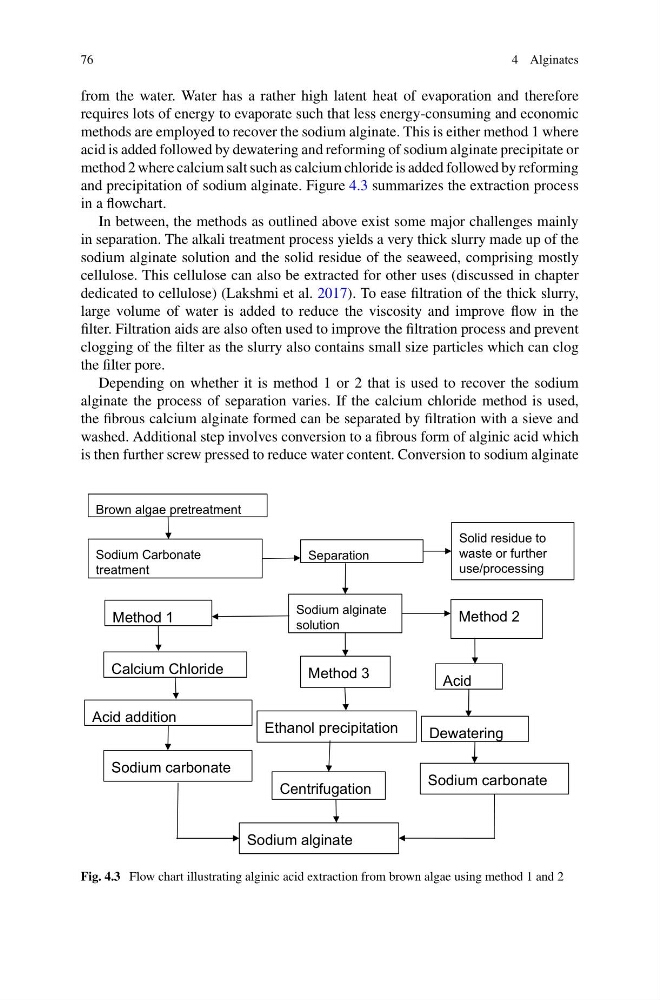
and precipitation of sodium alginate. Figure 4.3 summarizes the extraction process
in a flowchart.
In between, the methods as outlined above exist some major challenges mainly
in separation. The alkali treatment process yields a very thick slurry made up of the
sodium alginate solution and the solid residue of the seaweed, comprising mostly
cellulose. This cellulose can also be extracted for other uses (discussed in chapter
dedicated to cellulose) (Lakshmi et al. 2017). To ease filtration of the thick slurry,
large volume of water is added to reduce the viscosity and improve flow in the
filter. Filtration aids are also often used to improve the filtration process and prevent
clogging of the filter as the slurry also contains small size particles which can clog
the filter pore.
Depending on whether it is method 1 or 2 that is used to recover the sodium
alginate the process of separation varies. If the calcium chloride method is used,
the fibrous calcium alginate formed can be separated by filtration with a sieve and
washed. Additional step involves conversion to a fibrous form of alginic acid which
is then further screw pressed to reduce water content. Conversion to sodium alginate
Brown algae pretreatment
Sodium Carbonate
treatment
Separation
Solid residue to
waste or further
use/processing
Sodium alginate
solution
Method 1
Method 2
Calcium Chloride
Acid addition
Sodium carbonate
Sodium alginate
Acid
Dewatering
Sodium carbonate
Ethanol precipitation
Centrifugation
Method 3
Fig. 4.3 Flow chart illustrating alginic acid extraction from brown algae using method 1 and 2
4 Alginates
from the water. Water has a rather high latent heat of evaporation and therefore
requires lots of energy to evaporate such that less energy-consuming and economic
methods are employed to recover the sodium alginate. This is either method 1 where
acid is added followed by dewatering and reforming of sodium alginate precipitate or
method 2 where calcium salt such as calcium chloride is added followed by reforming
and precipitation of sodium alginate. Figure 4.3 summarizes the extraction process
in a flowchart.
In between, the methods as outlined above exist some major challenges mainly
in separation. The alkali treatment process yields a very thick slurry made up of the
sodium alginate solution and the solid residue of the seaweed, comprising mostly
cellulose. This cellulose can also be extracted for other uses (discussed in chapter
dedicated to cellulose) (Lakshmi et al. 2017). To ease filtration of the thick slurry,
large volume of water is added to reduce the viscosity and improve flow in the
filter. Filtration aids are also often used to improve the filtration process and prevent
clogging of the filter as the slurry also contains small size particles which can clog
the filter pore.
Depending on whether it is method 1 or 2 that is used to recover the sodium
alginate the process of separation varies. If the calcium chloride method is used,
the fibrous calcium alginate formed can be separated by filtration with a sieve and
washed. Additional step involves conversion to a fibrous form of alginic acid which
is then further screw pressed to reduce water content. Conversion to sodium alginate
Brown algae pretreatment
Sodium Carbonate
treatment
Separation
Solid residue to
waste or further
use/processing
Sodium alginate
solution
Method 1
Method 2
Calcium Chloride
Acid addition
Sodium carbonate
Sodium alginate
Acid
Dewatering
Sodium carbonate
Ethanol precipitation
Centrifugation
Method 3
Fig. 4.3 Flow chart illustrating alginic acid extraction from brown algae using method 1 and 2