

70
4 Alginates
Fig. 4.1 A section of one possible block and alternating patterns of mannuronic acid (M) and
guluronic acid (G) within an alginate chain
The manner in which the mannuronic acid and guluronic acids are arranged along
the polymer chain varies in different seaweeds. So does the ratio of mannuronic:
guluronic acid of the alginate. The GG blocks confer more stiffening effect on the
polymer chain and are also more soluble at lower pH than the alternating GM blocks
(Aravamudhan et al. 2014). An example composition of alginate extracted from the
brown algae Laminaria digitata M and G blocks is 0.47, 0.41, 0.06 and 0.06 MM, GG,
MG and GM (Fertah et al. 2017). Where MM and GG refer to the fraction of the chain
which is made of block arrangements of mannuronic acids and guluronic acids within
the polymer chain and MG and GM refers to the fraction of the chain with alternating
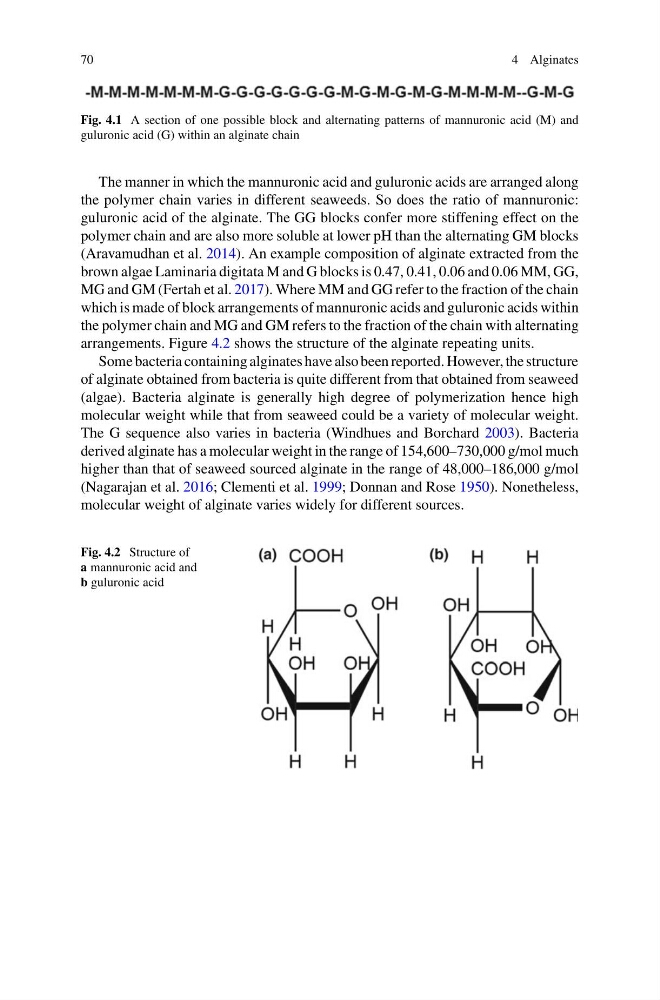
arrangements. Figure 4.2 shows the structure of the alginate repeating units.
Some bacteria containing alginates have also been reported. However, the structure
of alginate obtained from bacteria is quite different from that obtained from seaweed
(algae). Bacteria alginate is generally high degree of polymerization hence high
molecular weight while that from seaweed could be a variety of molecular weight.
The G sequence also varies in bacteria (Windhues and Borchard 2003). Bacteria
derived alginate has a molecular weight in the range of 154,600–730,000 g/mol much
higher than that of seaweed sourced alginate in the range of 48,000–186,000 g/mol
(Nagarajan et al. 2016; Clementi et al. 1999; Donnan and Rose 1950). Nonetheless,
molecular weight of alginate varies widely for different sources.
Fig. 4.2 Structure of
a mannuronic acid and
b guluronic acid
4 Alginates
Fig. 4.1 A section of one possible block and alternating patterns of mannuronic acid (M) and
guluronic acid (G) within an alginate chain
The manner in which the mannuronic acid and guluronic acids are arranged along
the polymer chain varies in different seaweeds. So does the ratio of mannuronic:
guluronic acid of the alginate. The GG blocks confer more stiffening effect on the
polymer chain and are also more soluble at lower pH than the alternating GM blocks
(Aravamudhan et al. 2014). An example composition of alginate extracted from the
brown algae Laminaria digitata M and G blocks is 0.47, 0.41, 0.06 and 0.06 MM, GG,
MG and GM (Fertah et al. 2017). Where MM and GG refer to the fraction of the chain
which is made of block arrangements of mannuronic acids and guluronic acids within
the polymer chain and MG and GM refers to the fraction of the chain with alternating
arrangements. Figure 4.2 shows the structure of the alginate repeating units.
Some bacteria containing alginates have also been reported. However, the structure
of alginate obtained from bacteria is quite different from that obtained from seaweed
(algae). Bacteria alginate is generally high degree of polymerization hence high
molecular weight while that from seaweed could be a variety of molecular weight.
The G sequence also varies in bacteria (Windhues and Borchard 2003). Bacteria
derived alginate has a molecular weight in the range of 154,600–730,000 g/mol much
higher than that of seaweed sourced alginate in the range of 48,000–186,000 g/mol
(Nagarajan et al. 2016; Clementi et al. 1999; Donnan and Rose 1950). Nonetheless,
molecular weight of alginate varies widely for different sources.
Fig. 4.2 Structure of
a mannuronic acid and
b guluronic acid