

34
3 Chitin
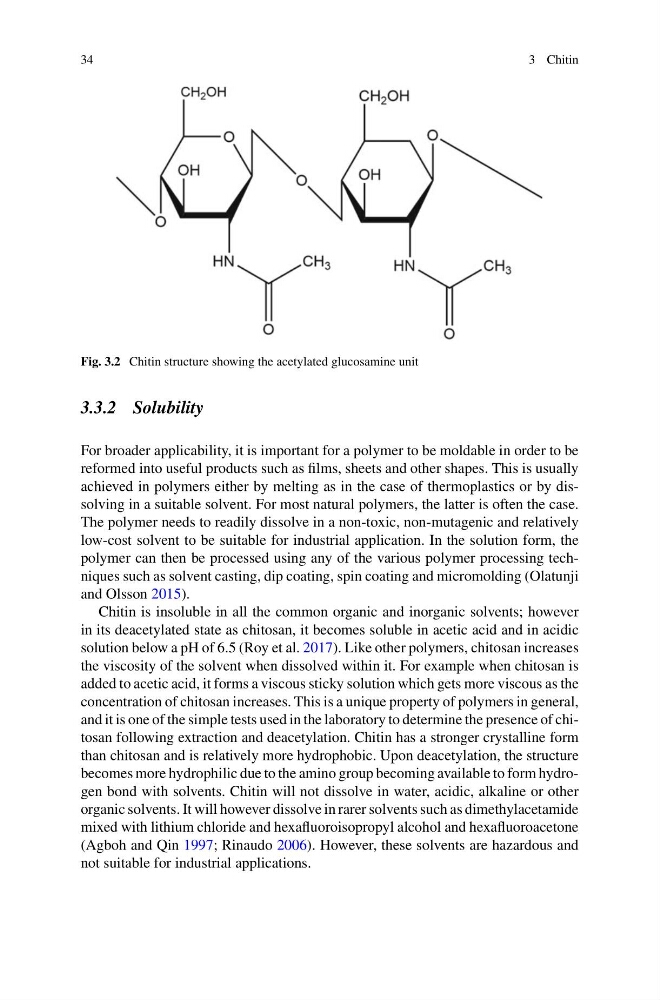
Fig. 3.2 Chitin structure showing the acetylated glucosamine unit
3.3.2 Solubility
For broader applicability, it is important for a polymer to be moldable in order to be
reformed into useful products such as films, sheets and other shapes. This is usually
achieved in polymers either by melting as in the case of thermoplastics or by dissolving in a suitable solvent. For most natural polymers, the latter is often the case.
The polymer needs to readily dissolve in a non-toxic, non-mutagenic and relatively
low-cost solvent to be suitable for industrial application. In the solution form, the
polymer can then be processed using any of the various polymer processing techniques such as solvent casting, dip coating, spin coating and micromolding (Olatunji
and Olsson 2015).
Chitin is insoluble in all the common organic and inorganic solvents; however
in its deacetylated state as chitosan, it becomes soluble in acetic acid and in acidic
solution below a pH of 6.5 (Roy et al. 2017). Like other polymers, chitosan increases
the viscosity of the solvent when dissolved within it. For example when chitosan is
added to acetic acid, it forms a viscous sticky solution which gets more viscous as the
concentration of chitosan increases. This is a unique property of polymers in general,
and it is one of the simple tests used in the laboratory to determine the presence of chitosan following extraction and deacetylation. Chitin has a stronger crystalline form
than chitosan and is relatively more hydrophobic. Upon deacetylation, the structure
becomes more hydrophilic due to the amino group becoming available to form hydrogen bond with solvents. Chitin will not dissolve in water, acidic, alkaline or other
organic solvents. It will however dissolve in rarer solvents such as dimethylacetamide
mixed with lithium chloride and hexafluoroisopropyl alcohol and hexafluoroacetone
(Agboh and Qin 1997; Rinaudo 2006). However, these solvents are hazardous and
not suitable for industrial applications.
3 Chitin
Fig. 3.2 Chitin structure showing the acetylated glucosamine unit
3.3.2 Solubility
For broader applicability, it is important for a polymer to be moldable in order to be
reformed into useful products such as films, sheets and other shapes. This is usually
achieved in polymers either by melting as in the case of thermoplastics or by dissolving in a suitable solvent. For most natural polymers, the latter is often the case.
The polymer needs to readily dissolve in a non-toxic, non-mutagenic and relatively
low-cost solvent to be suitable for industrial application. In the solution form, the
polymer can then be processed using any of the various polymer processing techniques such as solvent casting, dip coating, spin coating and micromolding (Olatunji
and Olsson 2015).
Chitin is insoluble in all the common organic and inorganic solvents; however
in its deacetylated state as chitosan, it becomes soluble in acetic acid and in acidic
solution below a pH of 6.5 (Roy et al. 2017). Like other polymers, chitosan increases
the viscosity of the solvent when dissolved within it. For example when chitosan is
added to acetic acid, it forms a viscous sticky solution which gets more viscous as the
concentration of chitosan increases. This is a unique property of polymers in general,
and it is one of the simple tests used in the laboratory to determine the presence of chitosan following extraction and deacetylation. Chitin has a stronger crystalline form
than chitosan and is relatively more hydrophobic. Upon deacetylation, the structure
becomes more hydrophilic due to the amino group becoming available to form hydrogen bond with solvents. Chitin will not dissolve in water, acidic, alkaline or other
organic solvents. It will however dissolve in rarer solvents such as dimethylacetamide
mixed with lithium chloride and hexafluoroisopropyl alcohol and hexafluoroacetone
(Agboh and Qin 1997; Rinaudo 2006). However, these solvents are hazardous and
not suitable for industrial applications.