

8
2 Overview of the Aquatic Ecosystem
Table 2.3 Different Lake zones
Lake zones
Subdivision
Depth range
Organisms and features
Littoral zone
Epilimnetic
Surface to 6 m
Aquatic plants
Hypolimnetic
6–10 m
Limnetic zone
From 10 to depth of effective
light penetration
Planktons
Profundal zone
From point beyond light
penetration to bottom
Heterotrophs
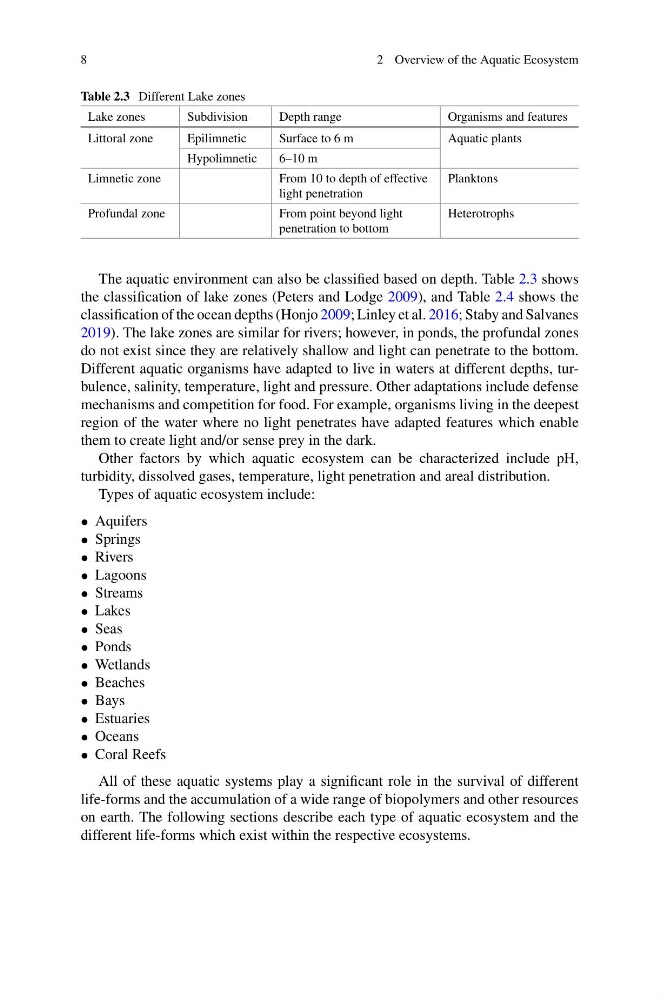
The aquatic environment can also be classified based on depth. Table 2.3 shows
the classification of lake zones (Peters and Lodge 2009), and Table 2.4 shows the
classification of the ocean depths (Honjo 2009; Linley et al. 2016; Staby and Salvanes
2019). The lake zones are similar for rivers; however, in ponds, the profundal zones
do not exist since they are relatively shallow and light can penetrate to the bottom.
Different aquatic organisms have adapted to live in waters at different depths, turbulence, salinity, temperature, light and pressure. Other adaptations include defense
mechanisms and competition for food. For example, organisms living in the deepest
region of the water where no light penetrates have adapted features which enable
them to create light and/or sense prey in the dark.
Other factors by which aquatic ecosystem can be characterized include pH,
turbidity, dissolved gases, temperature, light penetration and areal distribution.
Types of aquatic ecosystem include:
• Aquifers
• Springs
• Rivers
• Lagoons
• Streams
• Lakes
• Seas
• Ponds
• Wetlands
• Beaches
• Bays
• Estuaries
• Oceans
• Coral Reefs
All of these aquatic systems play a significant role in the survival of different
life-forms and the accumulation of a wide range of biopolymers and other resources
on earth. The following sections describe each type of aquatic ecosystem and the
different life-forms which exist within the respective ecosystems.
2 Overview of the Aquatic Ecosystem
Table 2.3 Different Lake zones
Lake zones
Subdivision
Depth range
Organisms and features
Littoral zone
Epilimnetic
Surface to 6 m
Aquatic plants
Hypolimnetic
6–10 m
Limnetic zone
From 10 to depth of effective
light penetration
Planktons
Profundal zone
From point beyond light
penetration to bottom
Heterotrophs
The aquatic environment can also be classified based on depth. Table 2.3 shows
the classification of lake zones (Peters and Lodge 2009), and Table 2.4 shows the
classification of the ocean depths (Honjo 2009; Linley et al. 2016; Staby and Salvanes
2019). The lake zones are similar for rivers; however, in ponds, the profundal zones
do not exist since they are relatively shallow and light can penetrate to the bottom.
Different aquatic organisms have adapted to live in waters at different depths, turbulence, salinity, temperature, light and pressure. Other adaptations include defense
mechanisms and competition for food. For example, organisms living in the deepest
region of the water where no light penetrates have adapted features which enable
them to create light and/or sense prey in the dark.
Other factors by which aquatic ecosystem can be characterized include pH,
turbidity, dissolved gases, temperature, light penetration and areal distribution.
Types of aquatic ecosystem include:
• Aquifers
• Springs
• Rivers
• Lagoons
• Streams
• Lakes
• Seas
• Ponds
• Wetlands
• Beaches
• Bays
• Estuaries
• Oceans
• Coral Reefs
All of these aquatic systems play a significant role in the survival of different
life-forms and the accumulation of a wide range of biopolymers and other resources
on earth. The following sections describe each type of aquatic ecosystem and the
different life-forms which exist within the respective ecosystems.