

7.3 Chemistry of Agar
147
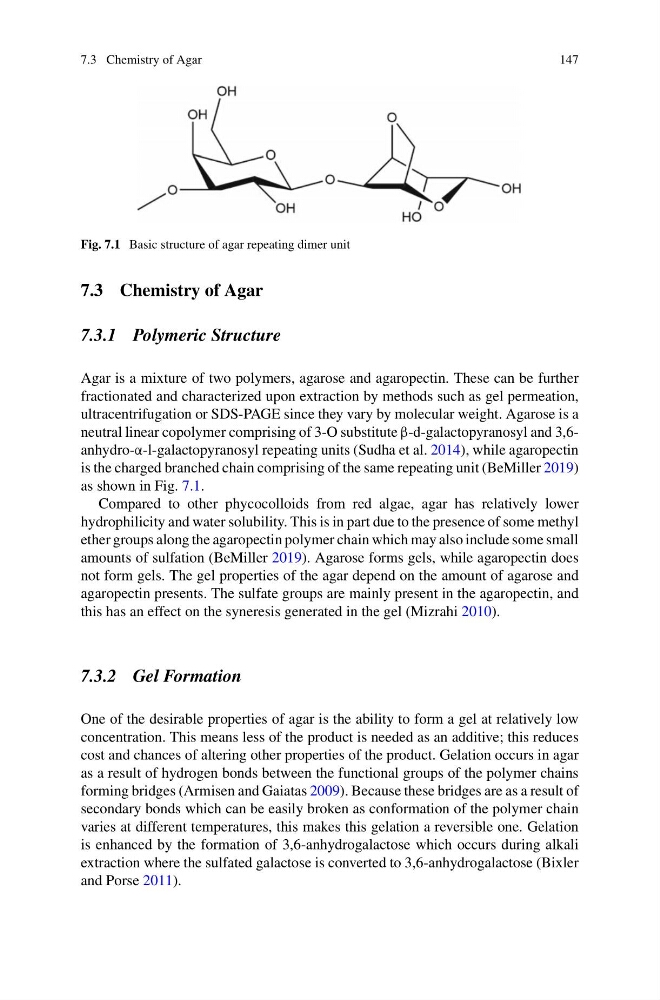
Fig. 7.1 Basic structure of agar repeating dimer unit
7.3 Chemistry of Agar
7.3.1 Polymeric Structure
Agar is a mixture of two polymers, agarose and agaropectin. These can be further
fractionated and characterized upon extraction by methods such as gel permeation,
ultracentrifugation or SDS-PAGE since they vary by molecular weight. Agarose is a
neutral linear copolymer comprising of 3-O substitute β-d-galactopyranosyl and 3,6anhydro-α-l-galactopyranosyl repeating units (Sudha et al. 2014), while agaropectin
is the charged branched chain comprising of the same repeating unit (BeMiller 2019)
as shown in Fig. 7.1.
Compared to other phycocolloids from red algae, agar has relatively lower
hydrophilicity and water solubility. This is in part due to the presence of some methyl
ether groups along the agaropectin polymer chain which may also include some small
amounts of sulfation (BeMiller 2019). Agarose forms gels, while agaropectin does
not form gels. The gel properties of the agar depend on the amount of agarose and
agaropectin presents. The sulfate groups are mainly present in the agaropectin, and
this has an effect on the syneresis generated in the gel (Mizrahi 2010).
7.3.2 Gel Formation
One of the desirable properties of agar is the ability to form a gel at relatively low
concentration. This means less of the product is needed as an additive; this reduces
cost and chances of altering other properties of the product. Gelation occurs in agar
as a result of hydrogen bonds between the functional groups of the polymer chains
forming bridges (Armisen and Gaiatas 2009). Because these bridges are as a result of
secondary bonds which can be easily broken as conformation of the polymer chain
varies at different temperatures, this makes this gelation a reversible one. Gelation
is enhanced by the formation of 3,6-anhydrogalactose which occurs during alkali
extraction where the sulfated galactose is converted to 3,6-anhydrogalactose (Bixler
and Porse 2011).
147
Fig. 7.1 Basic structure of agar repeating dimer unit
7.3 Chemistry of Agar
7.3.1 Polymeric Structure
Agar is a mixture of two polymers, agarose and agaropectin. These can be further
fractionated and characterized upon extraction by methods such as gel permeation,
ultracentrifugation or SDS-PAGE since they vary by molecular weight. Agarose is a
neutral linear copolymer comprising of 3-O substitute β-d-galactopyranosyl and 3,6anhydro-α-l-galactopyranosyl repeating units (Sudha et al. 2014), while agaropectin
is the charged branched chain comprising of the same repeating unit (BeMiller 2019)
as shown in Fig. 7.1.
Compared to other phycocolloids from red algae, agar has relatively lower
hydrophilicity and water solubility. This is in part due to the presence of some methyl
ether groups along the agaropectin polymer chain which may also include some small
amounts of sulfation (BeMiller 2019). Agarose forms gels, while agaropectin does
not form gels. The gel properties of the agar depend on the amount of agarose and
agaropectin presents. The sulfate groups are mainly present in the agaropectin, and
this has an effect on the syneresis generated in the gel (Mizrahi 2010).
7.3.2 Gel Formation
One of the desirable properties of agar is the ability to form a gel at relatively low
concentration. This means less of the product is needed as an additive; this reduces
cost and chances of altering other properties of the product. Gelation occurs in agar
as a result of hydrogen bonds between the functional groups of the polymer chains
forming bridges (Armisen and Gaiatas 2009). Because these bridges are as a result of
secondary bonds which can be easily broken as conformation of the polymer chain
varies at different temperatures, this makes this gelation a reversible one. Gelation
is enhanced by the formation of 3,6-anhydrogalactose which occurs during alkali
extraction where the sulfated galactose is converted to 3,6-anhydrogalactose (Bixler
and Porse 2011).