

130
6 Carrageenans
ranges between 1 and 3.5% in the volume ratio 1:1. This variation was done in
this particular study to investigate the effect of KCl concentration on the properties
of the carrageenan formed, and 2.5% was found to be the optimum concentration
(Manuhara et al. 2016). A duration of 15 min is allowed for the precipitation. The
carrageenan precipitates out as a gel which is separated from the liquid by filtration.
This is then followed by washing in 96% alcohol, drying at 70 °C in a cabinet dryer
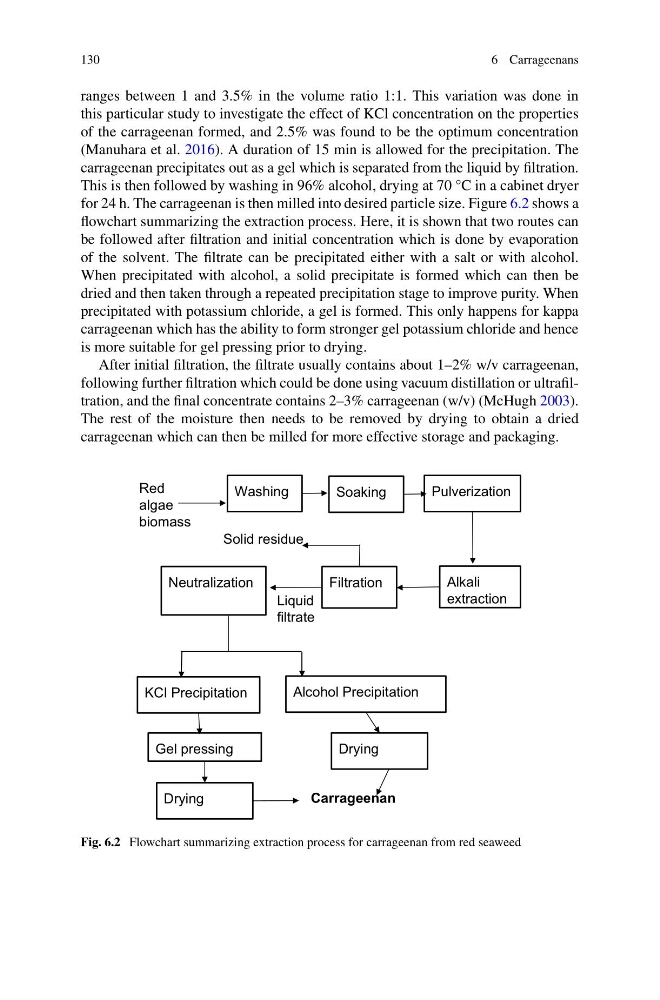
for 24 h. The carrageenan is then milled into desired particle size. Figure 6.2 shows a
flowchart summarizing the extraction process. Here, it is shown that two routes can
be followed after filtration and initial concentration which is done by evaporation
of the solvent. The filtrate can be precipitated either with a salt or with alcohol.
When precipitated with alcohol, a solid precipitate is formed which can then be
dried and then taken through a repeated precipitation stage to improve purity. When
precipitated with potassium chloride, a gel is formed. This only happens for kappa
carrageenan which has the ability to form stronger gel potassium chloride and hence
is more suitable for gel pressing prior to drying.
After initial filtration, the filtrate usually contains about 1–2% w/v carrageenan,
following further filtration which could be done using vacuum distillation or ultrafiltration, and the final concentrate contains 2–3% carrageenan (w/v) (McHugh 2003).
The rest of the moisture then needs to be removed by drying to obtain a dried
carrageenan which can then be milled for more effective storage and packaging.
Red
algae
biomass
Washing
Soaking
Pulverization
Alkali
extraction
Filtration
Neutralization
Solid residue
Liquid
filtrate
KCl Precipitation
Gel pressing
Drying
Alcohol Precipitation
Drying
Carrageenan
Fig. 6.2 Flowchart summarizing extraction process for carrageenan from red seaweed
6 Carrageenans
ranges between 1 and 3.5% in the volume ratio 1:1. This variation was done in
this particular study to investigate the effect of KCl concentration on the properties
of the carrageenan formed, and 2.5% was found to be the optimum concentration
(Manuhara et al. 2016). A duration of 15 min is allowed for the precipitation. The
carrageenan precipitates out as a gel which is separated from the liquid by filtration.
This is then followed by washing in 96% alcohol, drying at 70 °C in a cabinet dryer
for 24 h. The carrageenan is then milled into desired particle size. Figure 6.2 shows a
flowchart summarizing the extraction process. Here, it is shown that two routes can
be followed after filtration and initial concentration which is done by evaporation
of the solvent. The filtrate can be precipitated either with a salt or with alcohol.
When precipitated with alcohol, a solid precipitate is formed which can then be
dried and then taken through a repeated precipitation stage to improve purity. When
precipitated with potassium chloride, a gel is formed. This only happens for kappa
carrageenan which has the ability to form stronger gel potassium chloride and hence
is more suitable for gel pressing prior to drying.
After initial filtration, the filtrate usually contains about 1–2% w/v carrageenan,
following further filtration which could be done using vacuum distillation or ultrafiltration, and the final concentrate contains 2–3% carrageenan (w/v) (McHugh 2003).
The rest of the moisture then needs to be removed by drying to obtain a dried
carrageenan which can then be milled for more effective storage and packaging.
Red
algae
biomass
Washing
Soaking
Pulverization
Alkali
extraction
Filtration
Neutralization
Solid residue
Liquid
filtrate
KCl Precipitation
Gel pressing
Drying
Alcohol Precipitation
Drying
Carrageenan
Fig. 6.2 Flowchart summarizing extraction process for carrageenan from red seaweed