

126
6 Carrageenans
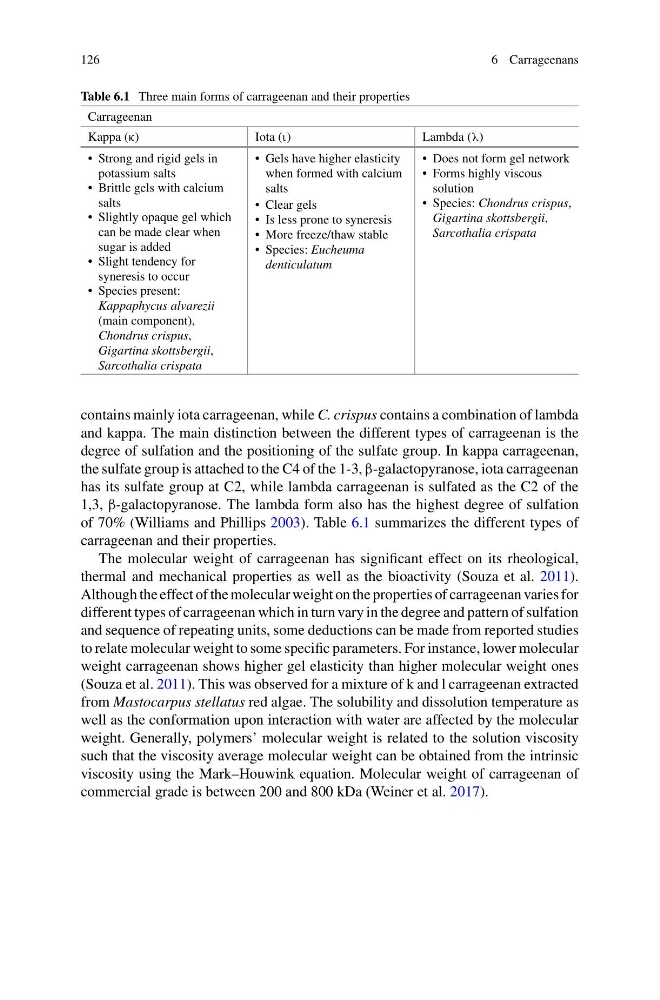
Table 6.1 Three main forms of carrageenan and their properties
Carrageenan
Kappa (κ)
Iota (ι)
Lambda (λ)
• Strong and rigid gels in
potassium salts
• Brittle gels with calcium
salts
• Slightly opaque gel which
can be made clear when
sugar is added
• Slight tendency for
syneresis to occur
• Species present:
Kappaphycus alvarezii
(main component),
Chondrus crispus,
Gigartina skottsbergii,
Sarcothalia crispata
• Gels have higher elasticity
when formed with calcium
salts
• Clear gels
• Is less prone to syneresis
• More freeze/thaw stable
• Species: Eucheuma
denticulatum
• Does not form gel network
• Forms highly viscous
solution
• Species: Chondrus crispus,
Gigartina skottsbergii,
Sarcothalia crispata
contains mainly iota carrageenan, while C. crispus contains a combination of lambda
and kappa. The main distinction between the different types of carrageenan is the
degree of sulfation and the positioning of the sulfate group. In kappa carrageenan,
the sulfate group is attached to the C4 of the 1-3, β-galactopyranose, iota carrageenan
has its sulfate group at C2, while lambda carrageenan is sulfated as the C2 of the
1,3, β-galactopyranose. The lambda form also has the highest degree of sulfation
of 70% (Williams and Phillips 2003). Table 6.1 summarizes the different types of
carrageenan and their properties.
The molecular weight of carrageenan has significant effect on its rheological,
thermal and mechanical properties as well as the bioactivity (Souza et al. 2011).
Although the effect of the molecular weight on the properties of carrageenan varies for
different types of carrageenan which in turn vary in the degree and pattern of sulfation
and sequence of repeating units, some deductions can be made from reported studies
to relate molecular weight to some specific parameters. For instance, lower molecular
weight carrageenan shows higher gel elasticity than higher molecular weight ones
(Souza et al. 2011). This was observed for a mixture of k and l carrageenan extracted
from Mastocarpus stellatus red algae. The solubility and dissolution temperature as
well as the conformation upon interaction with water are affected by the molecular
weight. Generally, polymers’ molecular weight is related to the solution viscosity
such that the viscosity average molecular weight can be obtained from the intrinsic
viscosity using the Mark–Houwink equation. Molecular weight of carrageenan of
commercial grade is between 200 and 800 kDa (Weiner et al. 2017).
6 Carrageenans
Table 6.1 Three main forms of carrageenan and their properties
Carrageenan
Kappa (κ)
Iota (ι)
Lambda (λ)
• Strong and rigid gels in
potassium salts
• Brittle gels with calcium
salts
• Slightly opaque gel which
can be made clear when
sugar is added
• Slight tendency for
syneresis to occur
• Species present:
Kappaphycus alvarezii
(main component),
Chondrus crispus,
Gigartina skottsbergii,
Sarcothalia crispata
• Gels have higher elasticity
when formed with calcium
salts
• Clear gels
• Is less prone to syneresis
• More freeze/thaw stable
• Species: Eucheuma
denticulatum
• Does not form gel network
• Forms highly viscous
solution
• Species: Chondrus crispus,
Gigartina skottsbergii,
Sarcothalia crispata
contains mainly iota carrageenan, while C. crispus contains a combination of lambda
and kappa. The main distinction between the different types of carrageenan is the
degree of sulfation and the positioning of the sulfate group. In kappa carrageenan,
the sulfate group is attached to the C4 of the 1-3, β-galactopyranose, iota carrageenan
has its sulfate group at C2, while lambda carrageenan is sulfated as the C2 of the
1,3, β-galactopyranose. The lambda form also has the highest degree of sulfation
of 70% (Williams and Phillips 2003). Table 6.1 summarizes the different types of
carrageenan and their properties.
The molecular weight of carrageenan has significant effect on its rheological,
thermal and mechanical properties as well as the bioactivity (Souza et al. 2011).
Although the effect of the molecular weight on the properties of carrageenan varies for
different types of carrageenan which in turn vary in the degree and pattern of sulfation
and sequence of repeating units, some deductions can be made from reported studies
to relate molecular weight to some specific parameters. For instance, lower molecular
weight carrageenan shows higher gel elasticity than higher molecular weight ones
(Souza et al. 2011). This was observed for a mixture of k and l carrageenan extracted
from Mastocarpus stellatus red algae. The solubility and dissolution temperature as
well as the conformation upon interaction with water are affected by the molecular
weight. Generally, polymers’ molecular weight is related to the solution viscosity
such that the viscosity average molecular weight can be obtained from the intrinsic
viscosity using the Mark–Houwink equation. Molecular weight of carrageenan of
commercial grade is between 200 and 800 kDa (Weiner et al. 2017).