

106
5 Fucoidan
5.6.2 Use of Mineral Acids
HCl is used at a relatively low concentration of 0.01M in the acid extraction method.
Since the acid is not chemically altered, it is washed out at the end of the process
and goes to the wastewater treatment. Even where it is neutralized, this eventually
results in increasing the mineral content of the aquatic environment where it does
not lead to direct acidification.
One way of eliminating or minimizing the need for acids in the process of the
extraction is to use enzymes. Enzyme extraction has been more commonly reported
for extraction of fucoidan from sea cucumber. This is due to the fact that sea cucumber
involves mainly proteolytic enzymes to dissolve the proteins within the tissue. Papain
is commonly used at a concentration of 15% (Qin et al. 2018). Enzyme extraction of
fucoidan from brown algae is less feasible as this would require the use of a variety
of enzymes such as alginate lyase enzymes to break down the alginate, proteolytic
enzymes to break down the protein and then cellulases to remove the cellulose.
5.6.3 Energy Consumption
The amount of energy consumed varies with extraction method. The enzyme method
using papain can be carried out at 50 °C which is lower than the temperature required
for the hot water extraction at 70–80 °C for longer time period. Meanwhile, the acid
extraction process can be carried out at room temperature (Sinurat et al. 2015).
Further energy is consumed in centrifugation process which for the enzyme process
is required at two different stages at 7441 × g for 20 min and at 4816 × g for 15 min.
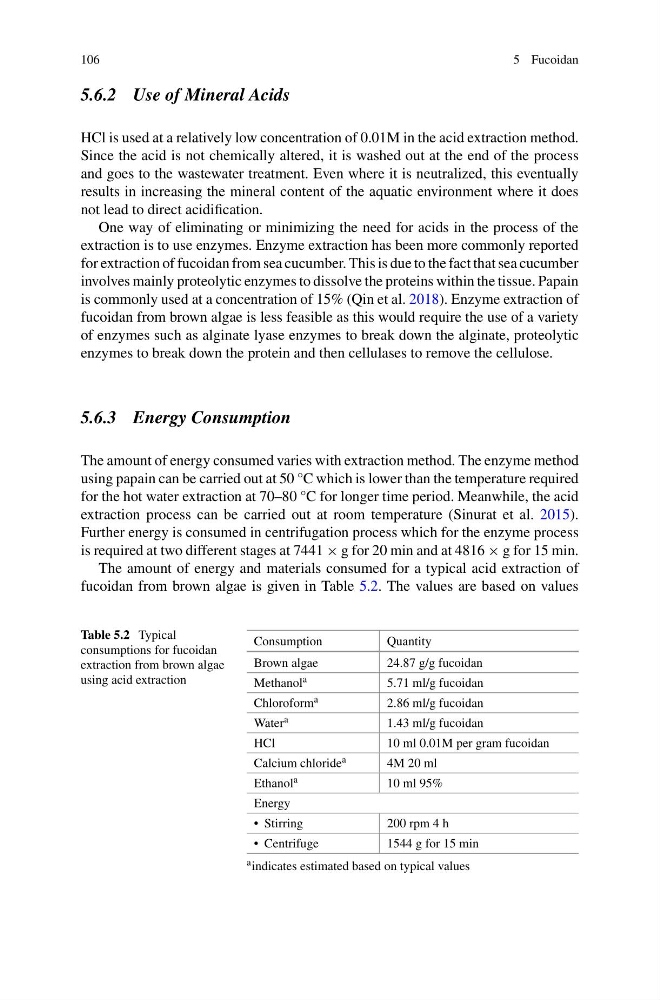
The amount of energy and materials consumed for a typical acid extraction of
fucoidan from brown algae is given in Table 5.2. The values are based on values
Table 5.2 Typical
consumptions for fucoidan
extraction from brown algae
using acid extraction
Consumption
Quantity
Brown algae
24.87 g/g fucoidan
Methanol a
5.71 ml/g fucoidan
Chloroform a
2.86 ml/g fucoidan
Water a
1.43 ml/g fucoidan
HCl
10 ml 0.01M per gram fucoidan
Calcium chloride a
4M 20 ml
Ethanol a
10 ml 95%
Energy
• Stirring
200 rpm 4 h
• Centrifuge
1544 g for 15 min
a indicates estimated based on typical values
5 Fucoidan
5.6.2 Use of Mineral Acids
HCl is used at a relatively low concentration of 0.01M in the acid extraction method.
Since the acid is not chemically altered, it is washed out at the end of the process
and goes to the wastewater treatment. Even where it is neutralized, this eventually
results in increasing the mineral content of the aquatic environment where it does
not lead to direct acidification.
One way of eliminating or minimizing the need for acids in the process of the
extraction is to use enzymes. Enzyme extraction has been more commonly reported
for extraction of fucoidan from sea cucumber. This is due to the fact that sea cucumber
involves mainly proteolytic enzymes to dissolve the proteins within the tissue. Papain
is commonly used at a concentration of 15% (Qin et al. 2018). Enzyme extraction of
fucoidan from brown algae is less feasible as this would require the use of a variety
of enzymes such as alginate lyase enzymes to break down the alginate, proteolytic
enzymes to break down the protein and then cellulases to remove the cellulose.
5.6.3 Energy Consumption
The amount of energy consumed varies with extraction method. The enzyme method
using papain can be carried out at 50 °C which is lower than the temperature required
for the hot water extraction at 70–80 °C for longer time period. Meanwhile, the acid
extraction process can be carried out at room temperature (Sinurat et al. 2015).
Further energy is consumed in centrifugation process which for the enzyme process
is required at two different stages at 7441 × g for 20 min and at 4816 × g for 15 min.
The amount of energy and materials consumed for a typical acid extraction of
fucoidan from brown algae is given in Table 5.2. The values are based on values
Table 5.2 Typical
consumptions for fucoidan
extraction from brown algae
using acid extraction
Consumption
Quantity
Brown algae
24.87 g/g fucoidan
Methanol a
5.71 ml/g fucoidan
Chloroform a
2.86 ml/g fucoidan
Water a
1.43 ml/g fucoidan
HCl
10 ml 0.01M per gram fucoidan
Calcium chloride a
4M 20 ml
Ethanol a
10 ml 95%
Energy
• Stirring
200 rpm 4 h
• Centrifuge
1544 g for 15 min
a indicates estimated based on typical values