

104
5 Fucoidan
5.5.4 Subcritical Water Extraction
This method of extraction has recently shown to result in fucoidan yield of 25.98%
from Nizamuddinia zanardinii when used at optimal temperature of 150 °C for 29 min
at a 21 g/mL biomass-to-water ratio (Alboofetileh et al. 2019). This is much higher
that yield from conventional extraction from a similar species. Evaluation of the
monosaccharide components of the extract of Nizamuddinia zanardinii using the
subcritical water extraction method showed 34.13% fucose, 30.70% mannose, 9.35%
xylose, 23.19% galactose and 2.65% glucose. The extracted fucose had an average
molecular weight of 694 kDa, indicating a medium molecular weight fucoidan. The
fucoidan extracted using this method showed some anticancer properties.
The effect of extraction methods on the structure of fucoidan could potentially
give more control over the structure of fucoidan. Following extraction of the crude
fucoidan, it is important to separate the non-fucoidan components from the crude
extracts and where desired separate the fucoidans into fraction in order to have
fractions of more uniform chain length and structures with similar bioactivities.
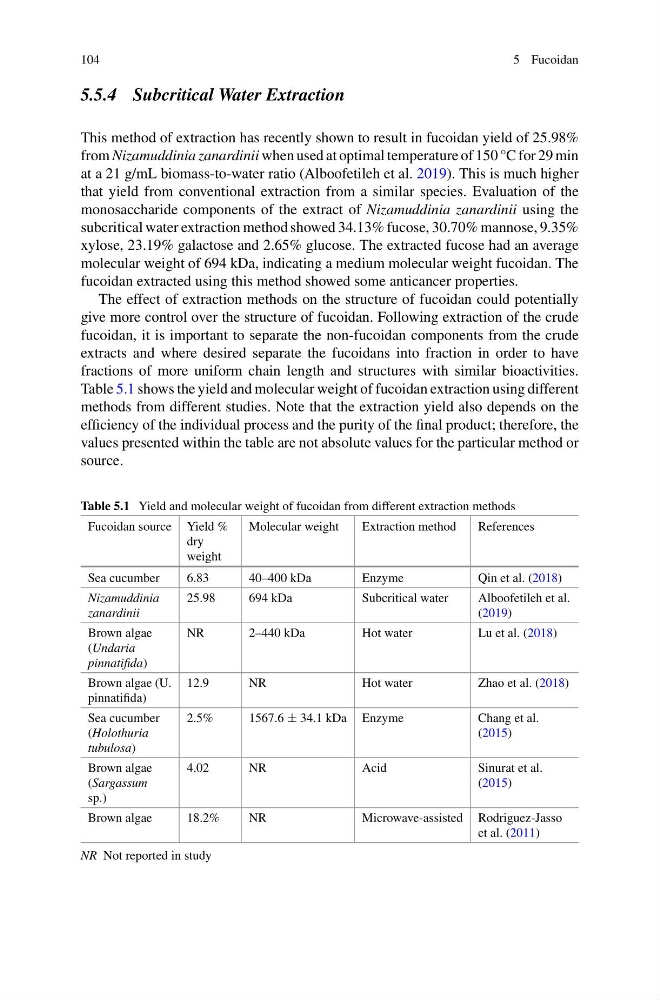
Table 5.1 shows the yield and molecular weight of fucoidan extraction using different
methods from different studies. Note that the extraction yield also depends on the
efficiency of the individual process and the purity of the final product; therefore, the
values presented within the table are not absolute values for the particular method or
source.
Table 5.1 Yield and molecular weight of fucoidan from different extraction methods
Fucoidan source Yield %
dry
weight
Molecular weight
Extraction method
References
Sea cucumber
6.83
40–400 kDa
Enzyme
Qin et al. (2018)
Nizamuddinia
zanardinii
25.98
694 kDa
Subcritical water
Alboofetileh et al.
(2019)
Brown algae
(Undaria
pinnatifida)
NR
2–440 kDa
Hot water
Lu et al. (2018)
Brown algae (U.
pinnatifida)
12.9
NR
Hot water
Zhao et al. (2018)
Sea cucumber
(Holothuria
tubulosa)
2.5%
1567.6 ± 34.1 kDa Enzyme
Chang et al.
(2015)
Brown algae
(Sargassum
sp.)
4.02
NR
Acid
Sinurat et al.
(2015)
Brown algae
18.2%
NR
Microwave-assisted Rodriguez-Jasso
et al. (2011)
NR Not reported in study
5 Fucoidan
5.5.4 Subcritical Water Extraction
This method of extraction has recently shown to result in fucoidan yield of 25.98%
from Nizamuddinia zanardinii when used at optimal temperature of 150 °C for 29 min
at a 21 g/mL biomass-to-water ratio (Alboofetileh et al. 2019). This is much higher
that yield from conventional extraction from a similar species. Evaluation of the
monosaccharide components of the extract of Nizamuddinia zanardinii using the
subcritical water extraction method showed 34.13% fucose, 30.70% mannose, 9.35%
xylose, 23.19% galactose and 2.65% glucose. The extracted fucose had an average
molecular weight of 694 kDa, indicating a medium molecular weight fucoidan. The
fucoidan extracted using this method showed some anticancer properties.
The effect of extraction methods on the structure of fucoidan could potentially
give more control over the structure of fucoidan. Following extraction of the crude
fucoidan, it is important to separate the non-fucoidan components from the crude
extracts and where desired separate the fucoidans into fraction in order to have
fractions of more uniform chain length and structures with similar bioactivities.
Table 5.1 shows the yield and molecular weight of fucoidan extraction using different
methods from different studies. Note that the extraction yield also depends on the
efficiency of the individual process and the purity of the final product; therefore, the
values presented within the table are not absolute values for the particular method or
source.
Table 5.1 Yield and molecular weight of fucoidan from different extraction methods
Fucoidan source Yield %
dry
weight
Molecular weight
Extraction method
References
Sea cucumber
6.83
40–400 kDa
Enzyme
Qin et al. (2018)
Nizamuddinia
zanardinii
25.98
694 kDa
Subcritical water
Alboofetileh et al.
(2019)
Brown algae
(Undaria
pinnatifida)
NR
2–440 kDa
Hot water
Lu et al. (2018)
Brown algae (U.
pinnatifida)
12.9
NR
Hot water
Zhao et al. (2018)
Sea cucumber
(Holothuria
tubulosa)
2.5%
1567.6 ± 34.1 kDa Enzyme
Chang et al.
(2015)
Brown algae
(Sargassum
sp.)
4.02
NR
Acid
Sinurat et al.
(2015)
Brown algae
18.2%
NR
Microwave-assisted Rodriguez-Jasso
et al. (2011)
NR Not reported in study