

98
5 Fucoidan
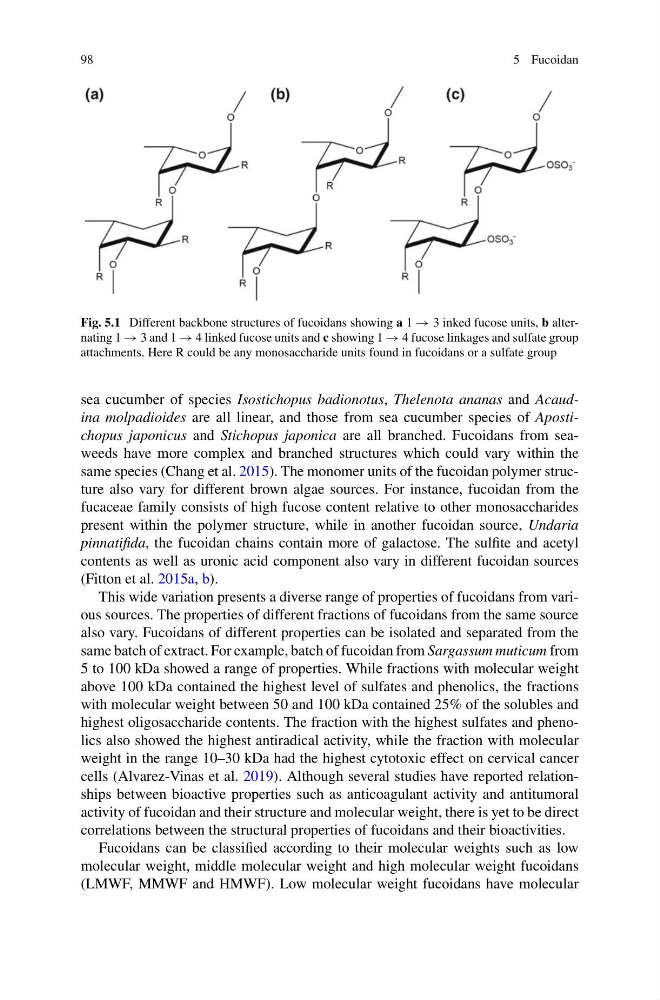
Fig. 5.1 Different backbone structures of fucoidans showing a 1 → 3 inked fucose units, b alternating 1 → 3 and 1 → 4 linked fucose units and c showing 1 → 4 fucose linkages and sulfate group
attachments. Here R could be any monosaccharide units found in fucoidans or a sulfate group
sea cucumber of species Isostichopus badionotus, Thelenota ananas and Acaudina molpadioides are all linear, and those from sea cucumber species of Apostichopus japonicus and Stichopus japonica are all branched. Fucoidans from seaweeds have more complex and branched structures which could vary within the
same species (Chang et al. 2015). The monomer units of the fucoidan polymer structure also vary for different brown algae sources. For instance, fucoidan from the
fucaceae family consists of high fucose content relative to other monosaccharides
present within the polymer structure, while in another fucoidan source, Undaria
pinnatifida, the fucoidan chains contain more of galactose. The sulfite and acetyl
contents as well as uronic acid component also vary in different fucoidan sources
(Fitton et al. 2015a, b).
This wide variation presents a diverse range of properties of fucoidans from various sources. The properties of different fractions of fucoidans from the same source
also vary. Fucoidans of different properties can be isolated and separated from the
same batch of extract. For example, batch of fucoidan from Sargassum muticum from
5 to 100 kDa showed a range of properties. While fractions with molecular weight
above 100 kDa contained the highest level of sulfates and phenolics, the fractions
with molecular weight between 50 and 100 kDa contained 25% of the solubles and
highest oligosaccharide contents. The fraction with the highest sulfates and phenolics also showed the highest antiradical activity, while the fraction with molecular
weight in the range 10–30 kDa had the highest cytotoxic effect on cervical cancer
cells (Alvarez-Vinas et al. 2019). Although several studies have reported relationships between bioactive properties such as anticoagulant activity and antitumoral
activity of fucoidan and their structure and molecular weight, there is yet to be direct
correlations between the structural properties of fucoidans and their bioactivities.
Fucoidans can be classified according to their molecular weights such as low
molecular weight, middle molecular weight and high molecular weight fucoidans
(LMWF, MMWF and HMWF). Low molecular weight fucoidans have molecular
5 Fucoidan
Fig. 5.1 Different backbone structures of fucoidans showing a 1 → 3 inked fucose units, b alternating 1 → 3 and 1 → 4 linked fucose units and c showing 1 → 4 fucose linkages and sulfate group
attachments. Here R could be any monosaccharide units found in fucoidans or a sulfate group
sea cucumber of species Isostichopus badionotus, Thelenota ananas and Acaudina molpadioides are all linear, and those from sea cucumber species of Apostichopus japonicus and Stichopus japonica are all branched. Fucoidans from seaweeds have more complex and branched structures which could vary within the
same species (Chang et al. 2015). The monomer units of the fucoidan polymer structure also vary for different brown algae sources. For instance, fucoidan from the
fucaceae family consists of high fucose content relative to other monosaccharides
present within the polymer structure, while in another fucoidan source, Undaria
pinnatifida, the fucoidan chains contain more of galactose. The sulfite and acetyl
contents as well as uronic acid component also vary in different fucoidan sources
(Fitton et al. 2015a, b).
This wide variation presents a diverse range of properties of fucoidans from various sources. The properties of different fractions of fucoidans from the same source
also vary. Fucoidans of different properties can be isolated and separated from the
same batch of extract. For example, batch of fucoidan from Sargassum muticum from
5 to 100 kDa showed a range of properties. While fractions with molecular weight
above 100 kDa contained the highest level of sulfates and phenolics, the fractions
with molecular weight between 50 and 100 kDa contained 25% of the solubles and
highest oligosaccharide contents. The fraction with the highest sulfates and phenolics also showed the highest antiradical activity, while the fraction with molecular
weight in the range 10–30 kDa had the highest cytotoxic effect on cervical cancer
cells (Alvarez-Vinas et al. 2019). Although several studies have reported relationships between bioactive properties such as anticoagulant activity and antitumoral
activity of fucoidan and their structure and molecular weight, there is yet to be direct
correlations between the structural properties of fucoidans and their bioactivities.
Fucoidans can be classified according to their molecular weights such as low
molecular weight, middle molecular weight and high molecular weight fucoidans
(LMWF, MMWF and HMWF). Low molecular weight fucoidans have molecular