

regulatory module. Both LIN28 and let-7 can also activate their
own expression. The dynamics of this regulatory circuit can be
modeled using ODEs as has been done previously for the EMT
regulatory circuit. These ODEs have been described in detail elsewhere [19]. The ODEs can be integrated numerically to obtain the
steady state expression levels of LIN28 and let-7 for different
concentrations of NF-κB. Three distinct phenotypes are evident
from this analysis—high LIN28, low LIN28, and intermediate
LIN28. LIN28 activates the expression of the pluripotency marker
OCT4 [84] and the stem cell state is characterized by the expression of OCT4 within a range—both very low and very high levels of
OCT4 expression lead to the loss of stemness [85–88]. Thus, only
cells with such intermediate levels of OCT4 expression can acquire
a cancer stem cell phenotype.
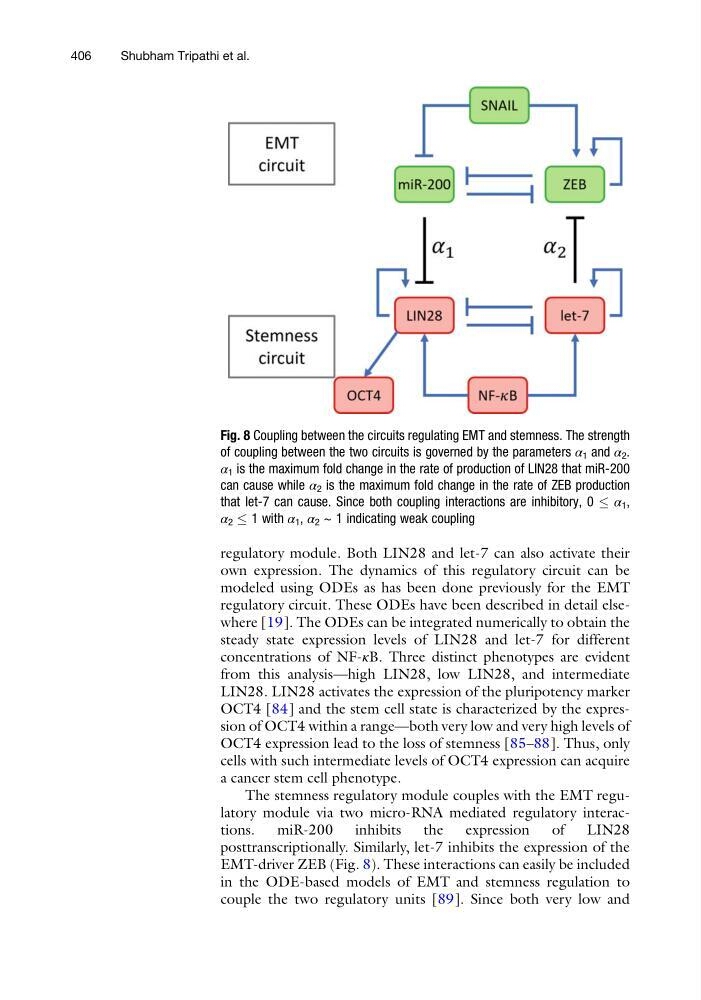
The stemness regulatory module couples with the EMT regulatory module via two micro-RNA mediated regulatory interactions.
miR-200
inhibits
the
expression
of
LIN28
posttranscriptionally. Similarly, let-7 inhibits the expression of the
EMT-driver ZEB (Fig. 8). These interactions can easily be included
in the ODE-based models of EMT and stemness regulation to
couple the two regulatory units [89]. Since both very low and
Fig. 8 Coupling between the circuits regulating EMT and stemness. The strength
of coupling between the two circuits is governed by the parameters α 1 and α 2 .
α 1 is the maximum fold change in the rate of production of LIN28 that miR-200
can cause while α 2 is the maximum fold change in the rate of ZEB production
that let-7 can cause. Since both coupling interactions are inhibitory, 0 α 1 ,
α 2 1 with α 1 , α 2 ~ 1 indicating weak coupling
406
Shubham Tripathi et al.
own expression. The dynamics of this regulatory circuit can be
modeled using ODEs as has been done previously for the EMT
regulatory circuit. These ODEs have been described in detail elsewhere [19]. The ODEs can be integrated numerically to obtain the
steady state expression levels of LIN28 and let-7 for different
concentrations of NF-κB. Three distinct phenotypes are evident
from this analysis—high LIN28, low LIN28, and intermediate
LIN28. LIN28 activates the expression of the pluripotency marker
OCT4 [84] and the stem cell state is characterized by the expression of OCT4 within a range—both very low and very high levels of
OCT4 expression lead to the loss of stemness [85–88]. Thus, only
cells with such intermediate levels of OCT4 expression can acquire
a cancer stem cell phenotype.
The stemness regulatory module couples with the EMT regulatory module via two micro-RNA mediated regulatory interactions.
miR-200
inhibits
the
expression
of
LIN28
posttranscriptionally. Similarly, let-7 inhibits the expression of the
EMT-driver ZEB (Fig. 8). These interactions can easily be included
in the ODE-based models of EMT and stemness regulation to
couple the two regulatory units [89]. Since both very low and
Fig. 8 Coupling between the circuits regulating EMT and stemness. The strength
of coupling between the two circuits is governed by the parameters α 1 and α 2 .
α 1 is the maximum fold change in the rate of production of LIN28 that miR-200
can cause while α 2 is the maximum fold change in the rate of ZEB production
that let-7 can cause. Since both coupling interactions are inhibitory, 0 α 1 ,
α 2 1 with α 1 , α 2 ~ 1 indicating weak coupling
406
Shubham Tripathi et al.