

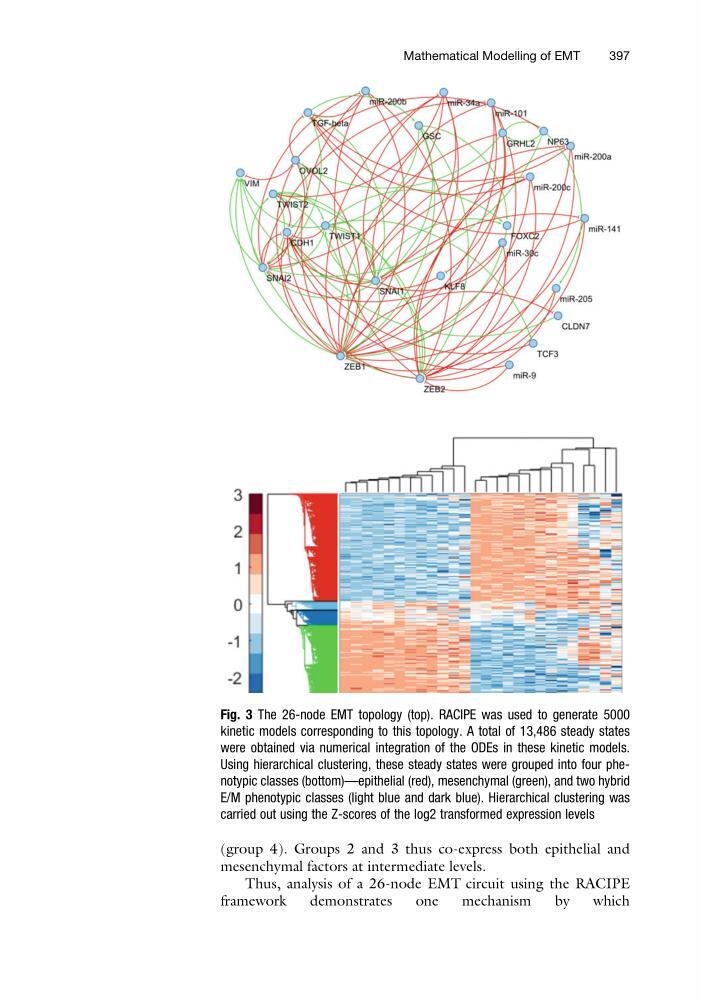
(group 4). Groups 2 and 3 thus co-express both epithelial and
mesenchymal factors at intermediate levels.
Thus, analysis of a 26-node EMT circuit using the RACIPE
framework
demonstrates
one
mechanism
by
which
Fig. 3 The 26-node EMT topology (top). RACIPE was used to generate 5000
kinetic models corresponding to this topology. A total of 13,486 steady states
were obtained via numerical integration of the ODEs in these kinetic models.
Using hierarchical clustering, these steady states were grouped into four phenotypic classes (bottom)—epithelial (red), mesenchymal (green), and two hybrid
E/M phenotypic classes (light blue and dark blue). Hierarchical clustering was
carried out using the Z-scores of the log2 transformed expression levels
Mathematical Modelling of EMT
397
mesenchymal factors at intermediate levels.
Thus, analysis of a 26-node EMT circuit using the RACIPE
framework
demonstrates
one
mechanism
by
which
Fig. 3 The 26-node EMT topology (top). RACIPE was used to generate 5000
kinetic models corresponding to this topology. A total of 13,486 steady states
were obtained via numerical integration of the ODEs in these kinetic models.
Using hierarchical clustering, these steady states were grouped into four phenotypic classes (bottom)—epithelial (red), mesenchymal (green), and two hybrid
E/M phenotypic classes (light blue and dark blue). Hierarchical clustering was
carried out using the Z-scores of the log2 transformed expression levels
Mathematical Modelling of EMT
397