

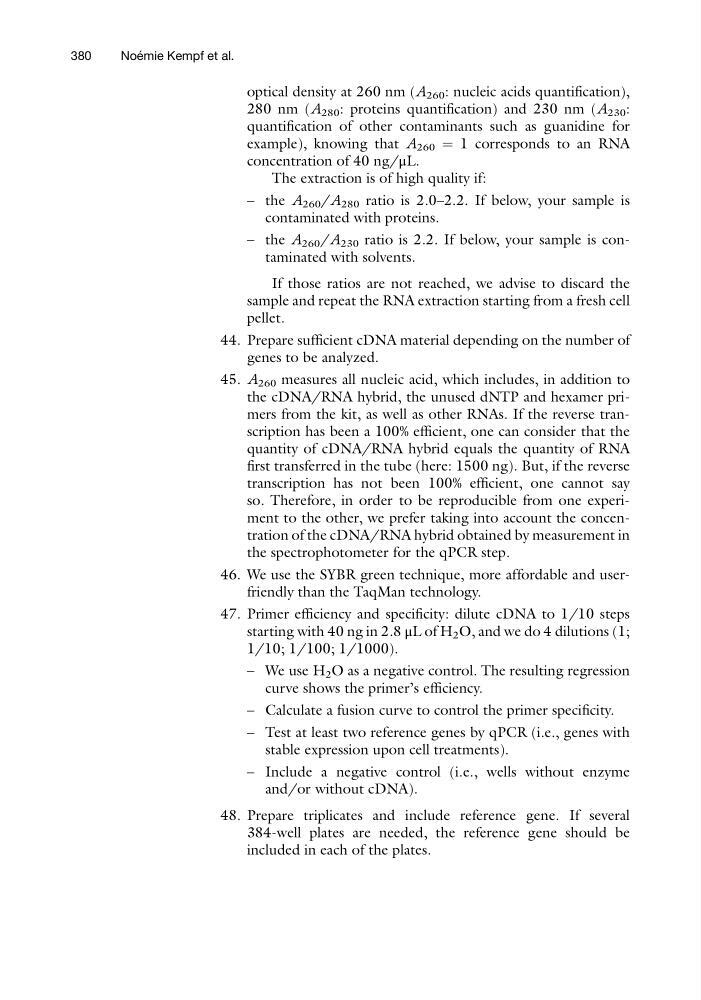
optical density at 260 nm (A 260 : nucleic acids quantification),
280 nm (A 280 : proteins quantification) and 230 nm (A 230 :
quantification of other contaminants such as guanidine for
example), knowing that A 260 ¼ 1 corresponds to an RNA
concentration of 40 ng/μL.
The extraction is of high quality if:
– the A 260 /A 280 ratio is 2.0–2.2. If below, your sample is
contaminated with proteins.
– the A 260 /A 230 ratio is 2.2. If below, your sample is contaminated with solvents.
If those ratios are not reached, we advise to discard the
sample and repeat the RNA extraction starting from a fresh cell
pellet.
44. Prepare sufficient cDNA material depending on the number of
genes to be analyzed.
45. A 260 measures all nucleic acid, which includes, in addition to
the cDNA/RNA hybrid, the unused dNTP and hexamer primers from the kit, as well as other RNAs. If the reverse transcription has been a 100% efficient, one can consider that the
quantity of cDNA/RNA hybrid equals the quantity of RNA
first transferred in the tube (here: 1500 ng). But, if the reverse
transcription has not been 100% efficient, one cannot say
so. Therefore, in order to be reproducible from one experiment to the other, we prefer taking into account the concentration of the cDNA/RNA hybrid obtained by measurement in
the spectrophotometer for the qPCR step.
46. We use the SYBR green technique, more affordable and userfriendly than the TaqMan technology.
47. Primer efficiency and specificity: dilute cDNA to 1/10 steps
starting with 40 ng in 2.8 μL of H 2 O, and we do 4 dilutions (1;
1/10; 1/100; 1/1000).
– We use H 2 O as a negative control. The resulting regression
curve shows the primer’s efficiency.
– Calculate a fusion curve to control the primer specificity.
– Test at least two reference genes by qPCR (i.e., genes with
stable expression upon cell treatments).
– Include a negative control (i.e., wells without enzyme
and/or without cDNA).
48. Prepare triplicates and include reference gene. If several
384-well plates are needed, the reference gene should be
included in each of the plates.
380
Noe ´ mie Kempf et al.
280 nm (A 280 : proteins quantification) and 230 nm (A 230 :
quantification of other contaminants such as guanidine for
example), knowing that A 260 ¼ 1 corresponds to an RNA
concentration of 40 ng/μL.
The extraction is of high quality if:
– the A 260 /A 280 ratio is 2.0–2.2. If below, your sample is
contaminated with proteins.
– the A 260 /A 230 ratio is 2.2. If below, your sample is contaminated with solvents.
If those ratios are not reached, we advise to discard the
sample and repeat the RNA extraction starting from a fresh cell
pellet.
44. Prepare sufficient cDNA material depending on the number of
genes to be analyzed.
45. A 260 measures all nucleic acid, which includes, in addition to
the cDNA/RNA hybrid, the unused dNTP and hexamer primers from the kit, as well as other RNAs. If the reverse transcription has been a 100% efficient, one can consider that the
quantity of cDNA/RNA hybrid equals the quantity of RNA
first transferred in the tube (here: 1500 ng). But, if the reverse
transcription has not been 100% efficient, one cannot say
so. Therefore, in order to be reproducible from one experiment to the other, we prefer taking into account the concentration of the cDNA/RNA hybrid obtained by measurement in
the spectrophotometer for the qPCR step.
46. We use the SYBR green technique, more affordable and userfriendly than the TaqMan technology.
47. Primer efficiency and specificity: dilute cDNA to 1/10 steps
starting with 40 ng in 2.8 μL of H 2 O, and we do 4 dilutions (1;
1/10; 1/100; 1/1000).
– We use H 2 O as a negative control. The resulting regression
curve shows the primer’s efficiency.
– Calculate a fusion curve to control the primer specificity.
– Test at least two reference genes by qPCR (i.e., genes with
stable expression upon cell treatments).
– Include a negative control (i.e., wells without enzyme
and/or without cDNA).
48. Prepare triplicates and include reference gene. If several
384-well plates are needed, the reference gene should be
included in each of the plates.
380
Noe ´ mie Kempf et al.