

41. Wash 3 Â 15 min in PBST on an orbital shaker with slow
motion.
42. We perform incubations with 20 mL diluted antibody, within
the small plastic box used for the washes.
43. Leave 1 h at room temperature on an orbital shaker with slow
motion.
44. Wash 3 Â 5 min in PBST before proceeding with revelation.
Finally, proceed with protein revelation (see steps 45–48)
(see Note 42).
45. Incubate the membrane with an appropriate volume of the
mix: we distribute the mix over a glass plate and dispose the
membrane over it, proteins turned toward the mix, taking care
not to introduce air bubbles between the membrane and
the mix.
46. Incubate for 1 min at room temperature. Absorb the excess of
liquid on a paper towel and display on your imaging system.
47. Expose as needed. For our system, usual exposure times
required with the antibodies dilutions mentioned above are:
3 min for N-cadherin, 1 min for E-cadherin, 10 s for occludin,
10 s for vimentin, and 5 s for H3.
48. Quantify the protein bands.
3.2.2 RT-qPCR
For all the RT-qPCR steps, we clean surfaces and material with
decontaminating solution against RNases such as RNAaseZap
(Ambion) or equivalent, we use RNase-free filtered tips to avoid
cross-contamination, and ultrapure autoclaved water (resistance at
18.2 MΩ·cm) that is RNase- and DNase-free. Perform RNA extraction following steps 1–4.
1. Total RNA from dry cell pellets stored at À80
C can be
extracted by using a ready-to-use kit.
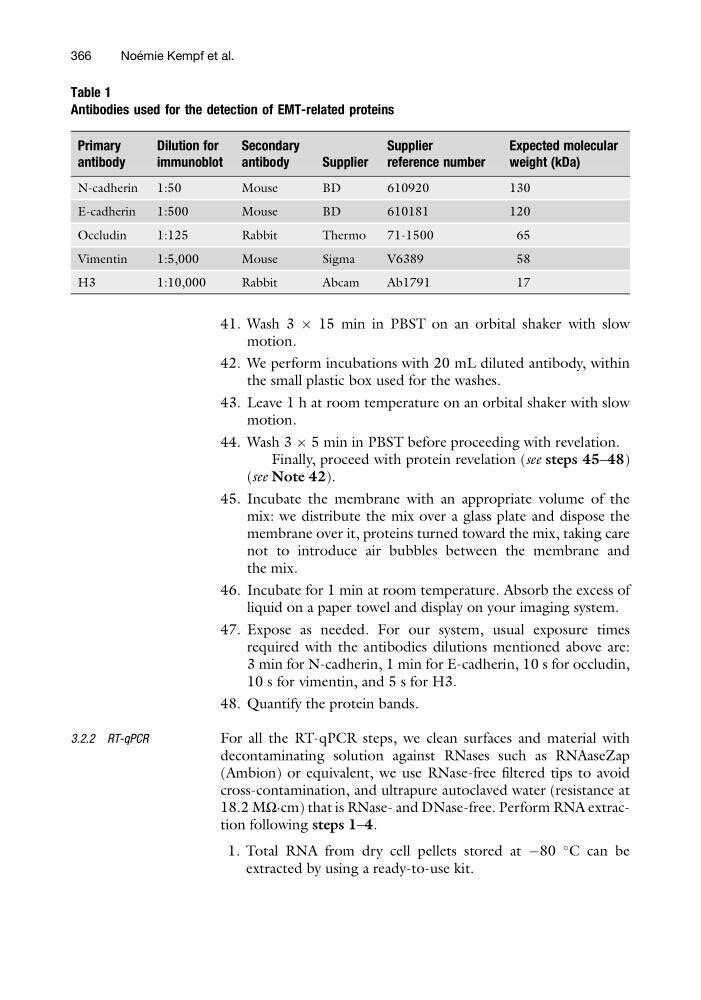
Table 1
Antibodies used for the detection of EMT-related proteins
Primary
antibody
Dilution for
immunoblot
Secondary
antibody
Supplier
Supplier
reference number
Expected molecular
weight (kDa)
N-cadherin
1:50
Mouse
BD
610920
130
E-cadherin
1:500
Mouse
BD
610181
120
Occludin
1:125
Rabbit
Thermo
71-1500
65
Vimentin
1:5,000
Mouse
Sigma
V6389
58
H3
1:10,000
Rabbit
Abcam
Ab1791
17
366
Noe ´ mie Kempf et al.
motion.
42. We perform incubations with 20 mL diluted antibody, within
the small plastic box used for the washes.
43. Leave 1 h at room temperature on an orbital shaker with slow
motion.
44. Wash 3 Â 5 min in PBST before proceeding with revelation.
Finally, proceed with protein revelation (see steps 45–48)
(see Note 42).
45. Incubate the membrane with an appropriate volume of the
mix: we distribute the mix over a glass plate and dispose the
membrane over it, proteins turned toward the mix, taking care
not to introduce air bubbles between the membrane and
the mix.
46. Incubate for 1 min at room temperature. Absorb the excess of
liquid on a paper towel and display on your imaging system.
47. Expose as needed. For our system, usual exposure times
required with the antibodies dilutions mentioned above are:
3 min for N-cadherin, 1 min for E-cadherin, 10 s for occludin,
10 s for vimentin, and 5 s for H3.
48. Quantify the protein bands.
3.2.2 RT-qPCR
For all the RT-qPCR steps, we clean surfaces and material with
decontaminating solution against RNases such as RNAaseZap
(Ambion) or equivalent, we use RNase-free filtered tips to avoid
cross-contamination, and ultrapure autoclaved water (resistance at
18.2 MΩ·cm) that is RNase- and DNase-free. Perform RNA extraction following steps 1–4.
1. Total RNA from dry cell pellets stored at À80
C can be
extracted by using a ready-to-use kit.
Table 1
Antibodies used for the detection of EMT-related proteins
Primary
antibody
Dilution for
immunoblot
Secondary
antibody
Supplier
Supplier
reference number
Expected molecular
weight (kDa)
N-cadherin
1:50
Mouse
BD
610920
130
E-cadherin
1:500
Mouse
BD
610181
120
Occludin
1:125
Rabbit
Thermo
71-1500
65
Vimentin
1:5,000
Mouse
Sigma
V6389
58
H3
1:10,000
Rabbit
Abcam
Ab1791
17
366
Noe ´ mie Kempf et al.