

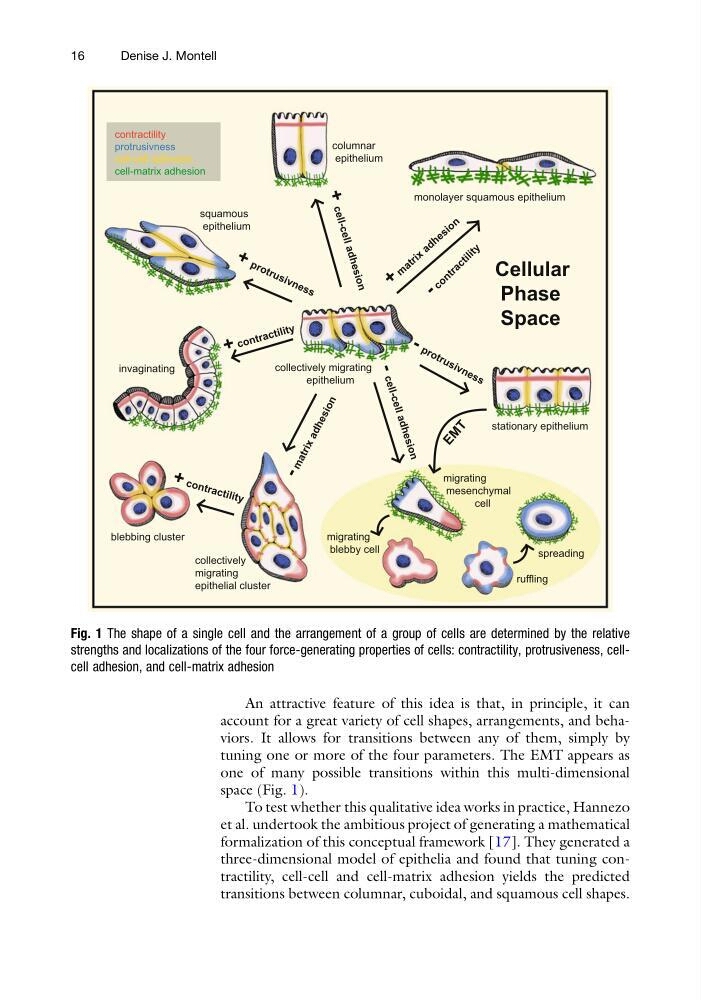
An attractive feature of this idea is that, in principle, it can
account for a great variety of cell shapes, arrangements, and behaviors. It allows for transitions between any of them, simply by
tuning one or more of the four parameters. The EMT appears as
one of many possible transitions within this multi-dimensional
space (Fig. 1).
To test whether this qualitative idea works in practice, Hannezo
et al. undertook the ambitious project of generating a mathematical
formalization of this conceptual framework [17]. They generated a
three-dimensional model of epithelia and found that tuning contractility, cell-cell and cell-matrix adhesion yields the predicted
transitions between columnar, cuboidal, and squamous cell shapes.
Cellular
Phase
Space
contractility
protrusivness
cell-cell adhesion
cell-matrix adhesion
columnar
epithelium
collectively migrating
epithelium
collectively
migrating
epithelial cluster
stationary epithelium
squamous
epithelium
monolayer squamous epithelium
invaginating
blebbing cluster
migrating
mesenchymal
cell
migrating
blebby cell
spreading
ruffling
E M
T
+ c e ll -c e ll a d h e s io n
+
m
a t r i x
a d h e s i o n
- p r o t r u s iv n e s s
-
c o n t r a c t i l i t y
+ c o n tr a c ti li ty
+ p r o t r u s iv n e s s
- c e
ll
-c
e
ll
a
d
h
e
s
io
n
- m a t r ix a d h e s io n
+ c o n tr a c ti li ty
Fig. 1 The shape of a single cell and the arrangement of a group of cells are determined by the relative
strengths and localizations of the four force-generating properties of cells: contractility, protrusiveness, cellcell adhesion, and cell-matrix adhesion
16
Denise J. Montell
account for a great variety of cell shapes, arrangements, and behaviors. It allows for transitions between any of them, simply by
tuning one or more of the four parameters. The EMT appears as
one of many possible transitions within this multi-dimensional
space (Fig. 1).
To test whether this qualitative idea works in practice, Hannezo
et al. undertook the ambitious project of generating a mathematical
formalization of this conceptual framework [17]. They generated a
three-dimensional model of epithelia and found that tuning contractility, cell-cell and cell-matrix adhesion yields the predicted
transitions between columnar, cuboidal, and squamous cell shapes.
Cellular
Phase
Space
contractility
protrusivness
cell-cell adhesion
cell-matrix adhesion
columnar
epithelium
collectively migrating
epithelium
collectively
migrating
epithelial cluster
stationary epithelium
squamous
epithelium
monolayer squamous epithelium
invaginating
blebbing cluster
migrating
mesenchymal
cell
migrating
blebby cell
spreading
ruffling
E M
T
+ c e ll -c e ll a d h e s io n
+
m
a t r i x
a d h e s i o n
- p r o t r u s iv n e s s
-
c o n t r a c t i l i t y
+ c o n tr a c ti li ty
+ p r o t r u s iv n e s s
- c e
ll
-c
e
ll
a
d
h
e
s
io
n
- m a t r ix a d h e s io n
+ c o n tr a c ti li ty
Fig. 1 The shape of a single cell and the arrangement of a group of cells are determined by the relative
strengths and localizations of the four force-generating properties of cells: contractility, protrusiveness, cellcell adhesion, and cell-matrix adhesion
16
Denise J. Montell