

3 Methods
3.1 Ex-Vivo Culture
of Xenopus Neural
Crest Cells
3.1.1 Extracellular Matrix
Preparation
1. Aliquot the Fibronectin solution as a 10Â stock by 20 or 50 μL
in 500 μL centrifuge tubes and store at À20
C. For coating on
glass coverslips, the 10Â stock is at 1 mg/mL. For coating on
plastic petri dishes, the 10Â stock is at 100 μg/mL. When
making the 10Â stock for plastic, use PBS1Â containing 0.1%
BSA for long-term stability of the solution.
2. On the day of the experiment, select a dish appropriate to your
microscope (see Note 3).
3. For glass dishes/coverslips dilute your Fibronectin in PBS1Â
to a final concentration of 100 μg/mL, for plastic, to 10 μg/
mL. Directly thaw the frozen aliquot of Fibronectin by adding
the required amount of PBS1Â at room temperature in the
Fibronectin aliquot. (e.g., add 450 μL of PBS1Â on top of a
50 μL aliquot of 10Â Fibronectin to obtain 500 μL of Fibronectin 1Â for coating) (see Note 4).
4. Place the dish on a heating block for 1 h at 37
C.
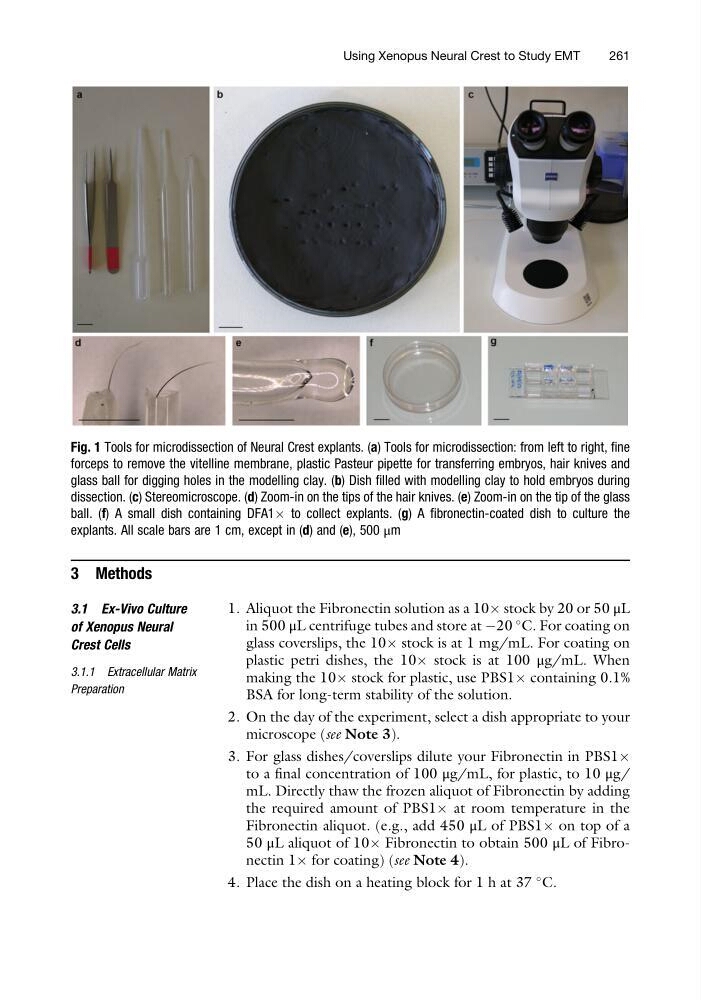
Fig. 1 Tools for microdissection of Neural Crest explants. (a) Tools for microdissection: from left to right, fine
forceps to remove the vitelline membrane, plastic Pasteur pipette for transferring embryos, hair knives and
glass ball for digging holes in the modelling clay. (b) Dish filled with modelling clay to hold embryos during
dissection. (c) Stereomicroscope. (d) Zoom-in on the tips of the hair knives. (e) Zoom-in on the tip of the glass
ball. (f) A small dish containing DFA1Â to collect explants. (g) A fibronectin-coated dish to culture the
explants. All scale bars are 1 cm, except in (d) and (e), 500 μm
Using Xenopus Neural Crest to Study EMT
261
3.1 Ex-Vivo Culture
of Xenopus Neural
Crest Cells
3.1.1 Extracellular Matrix
Preparation
1. Aliquot the Fibronectin solution as a 10Â stock by 20 or 50 μL
in 500 μL centrifuge tubes and store at À20
C. For coating on
glass coverslips, the 10Â stock is at 1 mg/mL. For coating on
plastic petri dishes, the 10Â stock is at 100 μg/mL. When
making the 10Â stock for plastic, use PBS1Â containing 0.1%
BSA for long-term stability of the solution.
2. On the day of the experiment, select a dish appropriate to your
microscope (see Note 3).
3. For glass dishes/coverslips dilute your Fibronectin in PBS1Â
to a final concentration of 100 μg/mL, for plastic, to 10 μg/
mL. Directly thaw the frozen aliquot of Fibronectin by adding
the required amount of PBS1Â at room temperature in the
Fibronectin aliquot. (e.g., add 450 μL of PBS1Â on top of a
50 μL aliquot of 10Â Fibronectin to obtain 500 μL of Fibronectin 1Â for coating) (see Note 4).
4. Place the dish on a heating block for 1 h at 37
C.
Fig. 1 Tools for microdissection of Neural Crest explants. (a) Tools for microdissection: from left to right, fine
forceps to remove the vitelline membrane, plastic Pasteur pipette for transferring embryos, hair knives and
glass ball for digging holes in the modelling clay. (b) Dish filled with modelling clay to hold embryos during
dissection. (c) Stereomicroscope. (d) Zoom-in on the tips of the hair knives. (e) Zoom-in on the tip of the glass
ball. (f) A small dish containing DFA1Â to collect explants. (g) A fibronectin-coated dish to culture the
explants. All scale bars are 1 cm, except in (d) and (e), 500 μm
Using Xenopus Neural Crest to Study EMT
261