

(e.g., ~30–40% for Ubx > netA.IR [21]) provide a very sensitive
background to detect mild suppression and enhancement effects.
We speculate that it is the nature of the pEMT event, that once a
perforation has formed there is a tendency for the disruption and
retraction of the PE to continue to completion, possibly because
the PE is under tension at the time of the pEMT [15]. Thus,
genetic perturbations that have a small effect on the formation of
perforation may have an amplified effect in terms of adult
phenotypes.
1. Create a new driver stock that incorporates the UAS RNAi
construct, the GAL4 driver, and the GAL80
ts construct, and
keep it at restrictive temperatures.
2. Cross this new driver stock to UAS RNAi stocks for other genes
and quantify the proportions of eversion defect categories to
see if phenotypic severity is increased or reduced.
B
C
A
F
F'
G
G'
G''
D
E
TM6B
lethal
double
single
cleft
normal
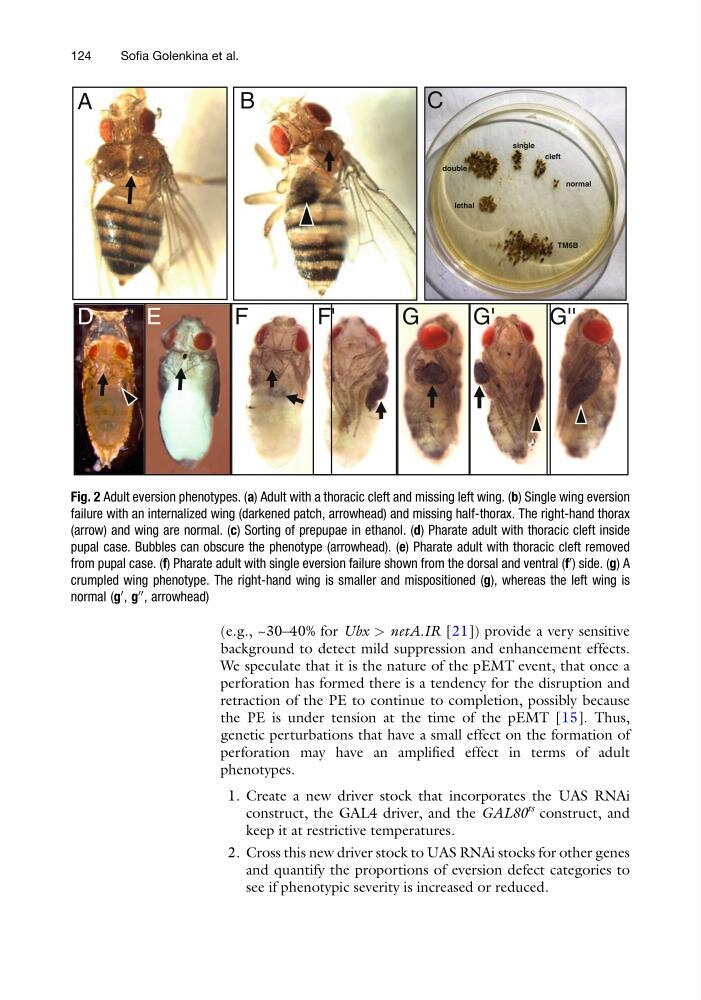
Fig. 2 Adult eversion phenotypes. (a) Adult with a thoracic cleft and missing left wing. (b) Single wing eversion
failure with an internalized wing (darkened patch, arrowhead) and missing half-thorax. The right-hand thorax
(arrow) and wing are normal. (c) Sorting of prepupae in ethanol. (d) Pharate adult with thoracic cleft inside
pupal case. Bubbles can obscure the phenotype (arrowhead). (e) Pharate adult with thoracic cleft removed
from pupal case. (f) Pharate adult with single eversion failure shown from the dorsal and ventral (f
0 ) side. (g) A
crumpled wing phenotype. The right-hand wing is smaller and mispositioned (g), whereas the left wing is
normal (g
0 , g
00 , arrowhead)
124
Sofia Golenkina et al.
background to detect mild suppression and enhancement effects.
We speculate that it is the nature of the pEMT event, that once a
perforation has formed there is a tendency for the disruption and
retraction of the PE to continue to completion, possibly because
the PE is under tension at the time of the pEMT [15]. Thus,
genetic perturbations that have a small effect on the formation of
perforation may have an amplified effect in terms of adult
phenotypes.
1. Create a new driver stock that incorporates the UAS RNAi
construct, the GAL4 driver, and the GAL80
ts construct, and
keep it at restrictive temperatures.
2. Cross this new driver stock to UAS RNAi stocks for other genes
and quantify the proportions of eversion defect categories to
see if phenotypic severity is increased or reduced.
B
C
A
F
F'
G
G'
G''
D
E
TM6B
lethal
double
single
cleft
normal
Fig. 2 Adult eversion phenotypes. (a) Adult with a thoracic cleft and missing left wing. (b) Single wing eversion
failure with an internalized wing (darkened patch, arrowhead) and missing half-thorax. The right-hand thorax
(arrow) and wing are normal. (c) Sorting of prepupae in ethanol. (d) Pharate adult with thoracic cleft inside
pupal case. Bubbles can obscure the phenotype (arrowhead). (e) Pharate adult with thoracic cleft removed
from pupal case. (f) Pharate adult with single eversion failure shown from the dorsal and ventral (f
0 ) side. (g) A
crumpled wing phenotype. The right-hand wing is smaller and mispositioned (g), whereas the left wing is
normal (g
0 , g
00 , arrowhead)
124
Sofia Golenkina et al.