

90
M. Maden
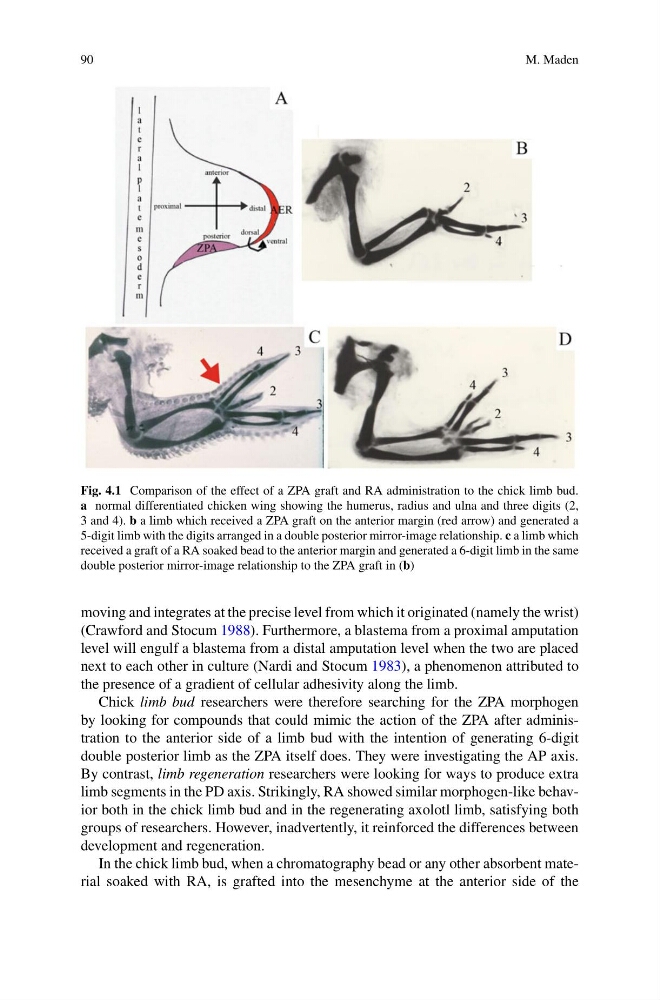
Fig. 4.1 Comparison of the effect of a ZPA graft and RA administration to the chick limb bud.
a normal differentiated chicken wing showing the humerus, radius and ulna and three digits (2,
3 and 4). b a limb which received a ZPA graft on the anterior margin (red arrow) and generated a
5-digit limb with the digits arranged in a double posterior mirror-image relationship. c a limb which
received a graft of a RA soaked bead to the anterior margin and generated a 6-digit limb in the same
double posterior mirror-image relationship to the ZPA graft in (b)
moving and integrates at the precise level from which it originated (namely the wrist)
(Crawford and Stocum 1988). Furthermore, a blastema from a proximal amputation
level will engulf a blastema from a distal amputation level when the two are placed
next to each other in culture (Nardi and Stocum 1983), a phenomenon attributed to
the presence of a gradient of cellular adhesivity along the limb.
Chick limb bud researchers were therefore searching for the ZPA morphogen
by looking for compounds that could mimic the action of the ZPA after administration to the anterior side of a limb bud with the intention of generating 6-digit
double posterior limb as the ZPA itself does. They were investigating the AP axis.
By contrast, limb regeneration researchers were looking for ways to produce extra
limb segments in the PD axis. Strikingly, RA showed similar morphogen-like behavior both in the chick limb bud and in the regenerating axolotl limb, satisfying both
groups of researchers. However, inadvertently, it reinforced the differences between
development and regeneration.
In the chick limb bud, when a chromatography bead or any other absorbent material soaked with RA, is grafted into the mesenchyme at the anterior side of the
M. Maden
Fig. 4.1 Comparison of the effect of a ZPA graft and RA administration to the chick limb bud.
a normal differentiated chicken wing showing the humerus, radius and ulna and three digits (2,
3 and 4). b a limb which received a ZPA graft on the anterior margin (red arrow) and generated a
5-digit limb with the digits arranged in a double posterior mirror-image relationship. c a limb which
received a graft of a RA soaked bead to the anterior margin and generated a 6-digit limb in the same
double posterior mirror-image relationship to the ZPA graft in (b)
moving and integrates at the precise level from which it originated (namely the wrist)
(Crawford and Stocum 1988). Furthermore, a blastema from a proximal amputation
level will engulf a blastema from a distal amputation level when the two are placed
next to each other in culture (Nardi and Stocum 1983), a phenomenon attributed to
the presence of a gradient of cellular adhesivity along the limb.
Chick limb bud researchers were therefore searching for the ZPA morphogen
by looking for compounds that could mimic the action of the ZPA after administration to the anterior side of a limb bud with the intention of generating 6-digit
double posterior limb as the ZPA itself does. They were investigating the AP axis.
By contrast, limb regeneration researchers were looking for ways to produce extra
limb segments in the PD axis. Strikingly, RA showed similar morphogen-like behavior both in the chick limb bud and in the regenerating axolotl limb, satisfying both
groups of researchers. However, inadvertently, it reinforced the differences between
development and regeneration.
In the chick limb bud, when a chromatography bead or any other absorbent material soaked with RA, is grafted into the mesenchyme at the anterior side of the