

3 Retinoic Acid-Regulated Target Genes During Development …
71
In conclusion, microarrays have been incredibly useful, but it must be stressed
that they have a number of limitations. First the signals are not quantitative as the
arrays become saturated at high DNA concentrations. Second they can only detect
sequences that are present on the array. Therefore, microarrays are being rapidly
replaced by the Next Generation Sequencing (NGS) technologies.
ChIP-On-Chip Analysis of RAR Binding Sites (ChIp-Chip)
The microarrays studies identified a large number of novel RA-regulated genes. However, they did not discriminate whether these genes are direct target genes (modulated
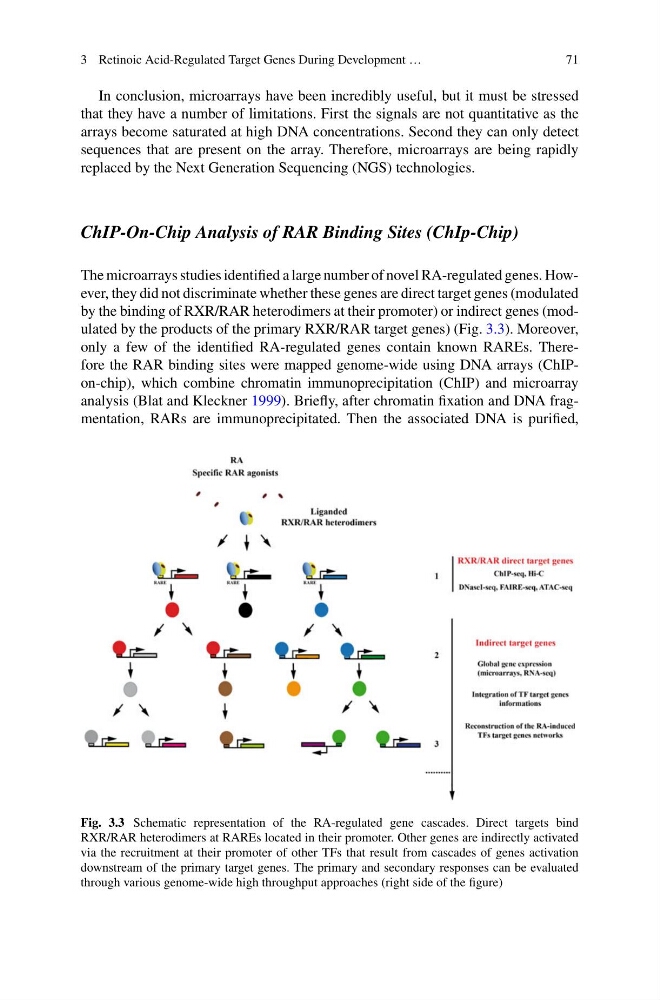
by the binding of RXR/RAR heterodimers at their promoter) or indirect genes (modulated by the products of the primary RXR/RAR target genes) (Fig. 3.3). Moreover,
only a few of the identified RA-regulated genes contain known RAREs. Therefore the RAR binding sites were mapped genome-wide using DNA arrays (ChIPon-chip), which combine chromatin immunoprecipitation (ChIP) and microarray
analysis (Blat and Kleckner 1999). Briefly, after chromatin fixation and DNA fragmentation, RARs are immunoprecipitated. Then the associated DNA is purified,
Fig. 3.3 Schematic representation of the RA-regulated gene cascades. Direct targets bind
RXR/RAR heterodimers at RAREs located in their promoter. Other genes are indirectly activated
via the recruitment at their promoter of other TFs that result from cascades of genes activation
downstream of the primary target genes. The primary and secondary responses can be evaluated
through various genome-wide high throughput approaches (right side of the figure)
71
In conclusion, microarrays have been incredibly useful, but it must be stressed
that they have a number of limitations. First the signals are not quantitative as the
arrays become saturated at high DNA concentrations. Second they can only detect
sequences that are present on the array. Therefore, microarrays are being rapidly
replaced by the Next Generation Sequencing (NGS) technologies.
ChIP-On-Chip Analysis of RAR Binding Sites (ChIp-Chip)
The microarrays studies identified a large number of novel RA-regulated genes. However, they did not discriminate whether these genes are direct target genes (modulated
by the binding of RXR/RAR heterodimers at their promoter) or indirect genes (modulated by the products of the primary RXR/RAR target genes) (Fig. 3.3). Moreover,
only a few of the identified RA-regulated genes contain known RAREs. Therefore the RAR binding sites were mapped genome-wide using DNA arrays (ChIPon-chip), which combine chromatin immunoprecipitation (ChIP) and microarray
analysis (Blat and Kleckner 1999). Briefly, after chromatin fixation and DNA fragmentation, RARs are immunoprecipitated. Then the associated DNA is purified,
Fig. 3.3 Schematic representation of the RA-regulated gene cascades. Direct targets bind
RXR/RAR heterodimers at RAREs located in their promoter. Other genes are indirectly activated
via the recruitment at their promoter of other TFs that result from cascades of genes activation
downstream of the primary target genes. The primary and secondary responses can be evaluated
through various genome-wide high throughput approaches (right side of the figure)