

40
L. Quadro and E. K. Spiegler
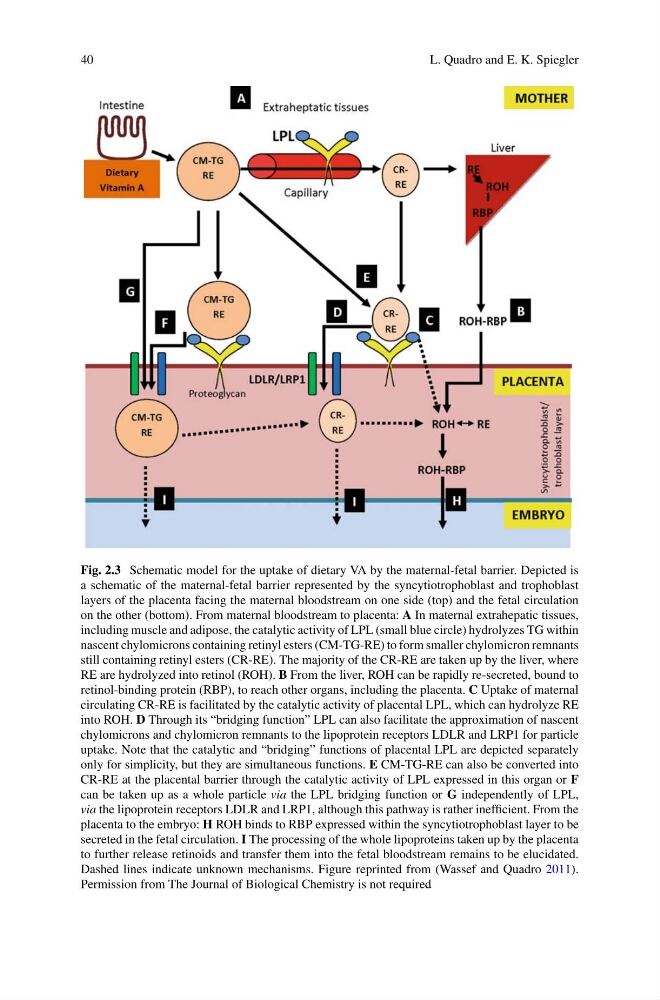
Fig. 2.3 Schematic model for the uptake of dietary VA by the maternal-fetal barrier. Depicted is
a schematic of the maternal-fetal barrier represented by the syncytiotrophoblast and trophoblast
layers of the placenta facing the maternal bloodstream on one side (top) and the fetal circulation
on the other (bottom). From maternal bloodstream to placenta: A In maternal extrahepatic tissues,
including muscle and adipose, the catalytic activity of LPL (small blue circle) hydrolyzes TG within
nascent chylomicrons containing retinyl esters (CM-TG-RE) to form smaller chylomicron remnants
still containing retinyl esters (CR-RE). The majority of the CR-RE are taken up by the liver, where
RE are hydrolyzed into retinol (ROH). B From the liver, ROH can be rapidly re-secreted, bound to
retinol-binding protein (RBP), to reach other organs, including the placenta. C Uptake of maternal
circulating CR-RE is facilitated by the catalytic activity of placental LPL, which can hydrolyze RE
into ROH. D Through its “bridging function” LPL can also facilitate the approximation of nascent
chylomicrons and chylomicron remnants to the lipoprotein receptors LDLR and LRP1 for particle
uptake. Note that the catalytic and “bridging” functions of placental LPL are depicted separately
only for simplicity, but they are simultaneous functions. E CM-TG-RE can also be converted into
CR-RE at the placental barrier through the catalytic activity of LPL expressed in this organ or F
can be taken up as a whole particle via the LPL bridging function or G independently of LPL,
via the lipoprotein receptors LDLR and LRP1, although this pathway is rather inefficient. From the
placenta to the embryo: H ROH binds to RBP expressed within the syncytiotrophoblast layer to be
secreted in the fetal circulation. I The processing of the whole lipoproteins taken up by the placenta
to further release retinoids and transfer them into the fetal bloodstream remains to be elucidated.
Dashed lines indicate unknown mechanisms. Figure reprinted from (Wassef and Quadro 2011).
Permission from The Journal of Biological Chemistry is not required
L. Quadro and E. K. Spiegler
Fig. 2.3 Schematic model for the uptake of dietary VA by the maternal-fetal barrier. Depicted is
a schematic of the maternal-fetal barrier represented by the syncytiotrophoblast and trophoblast
layers of the placenta facing the maternal bloodstream on one side (top) and the fetal circulation
on the other (bottom). From maternal bloodstream to placenta: A In maternal extrahepatic tissues,
including muscle and adipose, the catalytic activity of LPL (small blue circle) hydrolyzes TG within
nascent chylomicrons containing retinyl esters (CM-TG-RE) to form smaller chylomicron remnants
still containing retinyl esters (CR-RE). The majority of the CR-RE are taken up by the liver, where
RE are hydrolyzed into retinol (ROH). B From the liver, ROH can be rapidly re-secreted, bound to
retinol-binding protein (RBP), to reach other organs, including the placenta. C Uptake of maternal
circulating CR-RE is facilitated by the catalytic activity of placental LPL, which can hydrolyze RE
into ROH. D Through its “bridging function” LPL can also facilitate the approximation of nascent
chylomicrons and chylomicron remnants to the lipoprotein receptors LDLR and LRP1 for particle
uptake. Note that the catalytic and “bridging” functions of placental LPL are depicted separately
only for simplicity, but they are simultaneous functions. E CM-TG-RE can also be converted into
CR-RE at the placental barrier through the catalytic activity of LPL expressed in this organ or F
can be taken up as a whole particle via the LPL bridging function or G independently of LPL,
via the lipoprotein receptors LDLR and LRP1, although this pathway is rather inefficient. From the
placenta to the embryo: H ROH binds to RBP expressed within the syncytiotrophoblast layer to be
secreted in the fetal circulation. I The processing of the whole lipoproteins taken up by the placenta
to further release retinoids and transfer them into the fetal bloodstream remains to be elucidated.
Dashed lines indicate unknown mechanisms. Figure reprinted from (Wassef and Quadro 2011).
Permission from The Journal of Biological Chemistry is not required