

192
W. R. Jackman and Y. Gibert
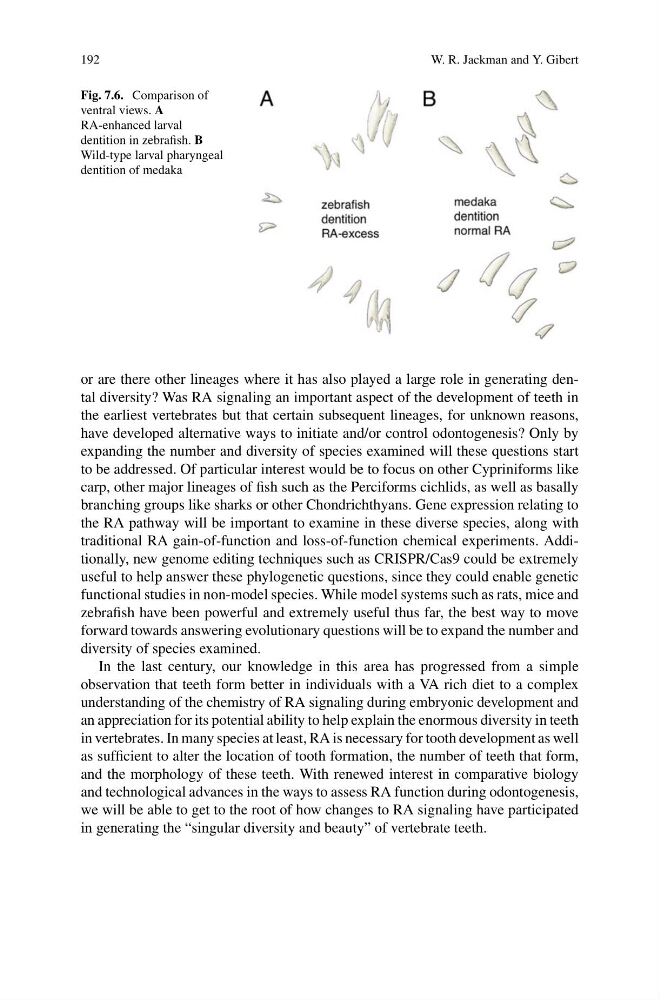
Fig. 7.6. Comparison of
ventral views. A
RA-enhanced larval
dentition in zebrafish. B
Wild-type larval pharyngeal
dentition of medaka
or are there other lineages where it has also played a large role in generating dental diversity? Was RA signaling an important aspect of the development of teeth in
the earliest vertebrates but that certain subsequent lineages, for unknown reasons,
have developed alternative ways to initiate and/or control odontogenesis? Only by
expanding the number and diversity of species examined will these questions start
to be addressed. Of particular interest would be to focus on other Cypriniforms like
carp, other major lineages of fish such as the Perciforms cichlids, as well as basally
branching groups like sharks or other Chondrichthyans. Gene expression relating to
the RA pathway will be important to examine in these diverse species, along with
traditional RA gain-of-function and loss-of-function chemical experiments. Additionally, new genome editing techniques such as CRISPR/Cas9 could be extremely
useful to help answer these phylogenetic questions, since they could enable genetic
functional studies in non-model species. While model systems such as rats, mice and
zebrafish have been powerful and extremely useful thus far, the best way to move
forward towards answering evolutionary questions will be to expand the number and
diversity of species examined.
In the last century, our knowledge in this area has progressed from a simple
observation that teeth form better in individuals with a VA rich diet to a complex
understanding of the chemistry of RA signaling during embryonic development and
an appreciation for its potential ability to help explain the enormous diversity in teeth
in vertebrates. In many species at least, RA is necessary for tooth development as well
as sufficient to alter the location of tooth formation, the number of teeth that form,
and the morphology of these teeth. With renewed interest in comparative biology
and technological advances in the ways to assess RA function during odontogenesis,
we will be able to get to the root of how changes to RA signaling have participated
in generating the “singular diversity and beauty” of vertebrate teeth.
W. R. Jackman and Y. Gibert
Fig. 7.6. Comparison of
ventral views. A
RA-enhanced larval
dentition in zebrafish. B
Wild-type larval pharyngeal
dentition of medaka
or are there other lineages where it has also played a large role in generating dental diversity? Was RA signaling an important aspect of the development of teeth in
the earliest vertebrates but that certain subsequent lineages, for unknown reasons,
have developed alternative ways to initiate and/or control odontogenesis? Only by
expanding the number and diversity of species examined will these questions start
to be addressed. Of particular interest would be to focus on other Cypriniforms like
carp, other major lineages of fish such as the Perciforms cichlids, as well as basally
branching groups like sharks or other Chondrichthyans. Gene expression relating to
the RA pathway will be important to examine in these diverse species, along with
traditional RA gain-of-function and loss-of-function chemical experiments. Additionally, new genome editing techniques such as CRISPR/Cas9 could be extremely
useful to help answer these phylogenetic questions, since they could enable genetic
functional studies in non-model species. While model systems such as rats, mice and
zebrafish have been powerful and extremely useful thus far, the best way to move
forward towards answering evolutionary questions will be to expand the number and
diversity of species examined.
In the last century, our knowledge in this area has progressed from a simple
observation that teeth form better in individuals with a VA rich diet to a complex
understanding of the chemistry of RA signaling during embryonic development and
an appreciation for its potential ability to help explain the enormous diversity in teeth
in vertebrates. In many species at least, RA is necessary for tooth development as well
as sufficient to alter the location of tooth formation, the number of teeth that form,
and the morphology of these teeth. With renewed interest in comparative biology
and technological advances in the ways to assess RA function during odontogenesis,
we will be able to get to the root of how changes to RA signaling have participated
in generating the “singular diversity and beauty” of vertebrate teeth.