

7 Retinoic Acid Signaling and the Zebrafish Dentition …
177
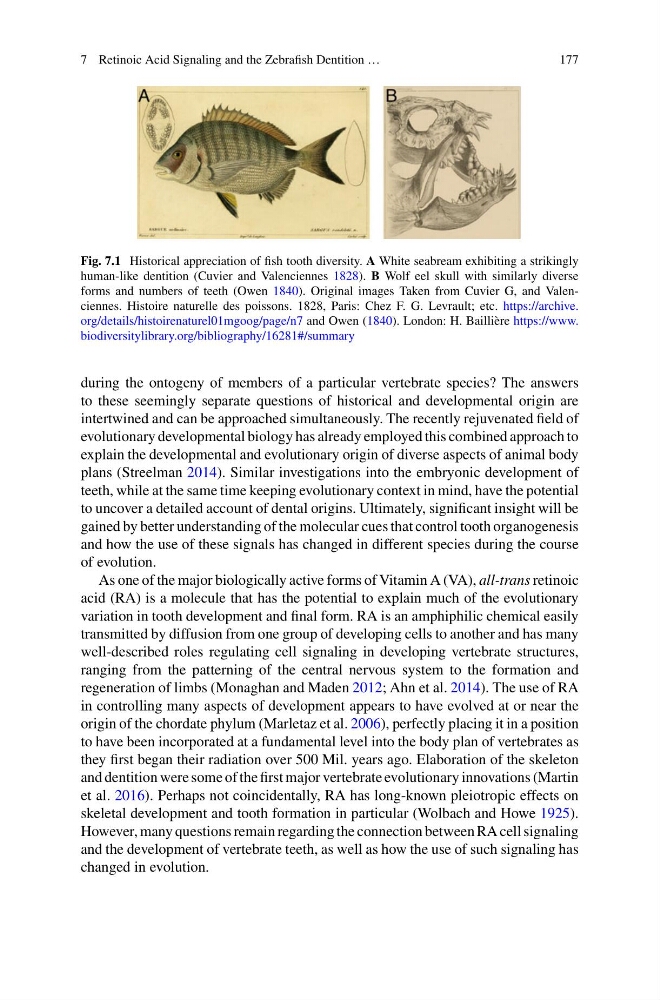
Fig. 7.1 Historical appreciation of fish tooth diversity. A White seabream exhibiting a strikingly
human-like dentition (Cuvier and Valenciennes 1828). B Wolf eel skull with similarly diverse
forms and numbers of teeth (Owen 1840). Original images Taken from Cuvier G, and Valenciennes. Histoire naturelle des poissons. 1828, Paris: Chez F. G. Levrault; etc. https://archive.
org/details/histoirenaturel01mgoog/page/n7 and Owen (1840). London: H. Baillière https://www.
biodiversitylibrary.org/bibliography/16281#/summary
during the ontogeny of members of a particular vertebrate species? The answers
to these seemingly separate questions of historical and developmental origin are
intertwined and can be approached simultaneously. The recently rejuvenated field of
evolutionary developmental biology has already employed this combined approach to
explain the developmental and evolutionary origin of diverse aspects of animal body
plans (Streelman 2014). Similar investigations into the embryonic development of
teeth, while at the same time keeping evolutionary context in mind, have the potential
to uncover a detailed account of dental origins. Ultimately, significant insight will be
gained by better understanding of the molecular cues that control tooth organogenesis
and how the use of these signals has changed in different species during the course
of evolution.
As one of the major biologically active forms of Vitamin A (VA), all-trans retinoic
acid (RA) is a molecule that has the potential to explain much of the evolutionary
variation in tooth development and final form. RA is an amphiphilic chemical easily
transmitted by diffusion from one group of developing cells to another and has many
well-described roles regulating cell signaling in developing vertebrate structures,
ranging from the patterning of the central nervous system to the formation and
regeneration of limbs (Monaghan and Maden 2012; Ahn et al. 2014). The use of RA
in controlling many aspects of development appears to have evolved at or near the
origin of the chordate phylum (Marletaz et al. 2006), perfectly placing it in a position
to have been incorporated at a fundamental level into the body plan of vertebrates as
they first began their radiation over 500 Mil. years ago. Elaboration of the skeleton
and dentition were some of the first major vertebrate evolutionary innovations (Martin
et al. 2016). Perhaps not coincidentally, RA has long-known pleiotropic effects on
skeletal development and tooth formation in particular (Wolbach and Howe 1925).
However, many questions remain regarding the connection between RA cell signaling
and the development of vertebrate teeth, as well as how the use of such signaling has
changed in evolution.
177
Fig. 7.1 Historical appreciation of fish tooth diversity. A White seabream exhibiting a strikingly
human-like dentition (Cuvier and Valenciennes 1828). B Wolf eel skull with similarly diverse
forms and numbers of teeth (Owen 1840). Original images Taken from Cuvier G, and Valenciennes. Histoire naturelle des poissons. 1828, Paris: Chez F. G. Levrault; etc. https://archive.
org/details/histoirenaturel01mgoog/page/n7 and Owen (1840). London: H. Baillière https://www.
biodiversitylibrary.org/bibliography/16281#/summary
during the ontogeny of members of a particular vertebrate species? The answers
to these seemingly separate questions of historical and developmental origin are
intertwined and can be approached simultaneously. The recently rejuvenated field of
evolutionary developmental biology has already employed this combined approach to
explain the developmental and evolutionary origin of diverse aspects of animal body
plans (Streelman 2014). Similar investigations into the embryonic development of
teeth, while at the same time keeping evolutionary context in mind, have the potential
to uncover a detailed account of dental origins. Ultimately, significant insight will be
gained by better understanding of the molecular cues that control tooth organogenesis
and how the use of these signals has changed in different species during the course
of evolution.
As one of the major biologically active forms of Vitamin A (VA), all-trans retinoic
acid (RA) is a molecule that has the potential to explain much of the evolutionary
variation in tooth development and final form. RA is an amphiphilic chemical easily
transmitted by diffusion from one group of developing cells to another and has many
well-described roles regulating cell signaling in developing vertebrate structures,
ranging from the patterning of the central nervous system to the formation and
regeneration of limbs (Monaghan and Maden 2012; Ahn et al. 2014). The use of RA
in controlling many aspects of development appears to have evolved at or near the
origin of the chordate phylum (Marletaz et al. 2006), perfectly placing it in a position
to have been incorporated at a fundamental level into the body plan of vertebrates as
they first began their radiation over 500 Mil. years ago. Elaboration of the skeleton
and dentition were some of the first major vertebrate evolutionary innovations (Martin
et al. 2016). Perhaps not coincidentally, RA has long-known pleiotropic effects on
skeletal development and tooth formation in particular (Wolbach and Howe 1925).
However, many questions remain regarding the connection between RA cell signaling
and the development of vertebrate teeth, as well as how the use of such signaling has
changed in evolution.