

6 Retinoic Acid Signaling and Development of the Respiratory System
169
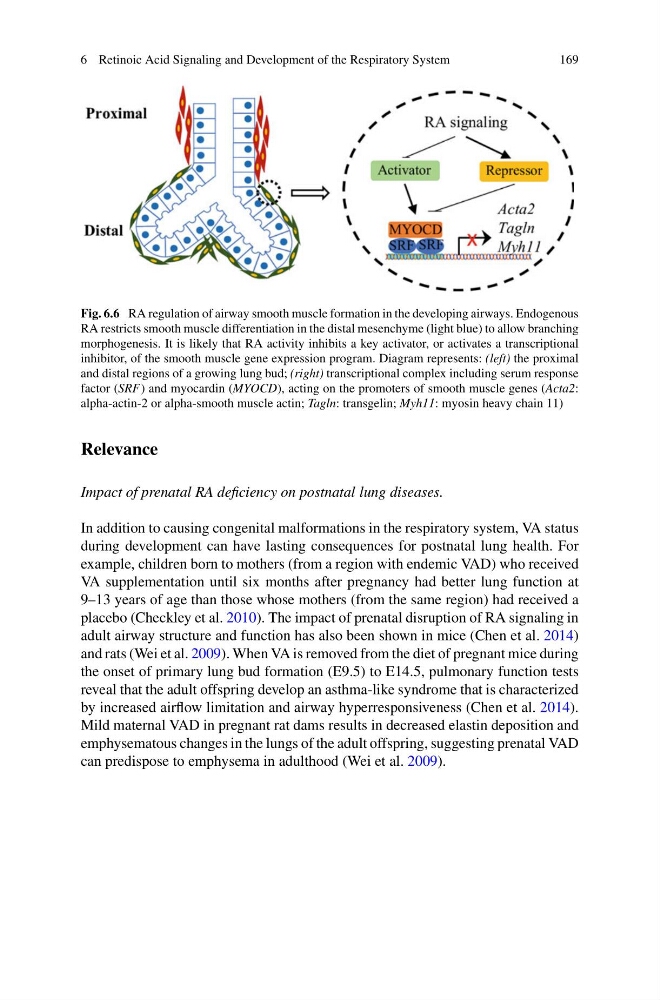
Fig. 6.6 RA regulation of airway smooth muscle formation in the developing airways. Endogenous
RA restricts smooth muscle differentiation in the distal mesenchyme (light blue) to allow branching
morphogenesis. It is likely that RA activity inhibits a key activator, or activates a transcriptional
inhibitor, of the smooth muscle gene expression program. Diagram represents: (left) the proximal
and distal regions of a growing lung bud; (right) transcriptional complex including serum response
factor (SRF) and myocardin (MYOCD), acting on the promoters of smooth muscle genes (Acta2:
alpha-actin-2 or alpha-smooth muscle actin; Tagln: transgelin; Myh11: myosin heavy chain 11)
Relevance
Impact of prenatal RA deficiency on postnatal lung diseases.
In addition to causing congenital malformations in the respiratory system, VA status
during development can have lasting consequences for postnatal lung health. For
example, children born to mothers (from a region with endemic VAD) who received
VA supplementation until six months after pregnancy had better lung function at
9–13 years of age than those whose mothers (from the same region) had received a
placebo (Checkley et al. 2010). The impact of prenatal disruption of RA signaling in
adult airway structure and function has also been shown in mice (Chen et al. 2014)
and rats (Wei et al. 2009). When VA is removed from the diet of pregnant mice during
the onset of primary lung bud formation (E9.5) to E14.5, pulmonary function tests
reveal that the adult offspring develop an asthma-like syndrome that is characterized
by increased airflow limitation and airway hyperresponsiveness (Chen et al. 2014).
Mild maternal VAD in pregnant rat dams results in decreased elastin deposition and
emphysematous changes in the lungs of the adult offspring, suggesting prenatal VAD
can predispose to emphysema in adulthood (Wei et al. 2009).
169
Fig. 6.6 RA regulation of airway smooth muscle formation in the developing airways. Endogenous
RA restricts smooth muscle differentiation in the distal mesenchyme (light blue) to allow branching
morphogenesis. It is likely that RA activity inhibits a key activator, or activates a transcriptional
inhibitor, of the smooth muscle gene expression program. Diagram represents: (left) the proximal
and distal regions of a growing lung bud; (right) transcriptional complex including serum response
factor (SRF) and myocardin (MYOCD), acting on the promoters of smooth muscle genes (Acta2:
alpha-actin-2 or alpha-smooth muscle actin; Tagln: transgelin; Myh11: myosin heavy chain 11)
Relevance
Impact of prenatal RA deficiency on postnatal lung diseases.
In addition to causing congenital malformations in the respiratory system, VA status
during development can have lasting consequences for postnatal lung health. For
example, children born to mothers (from a region with endemic VAD) who received
VA supplementation until six months after pregnancy had better lung function at
9–13 years of age than those whose mothers (from the same region) had received a
placebo (Checkley et al. 2010). The impact of prenatal disruption of RA signaling in
adult airway structure and function has also been shown in mice (Chen et al. 2014)
and rats (Wei et al. 2009). When VA is removed from the diet of pregnant mice during
the onset of primary lung bud formation (E9.5) to E14.5, pulmonary function tests
reveal that the adult offspring develop an asthma-like syndrome that is characterized
by increased airflow limitation and airway hyperresponsiveness (Chen et al. 2014).
Mild maternal VAD in pregnant rat dams results in decreased elastin deposition and
emphysematous changes in the lungs of the adult offspring, suggesting prenatal VAD
can predispose to emphysema in adulthood (Wei et al. 2009).