

6 Retinoic Acid Signaling and Development of the Respiratory System
167
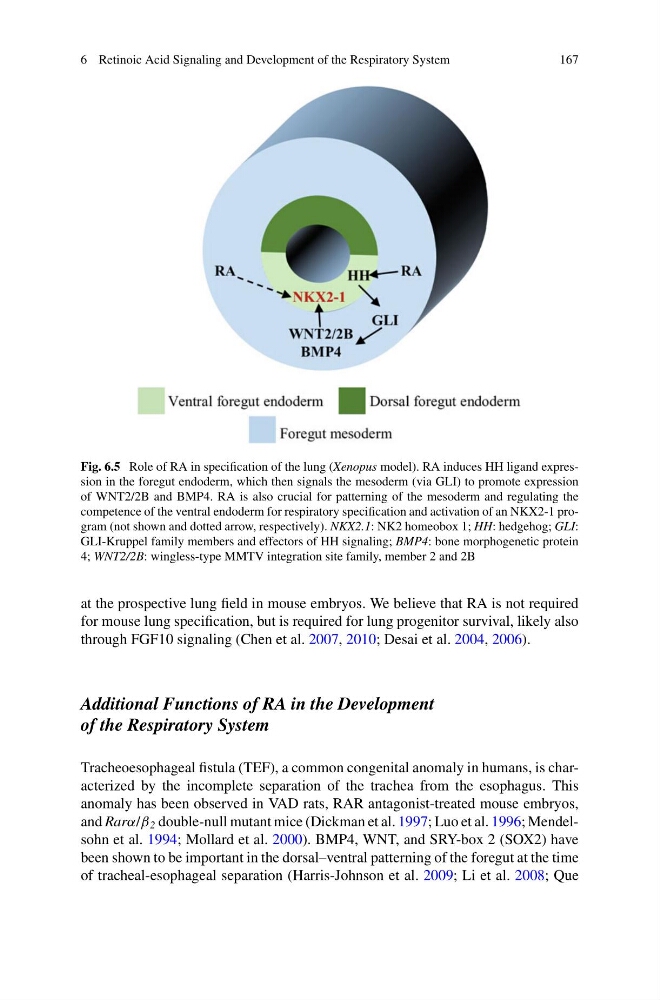
Fig. 6.5 Role of RA in specification of the lung (Xenopus model). RA induces HH ligand expression in the foregut endoderm, which then signals the mesoderm (via GLI) to promote expression
of WNT2/2B and BMP4. RA is also crucial for patterning of the mesoderm and regulating the
competence of the ventral endoderm for respiratory specification and activation of an NKX2-1 program (not shown and dotted arrow, respectively). NKX2.1: NK2 homeobox 1; HH: hedgehog; GLI:
GLI-Kruppel family members and effectors of HH signaling; BMP4: bone morphogenetic protein
4; WNT2/2B: wingless-type MMTV integration site family, member 2 and 2B
at the prospective lung field in mouse embryos. We believe that RA is not required
for mouse lung specification, but is required for lung progenitor survival, likely also
through FGF10 signaling (Chen et al. 2007, 2010; Desai et al. 2004, 2006).
Additional Functions of RA in the Development
of the Respiratory System
Tracheoesophageal fistula (TEF), a common congenital anomaly in humans, is characterized by the incomplete separation of the trachea from the esophagus. This
anomaly has been observed in VAD rats, RAR antagonist-treated mouse embryos,
and Rarα/β 2 double-null mutant mice (Dickman et al. 1997; Luo et al. 1996; Mendelsohn et al. 1994; Mollard et al. 2000). BMP4, WNT, and SRY-box 2 (SOX2) have
been shown to be important in the dorsal–ventral patterning of the foregut at the time
of tracheal-esophageal separation (Harris-Johnson et al. 2009; Li et al. 2008; Que
167
Fig. 6.5 Role of RA in specification of the lung (Xenopus model). RA induces HH ligand expression in the foregut endoderm, which then signals the mesoderm (via GLI) to promote expression
of WNT2/2B and BMP4. RA is also crucial for patterning of the mesoderm and regulating the
competence of the ventral endoderm for respiratory specification and activation of an NKX2-1 program (not shown and dotted arrow, respectively). NKX2.1: NK2 homeobox 1; HH: hedgehog; GLI:
GLI-Kruppel family members and effectors of HH signaling; BMP4: bone morphogenetic protein
4; WNT2/2B: wingless-type MMTV integration site family, member 2 and 2B
at the prospective lung field in mouse embryos. We believe that RA is not required
for mouse lung specification, but is required for lung progenitor survival, likely also
through FGF10 signaling (Chen et al. 2007, 2010; Desai et al. 2004, 2006).
Additional Functions of RA in the Development
of the Respiratory System
Tracheoesophageal fistula (TEF), a common congenital anomaly in humans, is characterized by the incomplete separation of the trachea from the esophagus. This
anomaly has been observed in VAD rats, RAR antagonist-treated mouse embryos,
and Rarα/β 2 double-null mutant mice (Dickman et al. 1997; Luo et al. 1996; Mendelsohn et al. 1994; Mollard et al. 2000). BMP4, WNT, and SRY-box 2 (SOX2) have
been shown to be important in the dorsal–ventral patterning of the foregut at the time
of tracheal-esophageal separation (Harris-Johnson et al. 2009; Li et al. 2008; Que