

158
H. A. Marquez and F. Chen
form a lumen. Starting on E15.0, epithelial cells lining the parabronchial lumen
form pouches (atria), which in turn give off infundibula (beginning on E16.0), follow by air capillaries (starts on E18.0) in quick succession. The blood capillaries
begin to form on E18.0. At hatching (~E21), a thin blood-gas barrier has formed
between air and blood capillaries. Growth of the gas-exchange tissue continues to
occur post-hatching. In some avian species, lung development completes just before
the bird begins to fly (Hsia et al. 2013).
Retinoid Deficiency Produces Respiratory System Birth Defects
Nutritional and genetically-induced retinoid deficiency that restricts the availability
of suitable amounts of vitamin A (VA) or retinoic acid (RA) during embryogenesis is associated with defective development of the respiratory system in different
species of mammals, including mice (Mendelsohn et al. 1994; Niederreither et al.
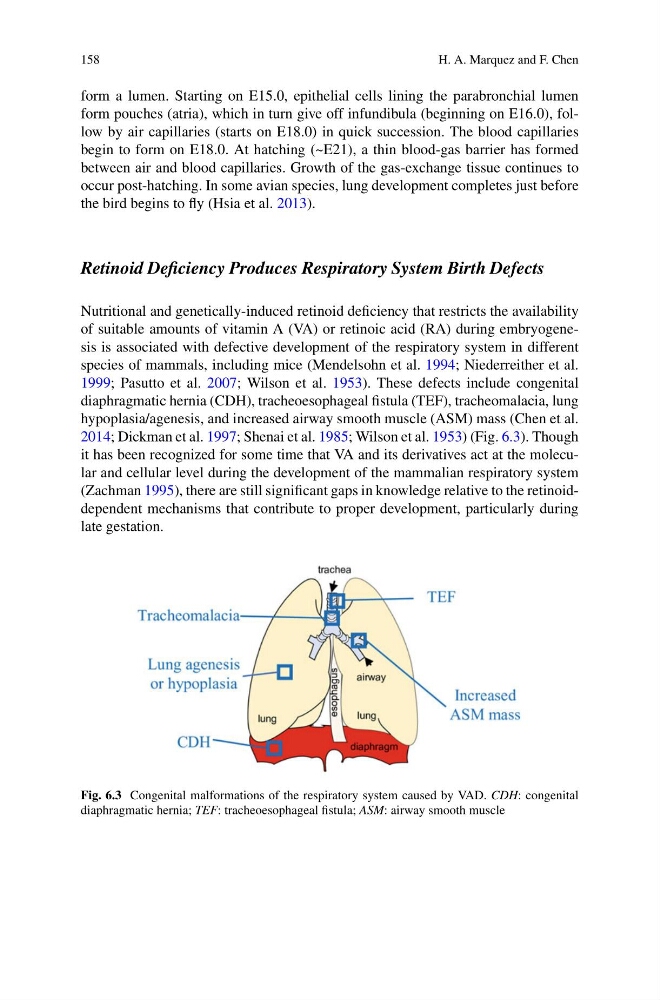
1999; Pasutto et al. 2007; Wilson et al. 1953). These defects include congenital
diaphragmatic hernia (CDH), tracheoesophageal fistula (TEF), tracheomalacia, lung
hypoplasia/agenesis, and increased airway smooth muscle (ASM) mass (Chen et al.
2014; Dickman et al. 1997; Shenai et al. 1985; Wilson et al. 1953) (Fig. 6.3). Though
it has been recognized for some time that VA and its derivatives act at the molecular and cellular level during the development of the mammalian respiratory system
(Zachman 1995), there are still significant gaps in knowledge relative to the retinoiddependent mechanisms that contribute to proper development, particularly during
late gestation.
Fig. 6.3 Congenital malformations of the respiratory system caused by VAD. CDH: congenital
diaphragmatic hernia; TEF: tracheoesophageal fistula; ASM: airway smooth muscle
H. A. Marquez and F. Chen
form a lumen. Starting on E15.0, epithelial cells lining the parabronchial lumen
form pouches (atria), which in turn give off infundibula (beginning on E16.0), follow by air capillaries (starts on E18.0) in quick succession. The blood capillaries
begin to form on E18.0. At hatching (~E21), a thin blood-gas barrier has formed
between air and blood capillaries. Growth of the gas-exchange tissue continues to
occur post-hatching. In some avian species, lung development completes just before
the bird begins to fly (Hsia et al. 2013).
Retinoid Deficiency Produces Respiratory System Birth Defects
Nutritional and genetically-induced retinoid deficiency that restricts the availability
of suitable amounts of vitamin A (VA) or retinoic acid (RA) during embryogenesis is associated with defective development of the respiratory system in different
species of mammals, including mice (Mendelsohn et al. 1994; Niederreither et al.
1999; Pasutto et al. 2007; Wilson et al. 1953). These defects include congenital
diaphragmatic hernia (CDH), tracheoesophageal fistula (TEF), tracheomalacia, lung
hypoplasia/agenesis, and increased airway smooth muscle (ASM) mass (Chen et al.
2014; Dickman et al. 1997; Shenai et al. 1985; Wilson et al. 1953) (Fig. 6.3). Though
it has been recognized for some time that VA and its derivatives act at the molecular and cellular level during the development of the mammalian respiratory system
(Zachman 1995), there are still significant gaps in knowledge relative to the retinoiddependent mechanisms that contribute to proper development, particularly during
late gestation.
Fig. 6.3 Congenital malformations of the respiratory system caused by VAD. CDH: congenital
diaphragmatic hernia; TEF: tracheoesophageal fistula; ASM: airway smooth muscle