

78
R. Chen et al.
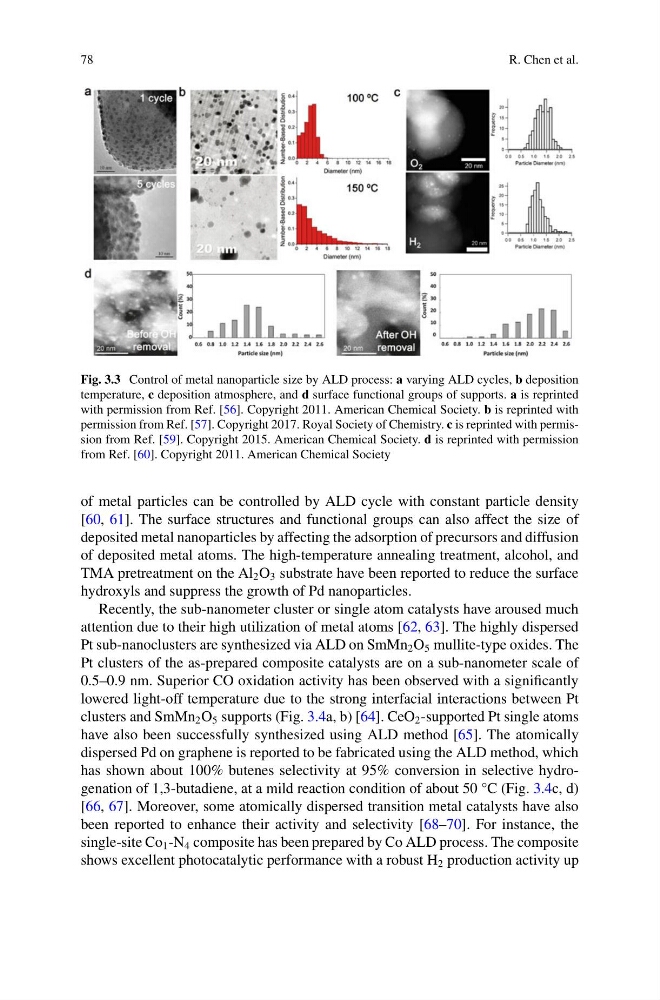
Fig. 3.3 Control of metal nanoparticle size by ALD process: a varying ALD cycles, b deposition
temperature, c deposition atmosphere, and d surface functional groups of supports. a is reprinted
with permission from Ref. [56]. Copyright 2011. American Chemical Society. b is reprinted with
permission from Ref. [57]. Copyright 2017. Royal Society of Chemistry. c is reprinted with permission from Ref. [59]. Copyright 2015. American Chemical Society. d is reprinted with permission
from Ref. [60]. Copyright 2011. American Chemical Society
of metal particles can be controlled by ALD cycle with constant particle density
[60, 61]. The surface structures and functional groups can also affect the size of
deposited metal nanoparticles by affecting the adsorption of precursors and diffusion
of deposited metal atoms. The high-temperature annealing treatment, alcohol, and
TMA pretreatment on the Al 2 O 3 substrate have been reported to reduce the surface
hydroxyls and suppress the growth of Pd nanoparticles.
Recently, the sub-nanometer cluster or single atom catalysts have aroused much
attention due to their high utilization of metal atoms [62, 63]. The highly dispersed
Pt sub-nanoclusters are synthesized via ALD on SmMn 2 O 5 mullite-type oxides. The
Pt clusters of the as-prepared composite catalysts are on a sub-nanometer scale of
0.5–0.9 nm. Superior CO oxidation activity has been observed with a significantly
lowered light-off temperature due to the strong interfacial interactions between Pt
clusters and SmMn 2 O 5 supports (Fig. 3.4a, b) [64]. CeO 2 -supported Pt single atoms
have also been successfully synthesized using ALD method [65]. The atomically
dispersed Pd on graphene is reported to be fabricated using the ALD method, which
has shown about 100% butenes selectivity at 95% conversion in selective hydrogenation of 1,3-butadiene, at a mild reaction condition of about 50 °C (Fig. 3.4c, d)
[66, 67]. Moreover, some atomically dispersed transition metal catalysts have also
been reported to enhance their activity and selectivity [68–70]. For instance, the
single-site Co 1 -N 4 composite has been prepared by Co ALD process. The composite
shows excellent photocatalytic performance with a robust H 2 production activity up
R. Chen et al.
Fig. 3.3 Control of metal nanoparticle size by ALD process: a varying ALD cycles, b deposition
temperature, c deposition atmosphere, and d surface functional groups of supports. a is reprinted
with permission from Ref. [56]. Copyright 2011. American Chemical Society. b is reprinted with
permission from Ref. [57]. Copyright 2017. Royal Society of Chemistry. c is reprinted with permission from Ref. [59]. Copyright 2015. American Chemical Society. d is reprinted with permission
from Ref. [60]. Copyright 2011. American Chemical Society
of metal particles can be controlled by ALD cycle with constant particle density
[60, 61]. The surface structures and functional groups can also affect the size of
deposited metal nanoparticles by affecting the adsorption of precursors and diffusion
of deposited metal atoms. The high-temperature annealing treatment, alcohol, and
TMA pretreatment on the Al 2 O 3 substrate have been reported to reduce the surface
hydroxyls and suppress the growth of Pd nanoparticles.
Recently, the sub-nanometer cluster or single atom catalysts have aroused much
attention due to their high utilization of metal atoms [62, 63]. The highly dispersed
Pt sub-nanoclusters are synthesized via ALD on SmMn 2 O 5 mullite-type oxides. The
Pt clusters of the as-prepared composite catalysts are on a sub-nanometer scale of
0.5–0.9 nm. Superior CO oxidation activity has been observed with a significantly
lowered light-off temperature due to the strong interfacial interactions between Pt
clusters and SmMn 2 O 5 supports (Fig. 3.4a, b) [64]. CeO 2 -supported Pt single atoms
have also been successfully synthesized using ALD method [65]. The atomically
dispersed Pd on graphene is reported to be fabricated using the ALD method, which
has shown about 100% butenes selectivity at 95% conversion in selective hydrogenation of 1,3-butadiene, at a mild reaction condition of about 50 °C (Fig. 3.4c, d)
[66, 67]. Moreover, some atomically dispersed transition metal catalysts have also
been reported to enhance their activity and selectivity [68–70]. For instance, the
single-site Co 1 -N 4 composite has been prepared by Co ALD process. The composite
shows excellent photocatalytic performance with a robust H 2 production activity up