

42
S. Li and R. Jin
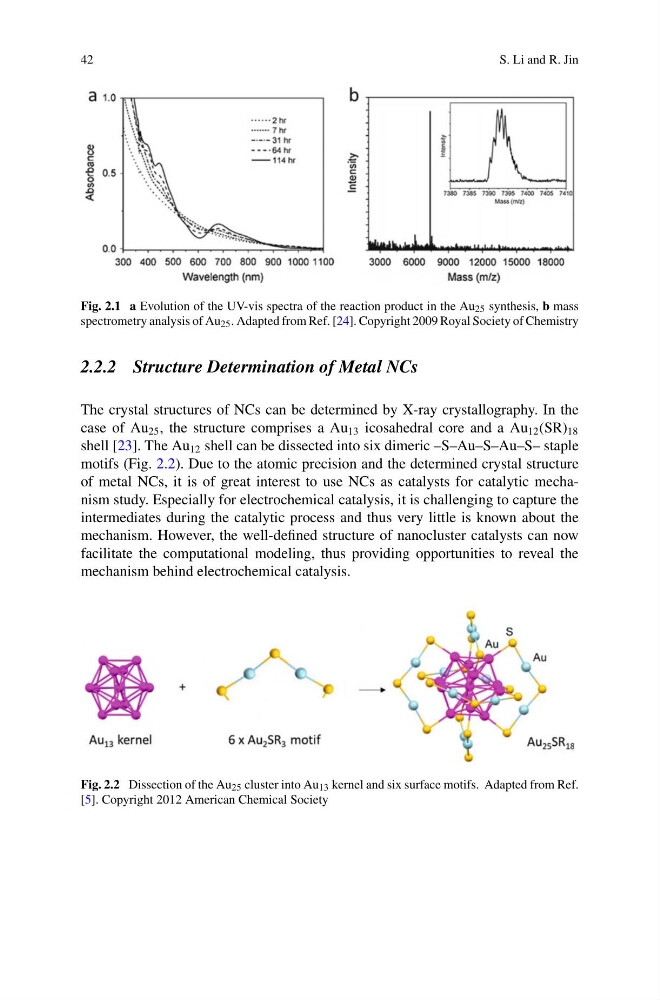
Fig. 2.1 a Evolution of the UV-vis spectra of the reaction product in the Au 25 synthesis, b mass
spectrometry analysis of Au 25 . Adapted from Ref. [24]. Copyright 2009 Royal Society of Chemistry
2.2.2 Structure Determination of Metal NCs
The crystal structures of NCs can be determined by X-ray crystallography. In the
case of Au 25 , the structure comprises a Au 13 icosahedral core and a Au 12 (SR) 18
shell [23]. The Au 12 shell can be dissected into six dimeric –S–Au–S–Au–S– staple
motifs (Fig. 2.2). Due to the atomic precision and the determined crystal structure
of metal NCs, it is of great interest to use NCs as catalysts for catalytic mechanism study. Especially for electrochemical catalysis, it is challenging to capture the
intermediates during the catalytic process and thus very little is known about the
mechanism. However, the well-defined structure of nanocluster catalysts can now
facilitate the computational modeling, thus providing opportunities to reveal the
mechanism behind electrochemical catalysis.
Fig. 2.2 Dissection of the Au 25 cluster into Au 13 kernel and six surface motifs. Adapted from Ref.
[5]. Copyright 2012 American Chemical Society
S. Li and R. Jin
Fig. 2.1 a Evolution of the UV-vis spectra of the reaction product in the Au 25 synthesis, b mass
spectrometry analysis of Au 25 . Adapted from Ref. [24]. Copyright 2009 Royal Society of Chemistry
2.2.2 Structure Determination of Metal NCs
The crystal structures of NCs can be determined by X-ray crystallography. In the
case of Au 25 , the structure comprises a Au 13 icosahedral core and a Au 12 (SR) 18
shell [23]. The Au 12 shell can be dissected into six dimeric –S–Au–S–Au–S– staple
motifs (Fig. 2.2). Due to the atomic precision and the determined crystal structure
of metal NCs, it is of great interest to use NCs as catalysts for catalytic mechanism study. Especially for electrochemical catalysis, it is challenging to capture the
intermediates during the catalytic process and thus very little is known about the
mechanism. However, the well-defined structure of nanocluster catalysts can now
facilitate the computational modeling, thus providing opportunities to reveal the
mechanism behind electrochemical catalysis.
Fig. 2.2 Dissection of the Au 25 cluster into Au 13 kernel and six surface motifs. Adapted from Ref.
[5]. Copyright 2012 American Chemical Society