

30
J. Oliver–Meseguer and A. Leyva–Pérez
1.3.3.2 Homocoupling of Thiols
The homocoupling of thiols is another clear example of catalysis by Au clusters. In
this case, single Au atoms supported on functionalized carbon nanotubes only show
activity in the oxidation of thiophenol with O 2 when they aggregate under reaction
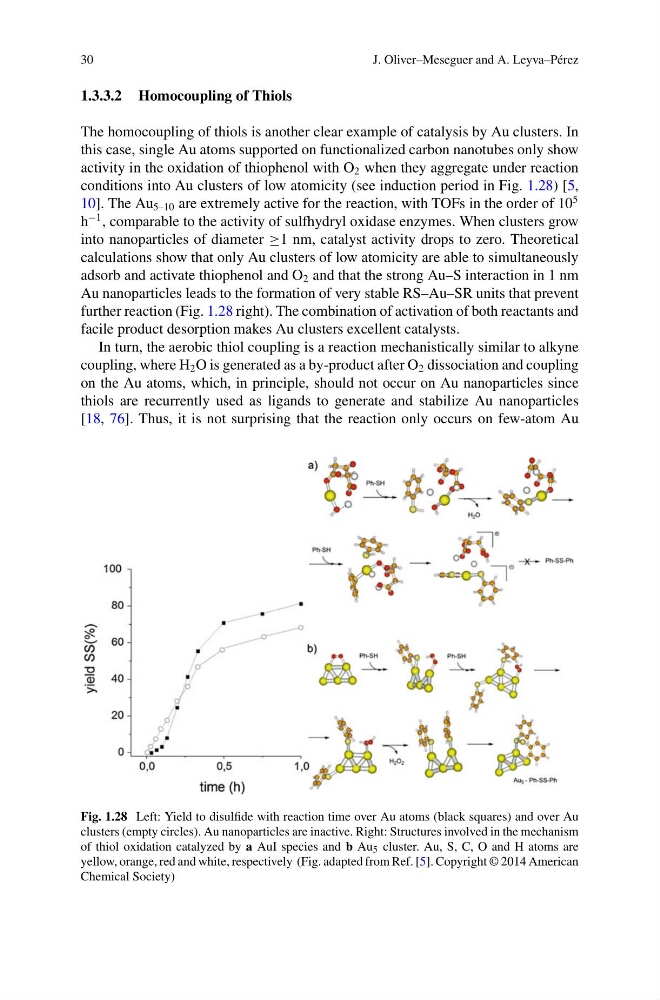
conditions into Au clusters of low atomicity (see induction period in Fig. 1.28) [5,
10]. The Au 5–10 are extremely active for the reaction, with TOFs in the order of 10
5
h
−1 , comparable to the activity of sulfhydryl oxidase enzymes. When clusters grow
into nanoparticles of diameter ≥1 nm, catalyst activity drops to zero. Theoretical
calculations show that only Au clusters of low atomicity are able to simultaneously
adsorb and activate thiophenol and O 2 and that the strong Au–S interaction in 1 nm
Au nanoparticles leads to the formation of very stable RS–Au–SR units that prevent
further reaction (Fig. 1.28 right). The combination of activation of both reactants and
facile product desorption makes Au clusters excellent catalysts.
In turn, the aerobic thiol coupling is a reaction mechanistically similar to alkyne
coupling, where H 2 O is generated as a by-product after O 2 dissociation and coupling
on the Au atoms, which, in principle, should not occur on Au nanoparticles since
thiols are recurrently used as ligands to generate and stabilize Au nanoparticles
[18, 76]. Thus, it is not surprising that the reaction only occurs on few-atom Au
Fig. 1.28 Left: Yield to disulfide with reaction time over Au atoms (black squares) and over Au
clusters (empty circles). Au nanoparticles are inactive. Right: Structures involved in the mechanism
of thiol oxidation catalyzed by a AuI species and b Au 5 cluster. Au, S, C, O and H atoms are
yellow, orange, red and white, respectively (Fig. adapted from Ref. [5]. Copyright © 2014 American
Chemical Society)
J. Oliver–Meseguer and A. Leyva–Pérez
1.3.3.2 Homocoupling of Thiols
The homocoupling of thiols is another clear example of catalysis by Au clusters. In
this case, single Au atoms supported on functionalized carbon nanotubes only show
activity in the oxidation of thiophenol with O 2 when they aggregate under reaction
conditions into Au clusters of low atomicity (see induction period in Fig. 1.28) [5,
10]. The Au 5–10 are extremely active for the reaction, with TOFs in the order of 10
5
h
−1 , comparable to the activity of sulfhydryl oxidase enzymes. When clusters grow
into nanoparticles of diameter ≥1 nm, catalyst activity drops to zero. Theoretical
calculations show that only Au clusters of low atomicity are able to simultaneously
adsorb and activate thiophenol and O 2 and that the strong Au–S interaction in 1 nm
Au nanoparticles leads to the formation of very stable RS–Au–SR units that prevent
further reaction (Fig. 1.28 right). The combination of activation of both reactants and
facile product desorption makes Au clusters excellent catalysts.
In turn, the aerobic thiol coupling is a reaction mechanistically similar to alkyne
coupling, where H 2 O is generated as a by-product after O 2 dissociation and coupling
on the Au atoms, which, in principle, should not occur on Au nanoparticles since
thiols are recurrently used as ligands to generate and stabilize Au nanoparticles
[18, 76]. Thus, it is not surprising that the reaction only occurs on few-atom Au
Fig. 1.28 Left: Yield to disulfide with reaction time over Au atoms (black squares) and over Au
clusters (empty circles). Au nanoparticles are inactive. Right: Structures involved in the mechanism
of thiol oxidation catalyzed by a AuI species and b Au 5 cluster. Au, S, C, O and H atoms are
yellow, orange, red and white, respectively (Fig. adapted from Ref. [5]. Copyright © 2014 American
Chemical Society)