

12 Ligand Effects in Ruthenium Nanoparticle Catalysis
409
12.2 Ligand-Stabilized Ru NPs
An interesting approach to tune the reactivity of colloidal MNPs is the use of organic
ligands as stabilizer, which can also transform the NP surface [8]. Different synthetic
approaches to stabilize colloidal MNPs with ancillary ligands have been developed
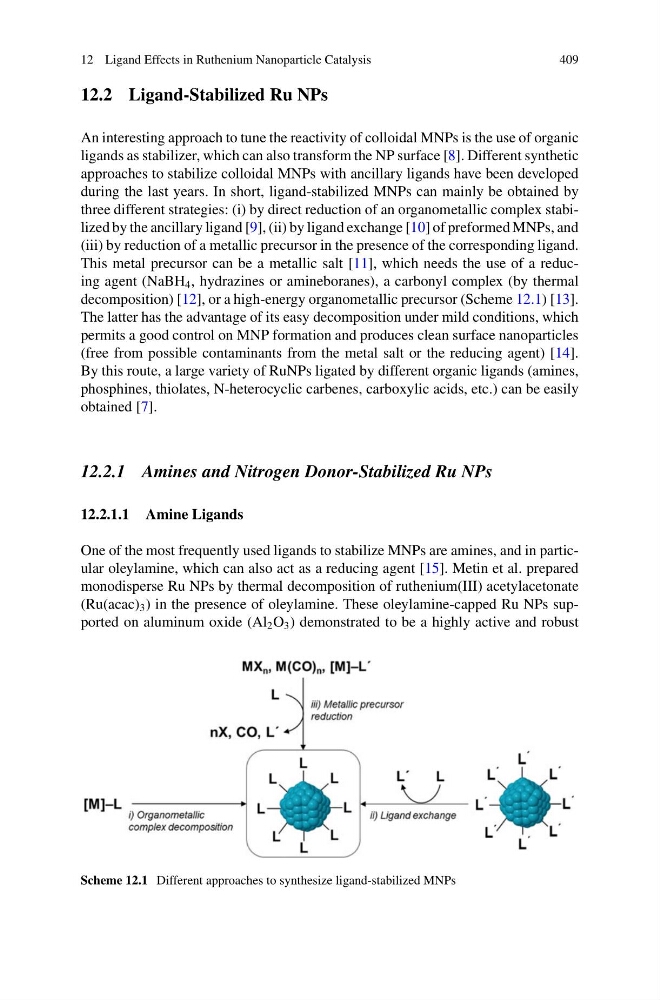
during the last years. In short, ligand-stabilized MNPs can mainly be obtained by
three different strategies: (i) by direct reduction of an organometallic complex stabilized by the ancillary ligand [9], (ii) by ligand exchange [10] of preformed MNPs, and
(iii) by reduction of a metallic precursor in the presence of the corresponding ligand.
This metal precursor can be a metallic salt [11], which needs the use of a reducing agent (NaBH 4 , hydrazines or amineboranes), a carbonyl complex (by thermal
decomposition) [12], or a high-energy organometallic precursor (Scheme 12.1) [13].
The latter has the advantage of its easy decomposition under mild conditions, which
permits a good control on MNP formation and produces clean surface nanoparticles
(free from possible contaminants from the metal salt or the reducing agent) [14].
By this route, a large variety of RuNPs ligated by different organic ligands (amines,
phosphines, thiolates, N-heterocyclic carbenes, carboxylic acids, etc.) can be easily
obtained [7].
12.2.1 Amines and Nitrogen Donor-Stabilized Ru NPs
12.2.1.1 Amine Ligands
One of the most frequently used ligands to stabilize MNPs are amines, and in particular oleylamine, which can also act as a reducing agent [15]. Metin et al. prepared
monodisperse Ru NPs by thermal decomposition of ruthenium(III) acetylacetonate
(Ru(acac) 3 ) in the presence of oleylamine. These oleylamine-capped Ru NPs supported on aluminum oxide (Al 2 O 3 ) demonstrated to be a highly active and robust
Scheme 12.1 Different approaches to synthesize ligand-stabilized MNPs
409
12.2 Ligand-Stabilized Ru NPs
An interesting approach to tune the reactivity of colloidal MNPs is the use of organic
ligands as stabilizer, which can also transform the NP surface [8]. Different synthetic
approaches to stabilize colloidal MNPs with ancillary ligands have been developed
during the last years. In short, ligand-stabilized MNPs can mainly be obtained by
three different strategies: (i) by direct reduction of an organometallic complex stabilized by the ancillary ligand [9], (ii) by ligand exchange [10] of preformed MNPs, and
(iii) by reduction of a metallic precursor in the presence of the corresponding ligand.
This metal precursor can be a metallic salt [11], which needs the use of a reducing agent (NaBH 4 , hydrazines or amineboranes), a carbonyl complex (by thermal
decomposition) [12], or a high-energy organometallic precursor (Scheme 12.1) [13].
The latter has the advantage of its easy decomposition under mild conditions, which
permits a good control on MNP formation and produces clean surface nanoparticles
(free from possible contaminants from the metal salt or the reducing agent) [14].
By this route, a large variety of RuNPs ligated by different organic ligands (amines,
phosphines, thiolates, N-heterocyclic carbenes, carboxylic acids, etc.) can be easily
obtained [7].
12.2.1 Amines and Nitrogen Donor-Stabilized Ru NPs
12.2.1.1 Amine Ligands
One of the most frequently used ligands to stabilize MNPs are amines, and in particular oleylamine, which can also act as a reducing agent [15]. Metin et al. prepared
monodisperse Ru NPs by thermal decomposition of ruthenium(III) acetylacetonate
(Ru(acac) 3 ) in the presence of oleylamine. These oleylamine-capped Ru NPs supported on aluminum oxide (Al 2 O 3 ) demonstrated to be a highly active and robust
Scheme 12.1 Different approaches to synthesize ligand-stabilized MNPs