

396
I. Cano and P. W. N. M. van Leeuwen
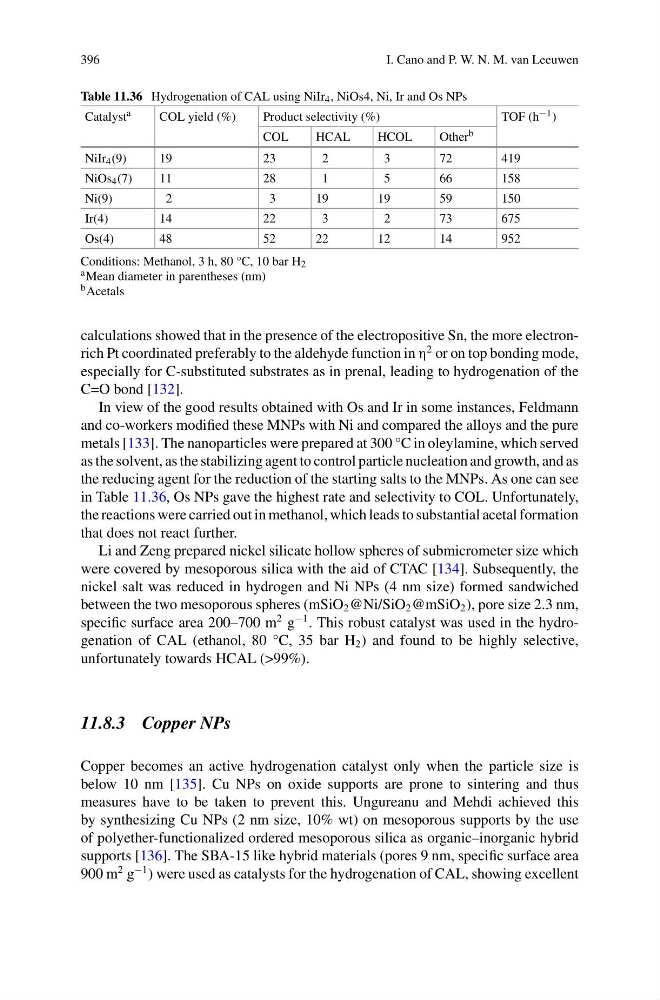
Table 11.36 Hydrogenation of CAL using NiIr 4 , NiOs4, Ni, Ir and Os NPs
Catalyst a
COL yield (%)
Product selectivity (%)
TOF (h −1 )
COL
HCAL
HCOL
Other b
NiIr 4 (9)
19
23
2
3
72
419
NiOs 4 (7)
11
28
1
5
66
158
Ni(9)
2
3
19
19
59
150
Ir(4)
14
22
3
2
73
675
Os(4)
48
52
22
12
14
952
Conditions: Methanol, 3 h, 80 °C, 10 bar H 2
a Mean diameter in parentheses (nm)
b Acetals
calculations showed that in the presence of the electropositive Sn, the more electronrich Pt coordinated preferably to the aldehyde function in η
2 or on top bonding mode,
especially for C-substituted substrates as in prenal, leading to hydrogenation of the
C=O bond [132].
In view of the good results obtained with Os and Ir in some instances, Feldmann
and co-workers modified these MNPs with Ni and compared the alloys and the pure
metals [133]. The nanoparticles were prepared at 300 °C in oleylamine, which served
as the solvent, as the stabilizing agent to control particle nucleation and growth, and as
the reducing agent for the reduction of the starting salts to the MNPs. As one can see
in Table 11.36, Os NPs gave the highest rate and selectivity to COL. Unfortunately,
the reactions were carried out in methanol, which leads to substantial acetal formation
that does not react further.
Li and Zeng prepared nickel silicate hollow spheres of submicrometer size which
were covered by mesoporous silica with the aid of CTAC [134]. Subsequently, the
nickel salt was reduced in hydrogen and Ni NPs (4 nm size) formed sandwiched
between the two mesoporous spheres (mSiO 2 @Ni/SiO 2 @mSiO 2 ), pore size 2.3 nm,
specific surface area 200–700 m
2 g
−1 . This robust catalyst was used in the hydrogenation of CAL (ethanol, 80 °C, 35 bar H 2 ) and found to be highly selective,
unfortunately towards HCAL (>99%).
11.8.3 Copper NPs
Copper becomes an active hydrogenation catalyst only when the particle size is
below 10 nm [135]. Cu NPs on oxide supports are prone to sintering and thus
measures have to be taken to prevent this. Ungureanu and Mehdi achieved this
by synthesizing Cu NPs (2 nm size, 10% wt) on mesoporous supports by the use
of polyether-functionalized ordered mesoporous silica as organic–inorganic hybrid
supports [136]. The SBA-15 like hybrid materials (pores 9 nm, specific surface area
900 m
2 g
−1 ) were used as catalysts for the hydrogenation of CAL, showing excellent
I. Cano and P. W. N. M. van Leeuwen
Table 11.36 Hydrogenation of CAL using NiIr 4 , NiOs4, Ni, Ir and Os NPs
Catalyst a
COL yield (%)
Product selectivity (%)
TOF (h −1 )
COL
HCAL
HCOL
Other b
NiIr 4 (9)
19
23
2
3
72
419
NiOs 4 (7)
11
28
1
5
66
158
Ni(9)
2
3
19
19
59
150
Ir(4)
14
22
3
2
73
675
Os(4)
48
52
22
12
14
952
Conditions: Methanol, 3 h, 80 °C, 10 bar H 2
a Mean diameter in parentheses (nm)
b Acetals
calculations showed that in the presence of the electropositive Sn, the more electronrich Pt coordinated preferably to the aldehyde function in η
2 or on top bonding mode,
especially for C-substituted substrates as in prenal, leading to hydrogenation of the
C=O bond [132].
In view of the good results obtained with Os and Ir in some instances, Feldmann
and co-workers modified these MNPs with Ni and compared the alloys and the pure
metals [133]. The nanoparticles were prepared at 300 °C in oleylamine, which served
as the solvent, as the stabilizing agent to control particle nucleation and growth, and as
the reducing agent for the reduction of the starting salts to the MNPs. As one can see
in Table 11.36, Os NPs gave the highest rate and selectivity to COL. Unfortunately,
the reactions were carried out in methanol, which leads to substantial acetal formation
that does not react further.
Li and Zeng prepared nickel silicate hollow spheres of submicrometer size which
were covered by mesoporous silica with the aid of CTAC [134]. Subsequently, the
nickel salt was reduced in hydrogen and Ni NPs (4 nm size) formed sandwiched
between the two mesoporous spheres (mSiO 2 @Ni/SiO 2 @mSiO 2 ), pore size 2.3 nm,
specific surface area 200–700 m
2 g
−1 . This robust catalyst was used in the hydrogenation of CAL (ethanol, 80 °C, 35 bar H 2 ) and found to be highly selective,
unfortunately towards HCAL (>99%).
11.8.3 Copper NPs
Copper becomes an active hydrogenation catalyst only when the particle size is
below 10 nm [135]. Cu NPs on oxide supports are prone to sintering and thus
measures have to be taken to prevent this. Ungureanu and Mehdi achieved this
by synthesizing Cu NPs (2 nm size, 10% wt) on mesoporous supports by the use
of polyether-functionalized ordered mesoporous silica as organic–inorganic hybrid
supports [136]. The SBA-15 like hybrid materials (pores 9 nm, specific surface area
900 m
2 g
−1 ) were used as catalysts for the hydrogenation of CAL, showing excellent