

1 Ligand-Free Sub-Nanometer Metal Clusters in Catalysis
27
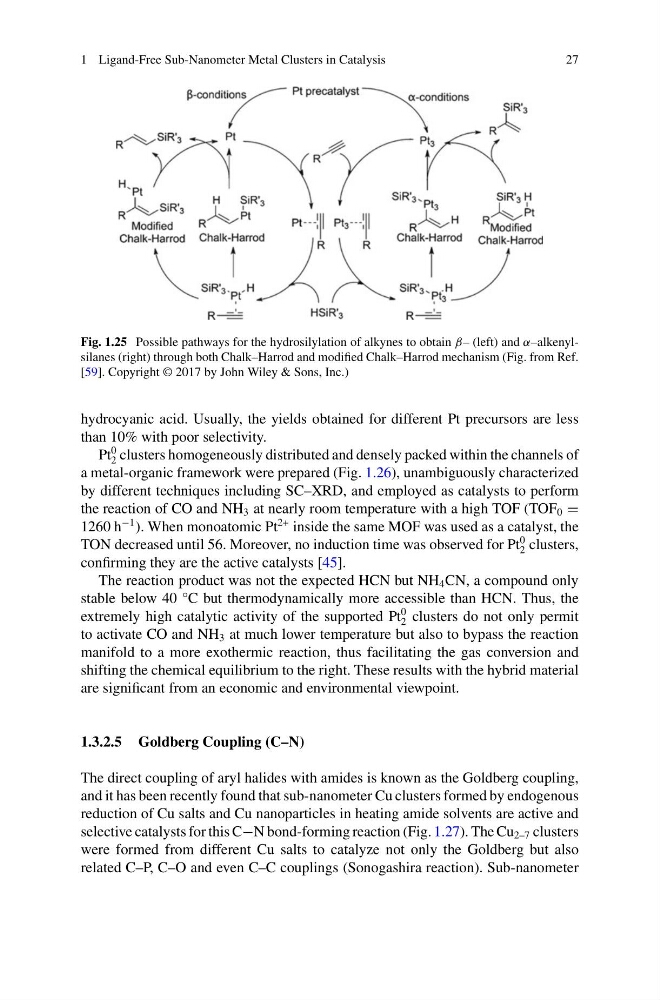
Fig. 1.25 Possible pathways for the hydrosilylation of alkynes to obtain β– (left) and α–alkenylsilanes (right) through both Chalk–Harrod and modified Chalk–Harrod mechanism (Fig. from Ref.
[59]. Copyright © 2017 by John Wiley & Sons, Inc.)
hydrocyanic acid. Usually, the yields obtained for different Pt precursors are less
than 10% with poor selectivity.
Pt
0
2 clusters homogeneously distributed and densely packed within the channels of
a metal-organic framework were prepared (Fig. 1.26), unambiguously characterized
by different techniques including SC–XRD, and employed as catalysts to perform
the reaction of CO and NH 3 at nearly room temperature with a high TOF (TOF 0 =
1260 h
−1 ). When monoatomic Pt
2+ inside the same MOF was used as a catalyst, the
TON decreased until 56. Moreover, no induction time was observed for Pt
0
2 clusters,
confirming they are the active catalysts [45].
The reaction product was not the expected HCN but NH 4 CN, a compound only
stable below 40 °C but thermodynamically more accessible than HCN. Thus, the
extremely high catalytic activity of the supported Pt
0
2 clusters do not only permit
to activate CO and NH 3 at much lower temperature but also to bypass the reaction
manifold to a more exothermic reaction, thus facilitating the gas conversion and
shifting the chemical equilibrium to the right. These results with the hybrid material
are significant from an economic and environmental viewpoint.
1.3.2.5 Goldberg Coupling (C–N)
The direct coupling of aryl halides with amides is known as the Goldberg coupling,
and it has been recently found that sub-nanometer Cu clusters formed by endogenous
reduction of Cu salts and Cu nanoparticles in heating amide solvents are active and
selective catalysts for this C−N bond-forming reaction (Fig. 1.27). The Cu 2–7 clusters
were formed from different Cu salts to catalyze not only the Goldberg but also
related C–P, C–O and even C–C couplings (Sonogashira reaction). Sub-nanometer
27
Fig. 1.25 Possible pathways for the hydrosilylation of alkynes to obtain β– (left) and α–alkenylsilanes (right) through both Chalk–Harrod and modified Chalk–Harrod mechanism (Fig. from Ref.
[59]. Copyright © 2017 by John Wiley & Sons, Inc.)
hydrocyanic acid. Usually, the yields obtained for different Pt precursors are less
than 10% with poor selectivity.
Pt
0
2 clusters homogeneously distributed and densely packed within the channels of
a metal-organic framework were prepared (Fig. 1.26), unambiguously characterized
by different techniques including SC–XRD, and employed as catalysts to perform
the reaction of CO and NH 3 at nearly room temperature with a high TOF (TOF 0 =
1260 h
−1 ). When monoatomic Pt
2+ inside the same MOF was used as a catalyst, the
TON decreased until 56. Moreover, no induction time was observed for Pt
0
2 clusters,
confirming they are the active catalysts [45].
The reaction product was not the expected HCN but NH 4 CN, a compound only
stable below 40 °C but thermodynamically more accessible than HCN. Thus, the
extremely high catalytic activity of the supported Pt
0
2 clusters do not only permit
to activate CO and NH 3 at much lower temperature but also to bypass the reaction
manifold to a more exothermic reaction, thus facilitating the gas conversion and
shifting the chemical equilibrium to the right. These results with the hybrid material
are significant from an economic and environmental viewpoint.
1.3.2.5 Goldberg Coupling (C–N)
The direct coupling of aryl halides with amides is known as the Goldberg coupling,
and it has been recently found that sub-nanometer Cu clusters formed by endogenous
reduction of Cu salts and Cu nanoparticles in heating amide solvents are active and
selective catalysts for this C−N bond-forming reaction (Fig. 1.27). The Cu 2–7 clusters
were formed from different Cu salts to catalyze not only the Goldberg but also
related C–P, C–O and even C–C couplings (Sonogashira reaction). Sub-nanometer