

380
I. Cano and P. W. N. M. van Leeuwen
O
H
O
O
O
O
O
O
O
O
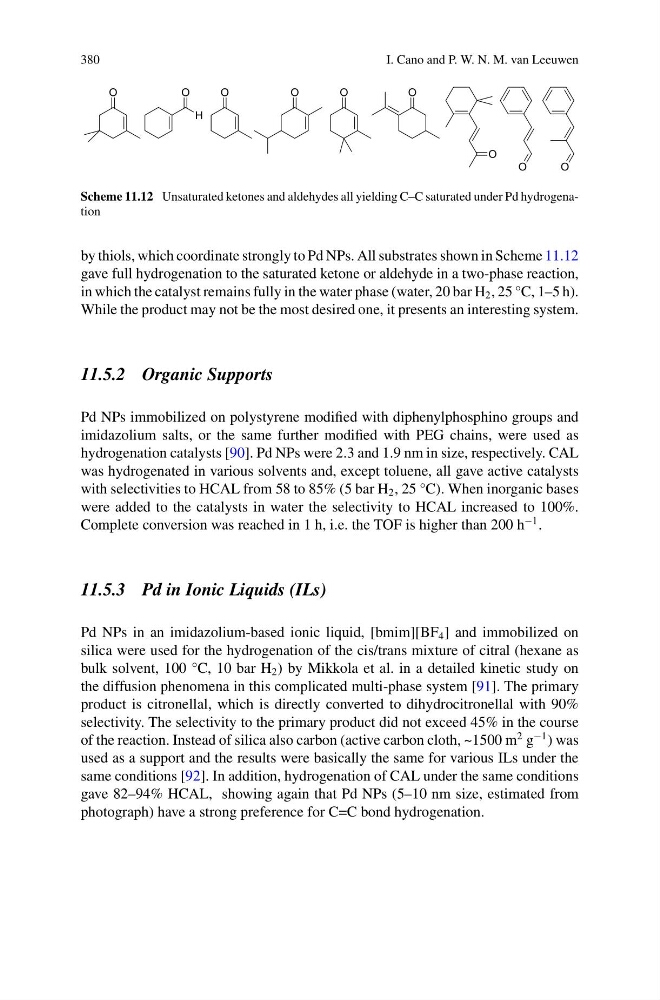
Scheme 11.12 Unsaturated ketones and aldehydes all yielding C–C saturated under Pd hydrogenation
by thiols, which coordinate strongly to Pd NPs. All substrates shown in Scheme 11.12
gave full hydrogenation to the saturated ketone or aldehyde in a two-phase reaction,
in which the catalyst remains fully in the water phase (water, 20 bar H 2 , 25 °C, 1–5 h).
While the product may not be the most desired one, it presents an interesting system.
11.5.2 Organic Supports
Pd NPs immobilized on polystyrene modified with diphenylphosphino groups and
imidazolium salts, or the same further modified with PEG chains, were used as
hydrogenation catalysts [90]. Pd NPs were 2.3 and 1.9 nm in size, respectively. CAL
was hydrogenated in various solvents and, except toluene, all gave active catalysts
with selectivities to HCAL from 58 to 85% (5 bar H 2 , 25 °C). When inorganic bases
were added to the catalysts in water the selectivity to HCAL increased to 100%.
Complete conversion was reached in 1 h, i.e. the TOF is higher than 200 h
−1 .
11.5.3 Pd in Ionic Liquids (ILs)
Pd NPs in an imidazolium-based ionic liquid, [bmim][BF 4 ] and immobilized on
silica were used for the hydrogenation of the cis/trans mixture of citral (hexane as
bulk solvent, 100 °C, 10 bar H 2 ) by Mikkola et al. in a detailed kinetic study on
the diffusion phenomena in this complicated multi-phase system [91]. The primary
product is citronellal, which is directly converted to dihydrocitronellal with 90%
selectivity. The selectivity to the primary product did not exceed 45% in the course
of the reaction. Instead of silica also carbon (active carbon cloth, ~1500 m
2 g
−1 ) was
used as a support and the results were basically the same for various ILs under the
same conditions [92]. In addition, hydrogenation of CAL under the same conditions
gave 82–94% HCAL, showing again that Pd NPs (5–10 nm size, estimated from
photograph) have a strong preference for C=C bond hydrogenation.
I. Cano and P. W. N. M. van Leeuwen
O
H
O
O
O
O
O
O
O
O
Scheme 11.12 Unsaturated ketones and aldehydes all yielding C–C saturated under Pd hydrogenation
by thiols, which coordinate strongly to Pd NPs. All substrates shown in Scheme 11.12
gave full hydrogenation to the saturated ketone or aldehyde in a two-phase reaction,
in which the catalyst remains fully in the water phase (water, 20 bar H 2 , 25 °C, 1–5 h).
While the product may not be the most desired one, it presents an interesting system.
11.5.2 Organic Supports
Pd NPs immobilized on polystyrene modified with diphenylphosphino groups and
imidazolium salts, or the same further modified with PEG chains, were used as
hydrogenation catalysts [90]. Pd NPs were 2.3 and 1.9 nm in size, respectively. CAL
was hydrogenated in various solvents and, except toluene, all gave active catalysts
with selectivities to HCAL from 58 to 85% (5 bar H 2 , 25 °C). When inorganic bases
were added to the catalysts in water the selectivity to HCAL increased to 100%.
Complete conversion was reached in 1 h, i.e. the TOF is higher than 200 h
−1 .
11.5.3 Pd in Ionic Liquids (ILs)
Pd NPs in an imidazolium-based ionic liquid, [bmim][BF 4 ] and immobilized on
silica were used for the hydrogenation of the cis/trans mixture of citral (hexane as
bulk solvent, 100 °C, 10 bar H 2 ) by Mikkola et al. in a detailed kinetic study on
the diffusion phenomena in this complicated multi-phase system [91]. The primary
product is citronellal, which is directly converted to dihydrocitronellal with 90%
selectivity. The selectivity to the primary product did not exceed 45% in the course
of the reaction. Instead of silica also carbon (active carbon cloth, ~1500 m
2 g
−1 ) was
used as a support and the results were basically the same for various ILs under the
same conditions [92]. In addition, hydrogenation of CAL under the same conditions
gave 82–94% HCAL, showing again that Pd NPs (5–10 nm size, estimated from
photograph) have a strong preference for C=C bond hydrogenation.