

1 Ligand-Free Sub-Nanometer Metal Clusters in Catalysis
23
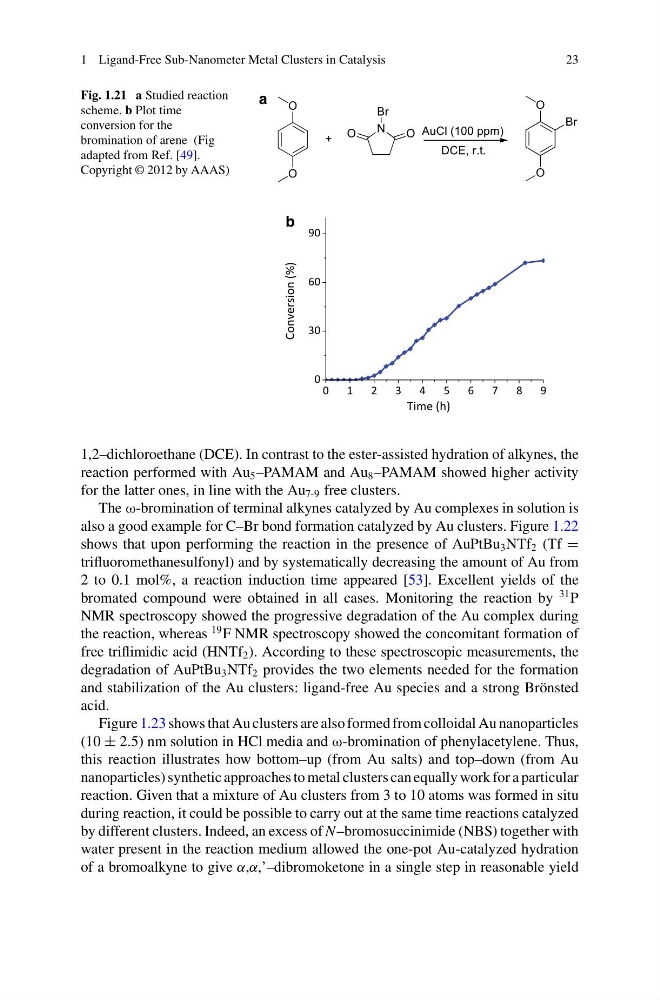
Fig. 1.21 a Studied reaction
scheme. b Plot time
conversion for the
bromination of arene (Fig
adapted from Ref. [49].
Copyright © 2012 by AAAS)
0
1
2
3
4
5
6
7
8
9
0
30
60
90
Conversion
(%)
Time (h)
a
b
1,2–dichloroethane (DCE). In contrast to the ester-assisted hydration of alkynes, the
reaction performed with Au 5 –PAMAM and Au 8 –PAMAM showed higher activity
for the latter ones, in line with the Au 7-9 free clusters.
The ω-bromination of terminal alkynes catalyzed by Au complexes in solution is
also a good example for C–Br bond formation catalyzed by Au clusters. Figure 1.22
shows that upon performing the reaction in the presence of AuPtBu 3 NTf 2 (Tf =
trifluoromethanesulfonyl) and by systematically decreasing the amount of Au from
2 to 0.1 mol%, a reaction induction time appeared [53]. Excellent yields of the
bromated compound were obtained in all cases. Monitoring the reaction by
31 P
NMR spectroscopy showed the progressive degradation of the Au complex during
the reaction, whereas
19 F NMR spectroscopy showed the concomitant formation of
free triflimidic acid (HNTf 2 ). According to these spectroscopic measurements, the
degradation of AuPtBu 3 NTf 2 provides the two elements needed for the formation
and stabilization of the Au clusters: ligand-free Au species and a strong Brönsted
acid.
Figure 1.23 shows that Au clusters are also formed from colloidal Au nanoparticles
(10 ± 2.5) nm solution in HCl media and ω-bromination of phenylacetylene. Thus,
this reaction illustrates how bottom–up (from Au salts) and top–down (from Au
nanoparticles) synthetic approaches to metal clusters can equally work for a particular
reaction. Given that a mixture of Au clusters from 3 to 10 atoms was formed in situ
during reaction, it could be possible to carry out at the same time reactions catalyzed
by different clusters. Indeed, an excess of N–bromosuccinimide (NBS) together with
water present in the reaction medium allowed the one-pot Au-catalyzed hydration
of a bromoalkyne to give α,α,’–dibromoketone in a single step in reasonable yield
23
Fig. 1.21 a Studied reaction
scheme. b Plot time
conversion for the
bromination of arene (Fig
adapted from Ref. [49].
Copyright © 2012 by AAAS)
0
1
2
3
4
5
6
7
8
9
0
30
60
90
Conversion
(%)
Time (h)
a
b
1,2–dichloroethane (DCE). In contrast to the ester-assisted hydration of alkynes, the
reaction performed with Au 5 –PAMAM and Au 8 –PAMAM showed higher activity
for the latter ones, in line with the Au 7-9 free clusters.
The ω-bromination of terminal alkynes catalyzed by Au complexes in solution is
also a good example for C–Br bond formation catalyzed by Au clusters. Figure 1.22
shows that upon performing the reaction in the presence of AuPtBu 3 NTf 2 (Tf =
trifluoromethanesulfonyl) and by systematically decreasing the amount of Au from
2 to 0.1 mol%, a reaction induction time appeared [53]. Excellent yields of the
bromated compound were obtained in all cases. Monitoring the reaction by
31 P
NMR spectroscopy showed the progressive degradation of the Au complex during
the reaction, whereas
19 F NMR spectroscopy showed the concomitant formation of
free triflimidic acid (HNTf 2 ). According to these spectroscopic measurements, the
degradation of AuPtBu 3 NTf 2 provides the two elements needed for the formation
and stabilization of the Au clusters: ligand-free Au species and a strong Brönsted
acid.
Figure 1.23 shows that Au clusters are also formed from colloidal Au nanoparticles
(10 ± 2.5) nm solution in HCl media and ω-bromination of phenylacetylene. Thus,
this reaction illustrates how bottom–up (from Au salts) and top–down (from Au
nanoparticles) synthetic approaches to metal clusters can equally work for a particular
reaction. Given that a mixture of Au clusters from 3 to 10 atoms was formed in situ
during reaction, it could be possible to carry out at the same time reactions catalyzed
by different clusters. Indeed, an excess of N–bromosuccinimide (NBS) together with
water present in the reaction medium allowed the one-pot Au-catalyzed hydration
of a bromoalkyne to give α,α,’–dibromoketone in a single step in reasonable yield